Monday / October 12. 2026
menu-logo menu-logo
brand-logo
Subscribe
Subscribe
Monday / October 12. 2026
  • Read
    • Daily News
      • Financial
      • Insights
      • U.S.
      • International
    • Digital Issue
    • Executive Announcements
    • Cover Stories
    • Feature Articles
      • Exclusive Interviews
    • International Focus
    • Company Spotlights
    • Forward Thinking
    • Legal Briefs
    • Insights from the Outside
    • For You | For Your Field
    • Working Smart
  • Listen & Watch
    • Direct Approach Podcast
    • What’s Working in Direct Selling
    • BUILT TO LAST
      • Zinzino
      • PM-International
      • LifeWave
    • The DSN Podcast
  • ATTEND
  • Achieve
    • Global 100 List
    • Bravo Awards
    • Best Places to Work
    • Legends
  • Research
    • Stock Watch
    • DSN Supplier Sponsors
    • The DSN Guide
    • Supplier Directory
    • Stock Ticker
    • Resources
  • Engage
    • About DSN
    • Supporter Program
    • Subscribe
    • Advertise
    • VIP Text Alerts
    • Connect
  • Search
Subscribe

Parallel Paths

March 1, 2025 by Beth Douglass Silcox

The symbiotic success of direct selling & personal development

Listen to this story on the new, revamped The DSN Podcast. Even when your day is packed, we make it easy to stay informed, engaged and one step ahead. Listen now or read below!

Panning the bench during the Philadelphia Eagles vs. Green Bay Packers wildcard game this January, the camera keyed in on the unique sight of Eagle’s wide receiver A.J. Brown reading a book on the sidelines. Turns out, it’s something Brown’s been doing for a while, trying to find peace in the midst of chaos.

“This game is violent, and you need everything. I’m just trying to slow my brain down,” Brown told ESPN’s Sal Paolantonio about his mid-game read of Jim Murphy’s personal development book, Inner Excellence: Train Your Mind for Extraordinary Performance and the Best Possible Life.

Albina Gavrilovic/shutterstock.com

Media and online questions came quick, but they didn’t deter Brown from continuing what he believes necessary to strengthen his game. He explained, “I’m proud of myself because I’m not changing who I am just because the world may say this is strange, it’s unorthodox. I’m…not afraid to push myself in areas or pick up a book because we’re playing this masculine football game…As men, we gotta be strong, tough guys. I don’t believe that. I can lift weights all day but that doesn’t do nothing for me if my mental is not correct.”

That quick-take footage went viral. It shot Inner Excellence to number one on Amazon’s bestseller list overnight. Criticism fell away, and Eagles fans posted thanks to Brown for opening their eyes to something new.

While the odds of rising to such status and prosperity were incalculably low, the Gilded Age prompted countless ordinary Americans to dream of more.

New Thought Philosophy

Today’s professional football has earmarks of rags-to-riches. Through hard work, determination and maybe a bit of luck, NFL players can achieve extraordinary success and often great wealth. It’s a fantastical picture of the American Dream manifesting for few but inspiring many—and an aspiration with origins in the Gilded Age.

Immigrants to America in the 1870s brought new ideas and mechanizations from Europe’s Industrial Revolution. Their contributions to our technical efficiency and productivity made the US the world leader in manufacturing by century’s end and ushered an era of opulence, excess and self-indulgence called the Gilded Age.

Palaces rose along Manhattan’s Fifth Avenue and housed society’s upper crust, the richest of self-made men like Andrew Carnegie, Cornelius Vanderbilt, J.P. Morgan and John D. Rockefeller. We still marvel at examples of ostentatious, Gilded Age architecture, like the Biltmore Estate near Asheville, North Carolina and The Breakers in Newport, Rhode Island.

Roman Samborskyi/shutterstock.com

While the odds of rising to such status and prosperity were incalculably low, the Gilded Age prompted countless ordinary Americans to dream of more. And when the financial Panic of 1893—caused in part by high tariffs and decreasing international trade—crashed the Gilded Age, it ignited progressive reform characterized by common men believing they could improve their life conditions.

Key to improvement was education, and accessing books had become easier for people decades before. Perhaps, the founding of Southwest Advantage Books in 1855 fostered an audience of readers for the New Thought Movement. But it is sure that Southwest established the oldest entrepreneurial and direct selling program for college and university students in the world in 1868. They helped college graduates build business and character skills for life-long careers and continue that mission today.

By 1886, traveling book salesman David H. McConnell offered his female customers fragrance samples to boost book sales, inadvertently starting the California Perfume Company which later became Avon. Women loved the products, and he recruited ladies to sell door-to-door. Persis Foster Eames Albee became the first Avon Lady to come calling and the rest is direct selling history.

Educational access and women’s contributions outside the household are indicative of the reformative New Thought Philosophy, which helped people harness personal power through positive thinking, life skills and discipline. Boston University and Harvard graduate, Orison Swett Marden was a proponent of “right thinking.” Inspired by Benjamin Franklin, Ralph Waldo Emerson, Oliver Wendell Holmes and others’ writings, Marden surmised potential was man’s greatest untapped resource. In 1894 his best-selling book, Pushing to the Front, told stories of everyday people achieving extraordinary things under extreme difficulties.

By 1897, Marden created SUCCESS, the earliest personal development magazine, which showcased the achievements of men like Vanderbilt, Rockefeller, Alexander Graham Bell and Thomas Edison. Literary contributors included personal development founders like Napoleon Hill, Samuel Merwin and W. Clement Stone.

Prolific thinkers answered public demand for New Thought during the first 30 years of the 20th century. James Allen, As a Man Thinketh and The Epoch; Wallace Wattles, The Science of Getting Rich, on Audible today; George Clason, The Richest Man in Babylon; and Oswald Chambers, My Utmost for His Highest, in print since 1924.

The paths of personal development and direct selling crossed publicly for, perhaps, the first time with Elbert Hubbard’s widely distributed essay, A Message to Garcia. The Larkin Soap Company salesman established door-to-door consumer sales in 1881 and installed sales premiums that grew from souvenir postcards and handkerchiefs to Morris Chairs and Chautauqua Desks that are highly collectible today.

It’s little wonder that the industrious Hubbard wrote and widely distributed an essay like Garcia, which contrasts the main character’s self-driven effort against “the imbecility of the average man—the inability or unwillingness to concentrate on a thing and do it.” Garcia simultaneously commiserated with company owners, who thought employees lazy, and taught employees to think differently.

Resilience and Visualization

The Great Depression brought individual frailty in an industrialized nation into sharp focus and established a lasting, symbiotic relationship between direct selling and personal development.

Frank Stanley Beveridge traveled door-to-door for years with Fuller Brush and was its director of sales. He and wife, Catherine, founded Stanley Home Products and pioneered home party direct selling during the depths of the Great Depression. Stanley’s novel, demonstration-focused sales methods valued social networks and instilled confidence in salespeople. The by-product was resilience for folks whose lives had been upended.

The more resilient we can be, the better we can overcome adversity, then through that positivity in our lives we are able to create connections, relationships. But we have to be that kind of person that people want to be in a relationship with or secure enough to be able to go out and do our jobs, especially in direct sales, to meet people, to make friends out of strangers. — Nancy Bogart / Founder & CEO of Jordan Essentials

New thoughts about life, potential and individual place in the world simmered, then boiled over in post-Depression America. Napoleon Hill spent two decades rubbing elbows with Edison, Bell, Henry Ford, King Gillette, Theodore Roosevelt, etc. Law of Success compiled secrets of America’s greatest achievers and set the stage for Hill’s arguably greatest book, Think and Grow Rich, whose publication ran parallel to Stanley’s direct selling foothold.

“What the mind can conceive and believe, the mind can achieve.” Like Marden before him, Hill recognized the mind (desire) and body (result) connection, a motivational principle reaching across generations and eras. Personal achievement’s 13 steps stressed optimistic autosuggestion to train the subconscious mind, something French psychologist Emile Coué conceptualized in 1920’s, Self-Mastery Through Conscious Autosuggestion. It later influenced Norman Vincent Peale, Robert Shuler and W. Clement Stone, too.

Visualization, not education, Hill reckoned, was key to success. Everything begins with the thought process of seeing yourself succeed before it happens.

On the heels of Hill’s publication came Dale Carnegie. No kin to the Gilded Age steel magnate, this Missouri farm boy turned self-improvement writer/lecturer spent nearly 25 years crafting public speaking and interpersonal skill courses in New York before he wrote How to Win Friends and Influence People. His timeless tips and strategies became an overnight sensation for those desperately needing guidance and empowerment post-Depression. Self-improvement was the goal; the formula focused on a person’s ability to change their thinking to better communicate and lead. Countless professionals attended his business performance-based Dale Carnegie Training, and the book still influences leaders of all kinds.

Personal development helps you recognize and break free from negative patterns, like self-doubt or fear of rejections, that can keep you stuck. It shifts your mindset toward growth and positivity, giving you the tools to build meaningful connections and a sense of belonging. — Sarah Shadonix / Founder & CEO of Scout & Cellar

Purpose and Validation

People, pushed to the brink by World War II, craved belonging, community, purpose and understanding. In 1950 came Man’s Search for Meaning by Austrian neurologist, psychiatrist and Holocaust survivor, Viktor Frankl, who described daily struggles of Nazi concentration camp life and its impact on prisoners’ mental states. Central to a person’s motivation, he deduced, is the desire to find meaning in life. The book raised the collective consciousness of America just as the joyous, optimistic and exuberant post-war 1950s cruised into focus.

Protestant preacher and author Norman Vincent Peale deeply cared about the pain, difficulty and struggle of human existence but scuttled his final draft of The Power of Positive Thinking to the trash bin. His wife, Ruth, rescued it and, perhaps, its 1952 release validated individual suffering and readers finally felt seen. He’d built an audience with his weekly radio show, The Art of Life, and now Peale encouraged readers to use positive thinking to recognize and work toward their hopes and ambitions.

Find, Develop, Multiply

At 29, Earl Nightingale, the would-be WGN Chicago radio announcer and writer of The Strangest Secret in 1957, got his hands on Think and Grow Rich. Hill’s idea that you become what you think about coalesced with his own research and everything clicked. Thoughts and habits control outcome; people can learn new things; Nightingale would teach them.

He recorded The Strangest Secret, the classic sales-motivation tool for his own Franklin Life Insurance Agency and in short order it outpaced his fulfillment capabilities. The Strangest Secret became the first spoken-word certified gold record and solidified Nightingale’s personal development legacy.

We all have a greatness inside us. Sometimes, all we need is someone to help us find it, develop it and multiply it. — Jeff Olson / Co-Founder & Co-CEO of Neora & author of The Slight Edge

Post-war 1950 saw the rise of direct selling companies like Tupperware, Jafra and Home Interiors, where Brownie Wise, Jan Day and Mary Crowley introduced personal development en masse to female audiences. Fueled by sales efforts of women who were looking to establish new and expanded roles for themselves in society, these direct selling companies shifted personal development from primarily a man’s growth opportunity to one that included everybody. Wise, Day and Crowley shaped the business model and enabled women to not only build social capital and break the isolation associated with being housewives and mothers but also earn economic capital that put food on their families’ tables.

And in 1959, Jay Van Andel and Richard DeVos, ambitious Michigan entrepreneurs who partnered a decade earlier, founded Amway, a company that would go on to revolutionize the direct selling industry and remains a global powerhouse.

The ’60s were marked by volatility, turmoil, struggle, protests and even assassinations, then in 1969 Apollo astronauts landed on the moon. A new iteration of SUCCESS magazine, relaunched by W. Clement Stone a decade earlier, bore witness to it all. He remained publisher into the 1970s and released The Success System That Never Fails. Partnering with the magazine’s editor and author of The Greatest Salesman in the World, Og Mandino, as well as Paul J. Meyer, founder of the SUCCESS Motivation Institute, SUCCESS became a modern torchbearer for personal development and shined its light on the direct selling industry.

Rawpixel.com/shutterstock.com

“Our job is to build people in this industry. That’s been happening since DeVos started Amway, since Mary Kay was around,” DSN Legend Rudy Revak said.

Mary Kay Ash experienced the symbiotic relationship of direct selling and personal development during her career with Stanley Home Products. When she founded Mary Kay Cosmetics in 1963, she aimed higher than just selling make-up.

“What was her goal? To teach ladies how to build a business. Mary Kay didn’t sell cosmetics. She sold the concept that they could build a business and become successful. She focused on helping them to develop, and her messages were always on personal development,” Revak explained.

Joe and Eunice Dudley, who got their start with Fuller Brush back in the 1950s, launched Dudley Beauty Corp in 1967. The Dudleys also followed a holistic approach to business building by helping women discover what was on the inside and pulling it to the outside through personal development.

The Era of Rohn

Personal development empowered vast audiences in the 1970s when Stone and SUCCESS launched Positive Mental Attitude rallies. Legacy gurus like Peale, Nightingale and Mandino shared the stage with newer voices: Denis Waitley, Art Linkletter, Paul Harvey, Zig Ziglar and rising star Jim Rohn.

Rohn started out as a human resources manager for Sears and in 1955 became a direct selling distributor. He built successful sales organizations and ran an expansion into Canada, but in the 1960s turned his sights to public lecturing and launched a new era of broadscale legitimacy for personal development.

For 45 years, Rohn asked four million people in 6,000 audiences, “What’s got you turned on? What’s got you up early? What’s got you eager to face the day? What’s got you inspired to learn the extra skill, put in the extra time, go the extra mile, learn how to work with people, guarantee your future?”

There were directives like: Work harder on yourself than you do on your job. Don’t wish for less problems, wish for more skills. And then there were the books and audios, over 25 of them, like The Power of Ambition, Take Charge of Your Life and The Day That Turns Your Life Around.

Over a decade after his death, Rohn’s speeches are free to watch on YouTube, Spotify and Instagram, offering new generations glimpses of a personal development legacy, whose disarming presentations distilled complex, personal characteristics and situations to drive home his points.

Rohn’s effectiveness, reach and influence are undeniable and can’t be underestimated. Names like Stephen Covey, Brian Tracy, Harvey Mackay and Les Brown, all authors whose books consistently appear on best-selling lists, came up under his tutelage.

“I first saw Jim speak when I was 17,” Tony Robbins wrote about his original teacher and mentor, Rohn. “He introduced me to a new way of thinking. He taught me that if you want anything to change, you must change. If you want things to get better, you’ve got to get better…Jim taught me that as soon as I committed myself to excellence, I would really have something to give others. And that’s a big part of what makes life meaningful for me.”

John C. Maxwell absorbed Rohn’s philosophy and for 40 years has connected people to the actionable steps they need to improve their lives through more than 100 books and his corporate lectures.

Every person has a longing to be significant; to make a contribution; to be a part of something noble and purposeful. — John C. Maxwell / #1 leadership expert & best-selling author

Parallel Evolution and Relevance

When eXp Realty CEO Glenn Sanford acquired SUCCESS Enterprises, it ensured the venerable brand would maintain its relevance as a trusted, curated space with high-quality, impactful content, including innovative coaching techniques that break through today’s digital noise and help people act purposefully in their own lives.

“From inception, eXp has valued personal development as a key underpinning of the success of real estate professionals,” Sanford explained.

“SUCCESS stands out through its timeless philosophy of holistic success—nurturing mind, body and spirit. Our brand’s authenticity, coupled with a unique blend of inspirational stories and practical advice, creates a distinctive content delivery style that resonates with diverse audiences from the new entrepreneur to the experienced business executive,” SUCCESS CEO Amy Somerville said.

Neora Founder Jeff Olson and Co-CEO Deborah Heisz created Live Happy in 2013 to bring positive psychology research into the light. Their print magazine, website and lifestyle store presented that science in engaging, consumer-friendly ways. The Live Happy Now podcast launched in 2015 and expanded in 2023.

It is now Live Happy’s primary messaging source, and offers two new podcasts, Happiness Unleashed and On a Positive Note. When loneliness emerged as a leading health issue, Live Happy offered perspective and solutions to tackle the problem, including a month-long happiness celebration in March.

Before Live Happy, however, Olson was a top, direct selling field distributor before founding The People’s Network and Neora with 13 years of top field leadership at PPLSI sandwiched in between. He is a driving force behind the belief that tools, systems and personal development is foundational to every sales organization. The Slight Edge lays out Olson’s philosophy that seemingly insignificant, daily decisions impact overall effectiveness and success in immeasurable ways.

“Mentoring is a lot like playing tennis,” Olson shared. “You can’t play unless there’s another good player on the other side of the net. When you find someone who’s receptive to learning, it’s exciting. You can’t teach all the answers, but you can teach them about mindset and philosophy. And that can help them navigate, solve problems and shorten their learning curve.”

I think one of the highest-value, under-promoted parts of what we do in this channel is give people access to mentors, to a peer group of positivity. It taught me the value and the impact of a mind shift, and how a single shift at the right time from the right person, in the right moment can radically change everything. — Blake Mallen / billion dollar brand builder & Shift podcast host

Direct selling continues to facilitate the disruptive shifts necessary for individual change and serves it up through thought-provoking teaching and opportunities like Patrick Bet-David offered in 2009, when he founded PHP Agency to empower families, build thriving communities and cultivate entrepreneurs to uphold capitalism and free enterprise.

Ed Mylett spent years in executive roles building direct selling company, World Financial Group and is now a fast-growing, social media business personality, who combines spirituality, faith and the inner workings of the mind as well as tactical thought and actions to help elite achievers max out their performance. As a top-ranked podcast host, two-time best-selling author, TV host and global speaker, Mylett believes where you are in life is the sum of the decisions you’ve made. “The instant you accept responsibility for everything in your life is the moment you acquire the power to change it,” Mylett said.

John Addison likes to say, “You’re either green and growing or ripe and rotten.” It’s that kind of attitude over 35 years that lifted him through Primerica’s ranks to Co-CEO, and later established him as a modern-day personal development lecture guru through speaking engagements and best-selling author. His new book, Turn Your Fear into Fuel, is hot off the presses.
“Being the kind of person others look up to and are glad to be around, the kind of person others will follow, isn’t something that happens to you. It’s something you decide, something you work on. It’s not a gift. It’s an ongoing project. And it’s more than worth the effort,” Addison shared. Because people don’t follow a leader’s words, “They follow your integrity, your spirit.”

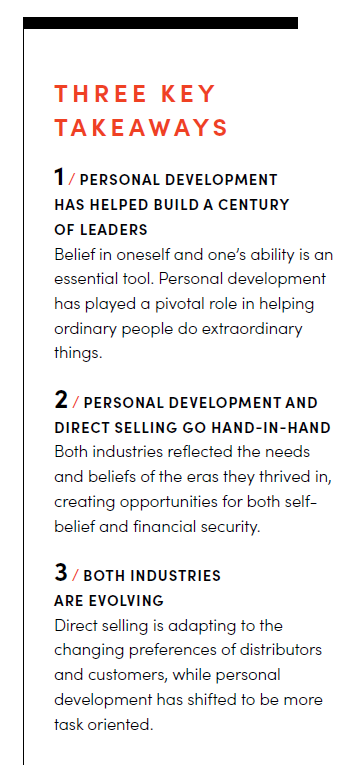
If history has taught us anything, it’s that direct selling’s path runs parallel to personal development. Tactics, messaging and delivery evolve. Technology increases accessibility. Methodology, like gamified and virtual programming, modernizes. Messaging keys to new themes like emotional intelligence and mindfulness, but retrieves original edicts like resilience, purpose, connection and earning, too. And people change. Today, there’s high demand for proactive, relatable, goal-oriented, actionable and intentional personal development. If people don’t see how it applies to them, they are quick to move on.

Heisz explained this perfectly. “The reality is that a big part of personal development is not simply consuming and digesting the information, it is putting it into action. People still need to take that next step, whether it is reading ten pages of a good book a day, as suggested by Jeff Olson in The Slight Edge, or journaling about the good things that happened that day for three minutes a night to focus on building a more optimistic outlook. So, in that sense, personal development is still very much the same. No one can do it for you.”


From the March/April 2025 issue of Direct Selling News magazine.

Filed Under: Feature Articles Tagged With: Blake Mallen, Brian Tracy, Deborah K. Heisz, Glenn Sanford, Harvey Mackay, Jeff Olson, Jim Rohn, John Addison, John C. Maxwell, Les Brown, Nancy Bogart, Neora, Orison Swett Marden, personal development, Primerica, Sarah Shadonix, Stephen Covey, SUCCESS Enterprises, Success magazine, Tony Robbins

How to Avoid Unconscious Bias in Your Business

March 1, 2025 by Susannah Schofield OBE

10 actionable strategies to help keep your assumptions in check.

Listen to this story starting at 19:16 on the new, revamped The DSN Podcast. Even when your day is packed, we make it easy to stay informed, engaged and one step ahead. Listen now or read below!

Unconscious bias refers to the attitudes or stereotypes that affect our understanding, actions and decisions. These biases are often automatic and unintentional, influencing how we perceive and interact with others based on characteristics such as race, gender or age.

AnnaStills/shutterstock.com

This can lead to inaccurate or unfair assumptions and judgments which could impact hiring practices, performance evaluations and social interactions. Recognizing and addressing unconscious bias involves increasing awareness and implementing strategies to mitigate this, such as training, reflection and promoting diversity and inclusion.

We live these daily without realizing it. The security guard is a man, reconfirming that men are strong; the receptionist is a woman, reconfirming that woman are kinder, gentler and able to assist you. These might not seem like important things, but even simple assumptions can lead us into judgments that negatively affect our businesses and opportunities.

Challenging yourself to look at opportunities with a fresh perspective can stimulate creativity and innovation. Here are some strategies to consider.

1 / Seek Diverse Perspectives
Engage with people from different backgrounds, cultures and experiences. They can offer insights and viewpoints that you might not have considered. This is particularly useful when looking to work with younger generations.

2 / Change Your Environment
Altering your physical workspace or visiting new places can help inspire fresh thinking, unlocking new ideas. When I am writing, I always put myself in a fresh situation to challenge myself and my perspective.

3 / Practice Mindfulness
Take time to reflect and be present. Mindfulness can help you clear away preconceptions and view opportunities more openly.

4 / Ask Questions
Challenge the status quo by asking “what if” questions. For example, “What if I approached this problem differently?” or “What if resources were unlimited?”

5 / Limit Assumptions
Write down your assumptions about a specific opportunity. Then, critically evaluate each assumption and consider alternative viewpoints.

6 / Try New Experiences
Step out of your comfort zone with new activities or hobbies. If you can do something that makes you feel a little uncomfortable every day, then you are opening yourself up to huge opportunities.

7 / Set a Time for Ideation
Allocate specific time for brainstorming without judgment. Write down all ideas—no matter how unconventional—and review them later. This is a great team exercise and one we do frequently at the UK Direct Selling Association.

8 / Engage in Continuous Learning
Read books, attend workshops or take courses in areas outside your expertise. Learning new things can often prompt fresh insights.

9 / Reflect on Past Experiences
Consider previous times when you may have approached opportunities differently and how that affected the outcomes. Applying those lessons can offer a new lens for future opportunities.

10 / Collaborate
Work with others on projects or ideas. Collaboration can lead to new concepts and solutions that you might not develop alone.

By consciously applying these strategies, you can train yourself to approach opportunities with openness and creativity, viewing them from various angles. This in turn helps you grow as a leader.

LightField Studios/shutterstock.com

What Does Good Leadership Really Look Like?

It’s easy as a leader to understand your vision, but a good leader not only has a clear vision for the future but can articulate it in a way that motivates others to work towards it.

Understanding and valuing the perspectives and feelings of others fosters a supportive environment where team members feel heard and respected. Empathy is so vital when building an effort-based business.

Effective leaders communicate openly and transparently, ensuring that team members understand their roles, expectations and overall objectives. Here are a few universal traits that all visionary leaders exhibit.

  • Integrity
    Good leaders demonstrate honesty and ethical behavior, building trust within their teams and with stakeholders. I am a firm believer that if you live your life with honesty, loyalty and integrity as your core values then you can sleep well at night.
  • Decisiveness
    The ability to make informed decisions promptly—even in challenging situations—is crucial for maintaining momentum and direction. My father always said, “Procrastination is the thief of all time.” Focus, decide, act. It is better to fall forward and fail fast, then to wait until it’s too late to change.
  • Adaptability
    A strong leader is flexible and open to change, able to pivot strategies as necessary in response to new information or circumstances.
  • Empowerment
    Good leaders empower their teams by delegating responsibilities, encouraging autonomy and providing opportunities for growth and development. You will be truly astounded how individuals rise to the occasion when they feel empowered.

  • Accountability
    Leaders take responsibility for their actions and decisions, fostering a culture of accountability within the team.

  • Vision
    Effective leaders inspire others through their passion, commitment and enthusiasm, creating a positive and motivating work environment.
  • Collaboration
    Good leadership recognizes that diverse perspectives and skills contribute to better outcomes. Leaders seek advice, listen and learn, so that the team can always succeed—together.

SUSANNAH SCHOFIELD OBE is the Director General of the Direct Selling Association UK, an industry which is worth over £1billion. Prior to her appointment as leader of the DSA, Susannah spent 18 years at Royal Mail, culminating in her holding the Board-level role of Commercial & Innovation Director, where she led a team of over 800 people. A passionate advocate for women and young people in business, Susannah was awarded an OBE for her work in this area in the 2015 New Year’s Honours List.

From the March/April 2025 issue of Direct Selling News magazine.

Filed Under: Insights from the Outside Tagged With: Bias, Stereotype, Susannah Schofield OBE

Beyond Compliance—Why Risk is Worth It

March 1, 2025 by Clay Brewer

How to successfully navigate risk and innovation in direct selling.

Listen to this story on the new, revamped The DSN Podcast. Even when your day is packed, we make it easy to stay informed, engaged and one step ahead. Listen now starting at 22:57 or read below!

Estée Lauder wrote in her autobiography that “Risk taking is the cornerstone of empires.”

In my work as an attorney, I help clients navigate the technical aspects of business—corporate structuring, taxation and compliance. But my greater goal is to empower entrepreneurs to think beyond compliance and to instead cultivate creativity. Risk is inherent to entrepreneurship, and it’s not something we can afford to avoid. In fact, the true danger lies in letting fear of risk paralyze us.

Marcos Castillo/shutterstock.com

Risk is not a binary concept; it’s a spectrum. Some entrepreneurs shy away from it, while others embrace it as part of their journey. In the direct selling industry, risk is inescapable. It is woven into the very fabric of entrepreneurship—what sets successful companies apart is not their ability to avoid risk, but their capacity to avoid ruin and navigate it with vision.

At the Crossroads

Today the direct selling industry is at an inflection point. Last year brought many changes to the industry. We witnessed the Federal Trade Commission issue guidance in 2024 that ignored case law and rescinded previous guidance, while numerous well-known brands exited the direct selling space for what some, but not all, called an outdated business model.

These changes are much more than logistical quirks; they present a deep philosophical moment for the industry. The direct selling industry is being invited to redefine what it means to take risks and build something that has lasting value as opposed to fleeting infatuation.

My plea for 2025 to all those within the direct selling space is to have the courage to be disliked.

One book that profoundly shaped my thinking on this subject is The Courage to Be Disliked by Fumitake Koga and Ichiro Kishimi. The book follows a dialogue between a youth and a philosopher. In one powerful exchange, the philosopher advises, “All you can do with regard to your own life is choose the best path that you believe in.”

This insight struck me deeply. It can easily be applied to companies. In direct sales, too often, decisions are made not based on what the entrepreneurs believe to be right, but on external pressures and expectations. Maybe that’s shareholders or maybe it’s the latest social media fad that’s taken off for whatever reason.

True innovation requires the courage to walk a path others may not understand or approve of. Long-term success is not achieved in the moment, it takes years to be an overnight success. Stop leaning into another’s dream.

A Modern Version of Success

The direct selling dream should be enriching lives, not buying Bugattis and Rolexes. Community, not the individual. Clean products, not cheap ones with high margins. There’s nothing wrong with making money, but the aim needs to be properly placed.

Direct selling companies seeking to compete directly with influencers, ecommerce and traditional retail is like a plane having lost its engines—it will hover for only so long before it hits the ground. There’s simply no power behind the movement.

Today, too many direct selling companies are driven by external noise—market trends, consumer demands or the opinions of critics and other detractors. The real challenge is not avoiding this noise but distinguishing between what is authentically right for your company and what is simply a reaction to the latest fad.

Risk, at its core, is not about avoiding controversy but about staying true to a vision despite external pressures. Yes, there’s risk in being disliked, but the greater risk is in seeking approval from every person, diluting your own voice and vision in the process.

As we look toward 2025, the direct selling industry faces an existential question: how will we choose to engage with risk? Will we continue to avoid the discomfort of risk in favor of fleeting trends, or will we embrace it as a transformative force that drives innovation and long-term success?

The most successful entrepreneurs will be those who see risk not as an obstacle, but as an integral part of their journey—those who commit to their vision and find strength in the face of uncertainty. If we’re to build a future that is both resilient and sustainable, we must learn to navigate risk with clarity, purpose and an unwavering commitment to the industry.

There’s a clear path forward if we’re ready. The only question is whether we will take it.


Clay Brewer‘s practice focuses on advising both established companies and startups on a wide range of matters such as business planning, capital raising, corporate structuring, regulatory risk and cross-border transactions. A prolific writer and thought leader, Clay provides strategic counsel to clients and has a strong interest in the evolving direct sales industry as well as digital assets and blockchain technologies.

From the March/April 2025 issue of Direct Selling News magazine.

Filed Under: Legal Briefs Tagged With: Clay Brewer, Compliance, legal

Better Together

March 1, 2025 by Lisa Robertson

Following Utah’s lead, direct selling companies in several states are forming powerful coalitions.

Listen to this story on the new, revamped The DSN Podcast. Even when your day is packed, we make it easy to stay informed, engaged and one step ahead. Listen now or read below!

The direct selling industry is a mystery to many people, especially lawmakers who often equate it with negative stereotypes of the past rather than recognizing the positive impact it has on state and local economies. We’ve long had a reputation problem—and it’s one that we can (and must) play a part in rectifying with our elected officials at local, state and national levels.

GaudiLab/shutterstock.com

Who better to explain all the positive attributes of direct selling than the companies themselves? And there are in fact many good stories to tell. The industry’s economic impact. The opportunities direct selling provides to millions of families for supplemental income. The innovative, quality products exclusively sold by direct sellers. Just to name a few.

But how best to tell these stories and leverage the channel’s considerable power and influence? As Direct Selling News (DSN) reported last year, the strongest messenger for these messages could be organized lobbying coalitions formed in states with strong contingents of direct selling companies.

DSN shared the story of the pioneers of this movement in Utah in a cover story last year, and since then, the impact and reach of these coalitions have only grown. Here’s an update on where things stand.

Utah

The Beehive State is the best and biggest example of what a coalition can hope to achieve. It is the gold standard when it comes to organization, mobilization and success. The Utah Direct Selling Coalition (UDSC) is comprised of leading Utah-based companies including 4Life, Asea, doTERRA, LifeVantage, LifeWave, Nature’s Sunshine, New U Life, Nu Skin, USANA, Xyngular, Young Living, Younique and Zyia Active.

The organization formed several years ago as direct selling companies realized the collective power their voices could have. The primary directive of the coalition is to help defend the industry by cultivating legislative champions. But they’ve also worked at the state level to adopt laws to make cosmetics manufacturing and international sales easier and explored ways to strengthen the industry’s position that direct selling distributors are independent contractors.

The benefits for companies working together toward common goals and with shared resources are clear. As Calvin Jolley, Member of the Coalition Board as VP of Corporate Communications for 4Life, explained, “The UDSC offers members an opportunity to participate in government affairs on a level that most companies simply can’t afford. Our board includes lawyers, government relations specialists, direct selling executives, marketers and professional communicators. Together, we develop positive relationships with policy makers and respond to regulatory overreach.”

It has also confirmed what many in the direct selling industry have known for years: the channel plays a vital role in the economic health of cities and states. As Grant Baskerville, Chair of the UDSC shared, “Utah’s direct selling industry accounts for over 38,000 jobs across our state and $6.3 billion in annual exports. This vital industry plays a key role in supporting economic prosperity in Utah and across our nation.”

The work in Utah has only just begun. Their agenda for 2025 is to further raise awareness of all the good work direct selling companies do both at home and throughout the world. It focuses on three key objectives all focused on protecting and promoting the future viability of the channel.

“During the course of 2025, the UDSC will work with its members to promote the direct selling business model; protect the ability of our members to share and sell products; and secure the status of distributors as independent contractors and business owners,” explained Baskerville. “We will advance these three priorities by working with fellow trade associations, state legislatures, members of Congress and federal agencies.”

Texas

The Lone Star state has a thriving direct selling community and is home to many iconic brands. It was only natural that Texas would be the next state to organize a coalition. Nathan Moore, who recently retired from his role as President of Global Sales and Marketing at Mary Kay, will serve as chairman of the newly formed Texas Direct Selling Coalition (TDSC). The official kickoff for the new entity will be held during Direct Selling University in Irving, Texas March 25-27.

Like the UDSC, the TDSC will provide education, information and networking for participants focused on building relationships and creating a collective impact of influence and engagement with lawmakers across all levels of government. The first order of business will be to welcome new members and create a board of directors for the organization.

“We know direct selling has a huge business impact in Texas. More than one million Texans are involved in direct selling and close to 30 direct selling companies have a presence in the state,” Moore explained. “It’s an exciting time for direct selling companies in Texas. Building relationships and sharing data with lawmakers and regulators will be impactful as the market grows and changes. I look forward to inviting all Texas-based direct selling companies to join us in this collaborative effort to grow and protect the direct selling channel in Texas and beyond.”

Florida

The Sunshine State is also home to multiple direct selling companies—many of whom have begun preliminary efforts to organize and mobilize. While in its infancy, there is considerable momentum and enthusiasm with direct selling companies headquartered in Florida as they see the positive results emerging in other states.

Long-time direct selling executive and consultant Gordon Hester is spearheading the movement as several companies coalesce around their shared goals and vision for the future.

As Hester explained, “The Florida Direct Selling Coalition (FDSC) is great way for those in our channel to work together with legislators, regulators and other stakeholders to protect the future of our distribution channel and business opportunity. I’m excited to take a lead in getting the FDSC set up so that Florida can help lead our channel to be competitive and relevant. Florida is one of the top three direct selling markets in the US, and our efforts will have an impact on our channel, other states and at the federal level. Together and united we can take direct selling to new heights.”

Aspen Emry, Founder and CEO of Bravenly Global is one of many true believers and early adaptors of the Florida mobilization. “We are looking forward to participating in the Florida coalition and working with like-minded companies who want to educate our representatives—both on a local and national level—about our industry and protect the future of our company and all the families involved with Bravenly. We believe strongly in this channel and want to play a part in preserving all that this industry means.”

Just the Beginning

The results from Utah and the burgeoning efforts in Texas and Florida are strong indicators of the power of creating an organized, synergistic coalition to protect, preserve and promote the direct selling opportunity at local, state and federal levels.

Troy Keller, partner with Dorsey & Whitney, practices law in Salt Lake City and spearheaded the founding of the UDSC several years ago. He is encouraged by the forward progress taking shape. “We are thrilled that the success of the Utah coalition has inspired efforts to create coalitions in other states. Direct selling needs all the advocacy it can get. The industry is lucky to have the DSA, certainly, but it needs more companies to be active directly in Washington D.C. and at the state levels. State-focused coalitions are a powerful and effective way to do this.”

The consensus is that continued expansion of coalition efforts in other states with multiple direct selling companies could do much of the heavy lifting in communicating all the good work direct selling does—not just for distributors but local economies as well.

There really is no reason for companies in these states—and others—to not get involved, get active and get mobilized while both the legislative and executive branches are aligned and receptive to direct selling.

As Jolley shared, “There exist numerous states that stand to benefit from direct selling coalitions. Texas, Florida, California. Show me a half dozen direct selling companies in your state and there’s your coalition.”


From the March/April 2025 issue of Direct Selling News magazine.

Filed Under: Feature Articles Tagged With: 4Life, ASEA, Aspen Emry, Bravenly, doTERRA, Florida, Gordon Hester, Grant Baskerville, LifeVantage, LifeWave, Nathan Moore, Nature’s Sunshine, New U Life, Nu Skin, Texas, Troy Keller, USANA, Utah, Xyngular, Young Living, Younique, Zyia Active

AI Pulse

March 1, 2025 by David Lee

Sunrider’s AI platforms provide customization and efficiency.

Listen to this story on the new, revamped The DSN Podcast. Even when your day is packed, we make it easy to stay informed, engaged and one step ahead. Listen now starting at 17:40 or read below!

Sunrider International, a nutrition company focused on herbal science, is employing a multifaceted artificial intelligence (AI) strategy empowering its field of Independent Business Owners (IBOs) and corporate employees. Leveraging various platforms is improving operational efficiency and creating a more personalized and effective experience. Gareth Hooper, Sunrider’s Chief Information Officer, recently shared insights into the company’s AI strategy and its impact with Direct Selling News.

Enhancing the IBO Experience

Sunrider’s suite of customized AI tools is tailored to meet the needs of its IBOs, focusing on simplifying processes, improving productivity and driving business growth. One of the standout innovations is the AI Shopping Assistant, a generative AI tool that provides personalized support to both distributors and customers. Designed to make the shopping experience intuitive, the assistant can answer questions based on product recommendations and comparisons and in different languages. It is integrated into Sunrider’s website and mobile app to help customers customize their experience.

Sutthiphong Chandaeng/shutterstock.com

“We don’t want people just coming to the homepage and getting lost. We’re going to be doing a very specific customer-orientated website—a more proactive shopping assistant,” Hooper explained. “In some of our countries, we’ve got 400 products.”

The AI Reporting Assistant streamlines access to critical business data. By enabling IBOs to generate complex reports through simple queries, this assistant eliminates the need for technical expertise in interpreting back office analytics. For example, an IBO can ask, “Who enrolled YTD, ordered skincare and lives within 50 miles of Dallas?” This feature is live for the US and Canada with plans to roll out to all other markets by the end of the year.

“We basically made it so you can create your own reports,” Hooper shared. “You’ve got 46 different data points. Some of our older IBOs still find the back office reports complicated to use. But with the AI Reporting Assistant, you can ask it any question, and it will look through your downline and provide the answer to you.”

Identifying specific action steps to trigger bonuses and earn income quickly is key. The Income Producing Activities (IPA) AI Coach uses personalized data to suggest actionable, prioritized tasks. This tool not only assists distributors in focusing on high-impact activities but also aids in onboarding new IBOs by providing step-by-step guidance. It can suggest action steps to help a new IBO whose bonus window is about to expire. “If someone’s going to qualify to rank up, or if someone’s within striking distance of a fast start bonus, then you definitely want to help that person achieve it,” Hooper added.

Customer retention is a critical metric for any direct selling company, and Sunrider’s Churn Predictor leverages machine learning to tackle this challenge head on. The tool predicts customer churn with about 80 percent accuracy within 60 days of a customer’s last order. Its predictions are integrated into the IPA AI Coach, prompting IBOs to take proactive measures to re-engage customers. The predictive analytics will suggest reaching out to a customer who most likely placed his last order, for example.

“Churn prediction is about giving our distributors the opportunity to act before it’s too late,” Hooper said. “It’s one of the ways we’re using AI to foster stronger, long-term relationships between IBOs and their customers.”

Boosting Corporate Productivity

AI is not just transforming the experience for IBOs, it’s also optimizing corporate operations at Sunrider. The IT department has been an early adopter, with about 30 percent of the company’s code now generated by AI tools such as Claude 3. Sunrider’s developers adhere to strict protocols to ensure data security and compliance while leveraging AI to expedite software development.

“Generative AI is helping our IT team work more efficiently,” Hooper shared. “It allows us to focus on innovation and scalability without compromising quality or security.”

Prostock-studio/shutterstock.com

Sunrider’s IT team also has plans to lean heavily on AI for test automation, which will significantly increase the efficiency of quality assurance (QA) processes. Currently, test case coverage stands at 60 percent, with manual QA still playing a role for more complex requirements.

In other departments, tools like ChatGPT and Copilot are being utilized to generate marketing content, while platforms such as HeyGen are being explored for video translations. Additionally, Sunrider is preparing to launch an AI-powered Adhoc Reporting Assistant for employees in 2025. This tool aims to reduce the time spent on adhoc reporting tasks by 90 percent by leveraging the company’s data warehouse.

Sunrider’s investment in AI reflects a forward-thinking approach that aligns with the company’s mission to empower its distributors and employees. By leveraging AI, the company is creating a more dynamic and supportive environment for IBOs, while also enhancing operational efficiency across its corporate functions. 


From the March/April 2025 issue of Direct Selling News magazine.

Filed Under: Forward Thinking Tagged With: AI, Sunrider

A Loneliness Epidemic

March 1, 2025 by Beth Douglass Silcox

The new revamped DSN Podcast will provide insightful, in-depth reporting direct from the pages of DSN magazine. Listen to our cover story and more in a fast, easy-to-digest format that fits into your busy schedule. Even when your day is packed, we make it easy to stay informed, engaged and one step ahead. Listen now!

Does Direct Selling Have a Unique Opportunity to Help?

Rido/shutterstock.com

When the US Surgeon General issued a report in 2023 detailing America’s struggle with loneliness and isolation, we were on the heels of a pandemic where varying degrees of social separation had been necessary to maintain individual and group health. So, perhaps, it came as little surprise to find out that this era deeply affected us.

Data collected in 2020, mid-COVID, showed people spent more and more time—nearly six hours each day—alone. That’s over 166 hours each month tucked away by themselves, and they engaged socially with friends a mere 10 hours a month.

The pandemic only accelerated trends that had been on the rise for decades. An American Time Use Survey indicates the rise in alone-time experienced in 2020 had not yet returned to typical levels by 2022, and more people chose to be alone more often even with family members in the house.

Human brains aren’t hardwired for a solitary existence. People turning inward runs contrary to what evolution dictates necessary for us to survive. People need people.

Back in 1990, 27 percent of respondents indicated they had fewer than three close friendships, yet almost half of Americans (49%) reported this in 2021. Overall, Americans’ social networks have been shrinking for decades and minimizing our chances to form the deep connections with other people that we so desperately need to thrive.

“Healthy relationships, where we feel seen and where we can be ourselves, can be a powerful source of joy and support and can be buffers to stress,” Vivek Murthy, US Surgeon General for the Biden Administration, wrote in My Parting Prescription for America in December 2024.

Differentiating Social Isolation and Loneliness

Social connection is as biologically fundamental as food, water and shelter. It is also dynamic and lives on a continuum in our lives. Illness, relocations, job transitions and life events like parenthood or caregiving, all impact social isolation.

It’s also influenced by the physical assets, programs and policies of the communities in which people grow up, live and interact, as well as social policies, cultural norms, the technological environment, the political environment and macroeconomic factors.

It cannot be understated that conditions such as cooperation, discrimination, inequality and the collective social connectedness or disconnectedness of a community also weigh heavy in individual social connectedness.

And while social isolation and loneliness are related, they are not the same. To be socially isolated does not necessarily equate to loneliness. Regardless, neither bodes well for long-term health, according to the Surgeon General’s report.

“Loneliness and social isolation increase the risk for premature death by 26 percent and 29 percent, respectively. More broadly, lacking social connection can increase the risk for premature death as much as smoking up to 15 cigarettes a day,” the report states. There’s also a substantial increase in risk for heart disease, stroke, anxiety, depression and dementia.

The ebb and flow of social connection throughout our lives can lead to transient loneliness, which comes and goes and may even motivate people to act to find new ways to connect. But chronic loneliness—with or without social isolation—is vastly different.

Too often people think someone is either lonely or they are not. But everyone is on a gradient, with more social connection leading to better outcomes. Just because a person reports an absence of loneliness, does not mean their social connections contribute to their overall resilience or enable them to thrive. Deep loneliness can still be felt in a crowded room because lack of high-quality, close relationships is equally as bad as lack of quantity.

Loneliness and isolation do not discriminate. Anyone can experience it. While gender, political affiliation and education level matter less, there are high risk groups including those in poor physical or mental health, with disabilities, lack of financial security, single parents and those who live alone, ethnic and racial minorities, LGBTQ+ individuals, rural residents and victims of domestic violence, among other marginalized peoples.

The Harvard Graduate School of Education’s Making Caring Common Project (MCCP), working with YouGov, dug deeper into the emotional, social and existential dimensions of loneliness, who or what Americans blame and the types of personal and community solutions they endorse, as well as the causes.

They drew on the views of a nationally representative pool of 1,500 adults surveyed in May 2024. Working with More in Common’s Americans in Conversation (AIC) panel in August last year, they also garnered responses from 193 adults to hone in on loneliness and the nature of adults’ social connections. The resulting publication, Loneliness in America: Just the Tip of the Iceberg? by Milena Batanova, Richard Weissbourd and Joseph McIntyre was published in October.

F8 studio/shutterstock.com

We tend to think of loneliness as an issue for the elderly, but the rate of loneliness among young adults is much higher than adults over 65, according to MCCP research.

18-29-year-olds….24%
30-44-year-olds….29%
45-64-year-olds….20%
65 and over….10%

The Surgeon General’s report indicates that the number of lonely young people grew every year between 1976 and 2019.

Income disparities are also a differentiator when it comes to loneliness.

Less than $30,000/year….29%
$30,000 – $49,000/year….21%
$50,000 – $100,000/year….19%
$100,000 and up/year….18%

But beyond these simple metrics lay complexities that, perhaps, Matthew Shaer of the New York Times, summarized best when he wrote, “When we talk about loneliness, what we’re actually talking about are all the issues that swirl perilously underneath it: alienation and isolation, distrust and disconnection and above all, a sense that many of the institutions and traditions that once held us together are less available to us or no longer of interest.”

The Loneliness and Mental Health Correlation

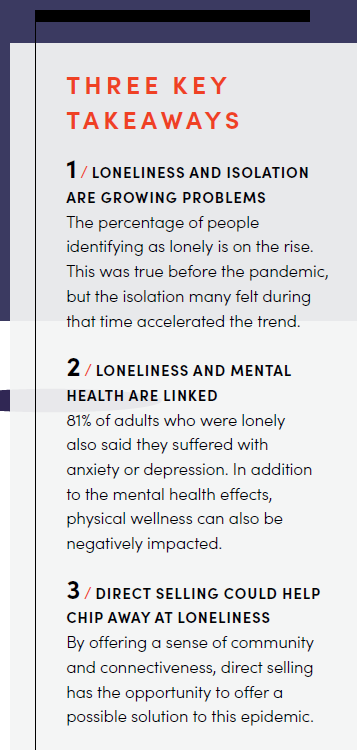
A strong correlation exists between loneliness and mental health. Eighty-one percent of adults who were lonely also said they suffered with anxiety or depression; compared to 29 percent of those who were less lonely. Many people, it seems, get stuck in a loop of chicken-or-egg, not knowing which comes first—loneliness or anxiety/depression. Therefore, loneliness may not only be the cause, but also the result of wide-ranging feelings that interact in complex ways that induce and deepen feelings of meaninglessness.

MCCP reports social-emotional loneliness or not feeling part of meaningful groups or communities stood at 67 percent among lonely respondents, while 61 percent of lonely people exist without enough close friends or family and 50 percent lack a single person to rely on for deep emotional support.

Josep Suria/shutterstock.com

Then comes reporting on existential loneliness, which culminates in feeling fundamentally disconnected from others or the world. Sixty-five percent report this; 63 percent do not feel their place in the world is important or relevant; and 40 percent (most often Democrats and Independents) don’t feel “part of this country.”

By any measure, these results are staggering and demand not only further examination for the health and well-being of all Americans, but also actions beyond that of the individuals who are suffering.

“Our data also reinforces the role that all of us have to play in reducing loneliness. There is only so much lonely people can do if the ones they feel close to are distracted by technology or so overworked or exhausted that they can’t devote quality time together—among the main sources of blame cited by our respondents. Encouragingly, the solution people endorsed most, including lonely adults, is available to almost all of us: ‘taking time each day to reach out to a friend or family member,’” Making Caring Common wrote.

How Can Direct Selling Contribute?

This is where the direct selling industry may serve a meaningful role in chipping away at America’s epidemic of loneliness. Arguably, it may not be the responsibility of a company or an industry to solve their employees’ or sales organizations’ loneliness or mental health issues. However, it is in their best interests to have teams comprised of healthy and productive individuals.

By the broadest definition, direct selling companies are communities, possessing many of the attributes of a “small town.” While they may not share a geographic location, its “citizens” willingly come together sharing common interests and goals, creating and living within a common culture and often working for the benefit of a greater good. They befriend, educate and support one another in ways that are completely unique to the business model. And research shows that it is through just such community building and social connectedness that loneliness has its best chance of dissipating.

The social infrastructure of a community—the places, programs and philosophies—all create opportunities for individuals, lonely or not, to build social capital. These are the accessible resources and people that turn into social networks, which so many of the lonely lack. Social networks are comprised of individuals who bridge or connect people outside of a lonely person’s core group and those who link them to people of differing power status within the community.

Through the perceived or actual availability of emotional, informational or tangible social support delivered by the social network, a sense of solidarity, strong social connections and high social participation forms a social cohesion that is beneficial to both individuals and the community itself. Trust formed within that community can improve population health, social functioning and economic prosperity.

At its core, the direct selling industry is driven by social connectedness. The uplines and downlines of the most successful field organizations already reflect corrective strategies to the loneliness epidemic, so too does the industry’s focus on community-building through culture.

Sarah Shadonix, Founder and CEO of Scout & Cellar firmly believes direct selling can help combat loneliness, particularly in young adults. “Direct selling is all about people—building relationships, connection, adding value, mentorship and teamwork. For young adults, it offers a flexible full- or part-time career with a built-in support system. Whether it’s virtual meetups, events or simply working with like-minded individuals, it creates opportunities for connection, confidence and purpose, which are key to fighting loneliness.”

With supporting frameworks like these already in place, perhaps, it is not such a big leap to think that direct selling companies could help remedy the effects of social isolation and loneliness by lifting characteristics like caring, inclusion and belonging closer to the surface in their day-to-day operations, messaging, training, recruitment and management.

It’s exciting to think that direct selling can provide not only a financial lifeline, but a social one as well. As Shadonix explained, “Direct selling is more than just a career—it fosters genuine connections and a sense of purpose. It provides an opportunity to be part of a supportive community where success becomes a collective journey where everyone encourages and celebrates each other’s growth.”


I See You. I Know You.

Jordan Essentials offers a case study in breaking through loneliness.

It’s been 25 years since a lonesome, 32-year-old mom felt pressures so many people feel today—too little money and too little time to deeply connect with others. The obligations, responsibilities and restrictions that come with parenthood overran Nancy Bogart’s days. “I was so lonely. Because I was raising my kids, I was very isolated, trying to do the right things and trying to make some extra money,” the Founder and CEO of Jordan Essentials explained.

SeventyFour/shutterstock.com

In 1999, a landline phone and a few friends from MOPs—Mothers of Preschoolers—launched her Lotion Bar and set Bogart on a personal journey to not only reconnect socially but also create a direct sales, multi-level, party plan company that has helped others do the same.

For that, Bogart is eternally grateful and remains firmly rooted in party plan—a business model based on the belly-to-belly, door-to-door legacy upon which direct selling was built and continues to gain strength due to the human desire to be seen, connect, learn from and rely on others.

“It was my network of people that really gave it life,” Bogart shared. Jordan Essentials thrives today because of the networks of thousands of people. They are setting all-time recruitment records and have grown for five consecutive years.

Bogart insists direct selling is not just a monetary equation. There’s intrinsic value in caring about other people and considering our impact on family and society. “There’s an intimacy in knowing somebody in person or through a real relationship.”

Bogart seeks to break free from the anonymity of digital platforms and use tech to build a foundation of common ground that keeps people excited for the day they finally get to meet in person.

“I have people who I recruited from across the country and never met before, but we became the closest of friends. After two years, we finally met at a conference. There’s a depth in that genuine relationship.”

But it’s vital to meet someone where they are—to consider the shoes they are standing in. How can a company insist that a mother of triplets orchestrate a trip to attend training or a convention? Simply finding childcare would be daunting and that mom deserves better, according to Bogart.

“Our (virtual) attendance at events is still very high. The hybrid model allows people to stay connected. To say if you’re not there in person, you won’t get trained and you won’t get the value of connection. It’s like telling people ‘you stay lonely; you stay isolated.’ That’s something I won’t let happen. I want them to know ‘I see you. I know you.’” That’s the power of connection. 


From the March/April 2025 issue of Direct Selling News magazine.

Filed Under: Cover Stories Tagged With: community, Jordan Essentials, Nancy Bogart, Sarah Shadonix, Scout & Cellar

Hugh & Grace: How Personal Trials Became a Professional Triumph

March 1, 2025 by Chelsea Hughes

Listen to this story starting at 11:22 on the new, revamped The DSN Podcast. Even when your day is packed, we make it easy to stay informed, engaged and one step ahead. Listen now or read below!

Founded | 2021

Headquarters | Los Angeles, California

Top Executives | Ben & Sara Jensen / Co-Founders & Co-CEOs

Product Category | Health & Wellness

When Ben and Sara Jensen decided to start their family, they could never have predicted the tumultuous path ahead. The young couple struggled for 14 years with unexplained infertility. Even with the support of world-renowned specialists across various medical fields and numerous IVF rounds, nothing ever worked.

Searching for a Silver Lining

Desperate to get pregnant, the Jensens tried everything. Sara, a passionate ultramarathoner, stopped running. She hated needles but did acupuncture multiple times per week. During their sixth round of IVF, the Jensens asked their doctor whether they might be missing something—anything—that could increase their chances of conceiving.

“Our doctor asked which skincare, homecare and wellness products we were using, sharing that those products contained chemicals that could disrupt our hormones,” Ben recalled. “We had seen this happen firsthand during IVF. The doctors had prescribed a hormone cream for Sara. After rubbing a small amount on her skin, her hormones would spike. We realized that if a small amount of cream could affect Sara’s hormones in such a significant way, then other products could as well—it was an enormous wakeup call. We spent countless hours researching and meeting with experts learning about how hormones impacted our health.”

“Incredibly, our sisters volunteered to be our surrogates,” Sara shared. “Ben’s sister gave birth to our son, Hugh, and my sister gave birth to our daughter, Grace. After having Grace, I couldn’t sleep—we felt incredibly fortunate to have our children, and we knew that what we had learned about hormone disruption and hormone health could benefit everyone. I felt a deep responsibility to share what we had learned and wanted to pay forward the generosity we had received. With a newborn and a two-year-old, we resigned from our careers and founded Hugh & Grace.”

Their 14-year battle with infertility would lead the Jensens to their favorite roles: parents of Hugh and Grace and launching a business named in their honor. Hugh & Grace has become a groundbreaking brand on a mission to create high-performance, hormone supportive products for everyone that help reduce exposure to hormone-disrupting chemicals.

Solving their Problem

Before founding Hugh & Grace, Ben was managing a multibillion-dollar family office in Beverly Hills, and Sara was working in philanthropy at the University of Southern California.

The couple had built a fantastic network of world-renowned doctors, top hormone health experts and thought leaders from across the country. “We loved our careers and never planned on starting a company,” Ben said. “But once we realized the universal need for improved hormone health, we knew it was something too important for us not to do.”

Many everyday products contain endocrine disrupting chemicals (EDCs). These chemicals disrupt hormones and can lead to infertility, anxiety, cancers and other diseases. Shockingly, men apply over 80 chemicals daily; women over 160. We’re exposed to hundreds more in our daily environment.

The Jensens consulted their medical advisors to determine the best way to solve it. As Ben explained, “We keep our messaging very clear—what goes on, in and around our bodies impacts our hormones—positively or negatively. We offer a lifestyle solution that helps promote hormone health with products, education and community.”

The Jensens work with a team of award-winning formulators and manufacturers and conduct third-party testing on their products. The couple take quality, performance and safety seriously, constantly looking at market trends and innovation when formulating the products.

With current product lines focused on skin, health and home care, Hugh & Grace provides customers with a baseline for detoxing their lives.

“We’ve learned that simplicity is key. While we love launching new products, The Routine is the key to our success. It’s three simple steps every morning—supplements, our hydrate + detox drink and collagen. Ben and I never miss a day. It’s helped with our energy and focus and helped us stay healthy even with long work hours and a crazy travel schedule,” explained Sara.

Empowering the Community

They have created a movement. “We knew if we were going to create a holistic solution to an issue most people don’t realize they have, we needed to create awareness, education and community,” Ben explained.

Hugh & Grace’s innovative Affiliate Plus model blends the best elements of affiliate marketing, retail partnerships and direct sales into a multichannel business model. “We saw the challenges and misconceptions surrounding direct sales and knew we had to build something different,” Ben explained. “Consumers today demand authenticity, purpose and performance. Our model delivers on all fronts and provides an opportunity for our Advocates to create meaningful impact.”

Hugh & Grace’s model focuses on education, community and trust. Advocates are empowered to share their knowledge of hormone health through masterclasses, podcasts and live events.

Proven Results

Hormone health is a topic that is trending, and the company is scaling rapidly. In Q4 2024 alone, Hugh & Grace achieved 215 percent growth with 2025 looking to top 300 percent of sustainable growth.

Beyond the numbers, Hugh & Grace is gaining traction among health professionals. Many top medical professionals, including oncologists, OB-GYNs and hormone specialists, are partnering with the brand, recommending its products and business model to their communities. Partnering with respected doctors’ offices including the Southern California Reproductive Center and Rodeo Drive Women’s Health Center put hormone health forefront of conversations in both healthcare and wellness.

The Jensens also believe in philanthropy. “Hormones impact your physical, mental and sexual health. This is a broad topic, and we collaborate with several incredible charitable organizations doing great work in the world,” Sara explained. These collaborations reflect the heart of the brand while giving back to their community.

The company is now preparing for international expansion. They recently pre-launched in Canada and returned from presenting in Saudi Arabia and Dubai.

And their success hasn’t gone unnoticed. Hugh & Grace was recently honored as 2025’s Most Transformative Company and Fastest Growing Impact Company by Real Leaders. Their book Hormone Health Simplified: Simple Swaps to Improve Your Physical, Mental and Sexual Health is scheduled to launch in April.

The Jensens feel fortunate to have such an incredible team. “Amanda Lorenz, EVP of Operations and Chief of Staff, has been an integral part of our growth. Craig Colyar, SVP of Sales, drives revenue growth with strategic expertise, and Kelli McVay, VP of Field Development, brings heart and passion. They create a fun work environment and equip our Advocates with the resources they need to thrive,” Sara explained. “This isn’t about us. It’s about creating an elevated platform where we can help people live their dreams. Hugh & Grace provides solutions and a platform to help live simpler, healthier, happier lives. And we’re just getting started.”


From the March/April 2025 issue of Direct Selling News magazine.

Filed Under: Company Spotlights Tagged With: Ben Jensen, Hugh & Grace, Sara Jensen

Earning on Demand

March 1, 2025 by Crystal Holtzendorff, SVP of Global Sales / PayQuicker

Why instant payments matter.

Listen to this story starting at 8:49 on the new, revamped The DSN Podcast. Even when your day is packed, we make it easy to stay informed, engaged and one step ahead. Listen now or read below!

All businesses want to score big wins in 2025, and fortunately, there hasn’t been a better time to focus on amplifying revenues. With a swift transformation in the direct selling landscape, the payments space is rapidly innovating to keep up with industry trends. The impact of this financial technology revolution is clear; traditional payment solutions significantly lack the agility needed to meet ambitious customer reach or sales goals.

pixadot.studio/shutterstock.com

With the walls of international payments breaking down and the global retail industry adding pressure, the race to attract the right distributors is well underway. These alone are convincing reasons for direct selling companies to revisit payment strategies to future-proof their revenue, alongside building distributor engagement. However, let’s not forget that the key drivers of modern-day business success also include consumer behaviors, AI and technological advancements, to name a few.

The good news is unlocking powerful growth for direct selling companies doesn’t have to be complicated—it all starts with instant payments.

1 / Improve loyalty with seller-centric perks

It has long been a challenge for direct selling companies to build seller-centric appeal that attracts top representatives and distributors. Providing a tried-and-tested solution, instant payments empower them with the right leverage to deliver an enriching experience and drive seamless sales growth. This may sound too simple, but a motivated workforce helps cut through the industry noise and reduces inefficiencies, in turn generating the right business activity required to expand market share.

In today’s fast-paced world, seller-centric perks like real-time payments and digital wallets provide much needed flexibility and financial autonomy to engage top sales talent. With the ability to issue payouts as frequently as your distributors desire: daily, weekly, monthly or perhaps even hourly, their performance is directly tied to how quickly they feel rewarded for their hard work.

Nature’s Sunshine, a leading natural health and wellness company ranking in the top 40 of US direct selling companies, pays out every one to two minutes. Meanwhile, Younique, a top 50 US direct selling company, issues payouts every three hours.

A reputation for speedy payments also means the direct selling business gains positioning as a stronger brand that more workers would want to partner with. The outcome? Loyalty, increased retention and incentivized representatives working hard to support revenue targets.

2 / Increase sales volume with affiliate programs

Traditionally, direct selling companies rely on higher commission structures that reward representatives to build teams and earn up to 50 percent in commission. Today, 35 percent of existing direct selling companies and 84 percent of new direct selling companies, are looking to incorporate affiliate programs that offer lower incentives, but more freedom to share and refer, rather than team build. Affiliates today are not looking for long-term growth and investment, but rather quick, guaranteed ROI for their time. With multiple income streams becoming the norm, getting their money faster is more important than ever before.

The success of this aggressive growth strategy is linked to faster commission payouts that instant payments seamlessly deliver. This means affiliates get immediate access to their funds, while the direct selling businesses strengthen their credibility to attract and retain more representatives. As a result, product sales growth and new partner signups become easier to achieve as brands and affiliates collaborate in seamless alignment.

3 / Accelerate growth within and beyond borders

Localization is pivotal to driving sales, but in today’s interconnected global markets, direct selling companies have the added advantage of pursuing international customers. Partnering with the right instant payouts partner not only facilitates global market growth but secures a crucial competitive edge.

Swiftly converting hard work into financial reward, modern payment platforms allow affiliate commission payouts to be immediately available to spend in local currency via options such as company-branded prepaid debit cards. Taking the ease of cross-border payments a step further, they manage regulatory compliance to mitigate risks traditionally associated with legacy payment systems.

Innovative payout platforms offer valuable features such as enhanced security, including two-step verification; if a card is lost or stolen, the balance remains safe in distributor-owned accounts. The chip debit cards, both physical and virtual, are equipped with additional fraud protections enabling hassle-free escalations and dispute assistance for absolute peace of mind. All customers have FDIC-insured accounts with the compliance team diligently working to expand safeguards and rapid response to suspicious activity.

4 / Attract top talent with flexible payment options

Direct selling companies want satisfied distributors and affiliates who feel seen and heard by the business. This is why switching to instant payments away from slow and outdated systems should not be a choice but a priority. As spending preferences evolve, payment flexibility must keep up, so money and operations continue moving fast.

While some distributors may still prefer bank transfers and paper checks, offering diverse payment methods including branded debit cards and instant virtual cards shows a serious commitment to workforce satisfaction. Current payment trends such as the ability to load virtual and plastic cards onto smartphone mobile wallets such as Apple and Google further indicate that generic payment methods don’t work for everyone. Instant payments, powered by secure innovation, ensure that your tech-savvy distributors can control their finances in a way optimized for their personal needs.

Start Paying on Demand Today

Gaining traction in the direct selling industry can be made easier with the right payments strategy that doubles down on your workforce’s happiness. From working with tech-savvy representatives and affiliates to more traditional distributors, a customizable platform like PayQuicker ensures your business attracts the best talent, both local and international. Empowering direct selling businesses with flexible payment methods, we have the expertise to work with all types of workforce structures, regardless of size, to ensure easy adaptability to changes in customer needs and industry demands.


CRYSTAL HOLTZENDORFF is SVP of Global Sales at PayQuicker, an innovative financial technology leader in the global payouts market. With over 20 years of industry experience, she is a masterful sales professional with a background in technology, healthcare and marketing.

From the March/April 2025 issue of Direct Selling News magazine.

Filed Under: Working Smart Tagged With: Payments, PayQuicker

Raising Voices

March 1, 2025 by David Lee

AI-powered voice assistants are transforming business and user experience.

Listen to this story starting at 15:37 on the new, revamped The DSN Podcast. Even when your day is packed, we make it easy to stay informed, engaged and one step ahead. Listen now or read below!

Voice technology has rapidly evolved, becoming an integral part of daily life and operations for more businesses. Customers regularly interact with brands and platforms through voice technologies. Recent advancements have significantly enhanced the capabilities and applications of voice assistants.

Beyond Smart Speakers

Voice assistants are no longer confined to smart speakers. They are now integrated into various devices, including televisions, thermostats and refrigerators as well as wearable technology like advanced headphones and interactive hearing aids. This expansion allows for more seamless and ubiquitous user interactions across different environments.

Companies are increasingly creating custom voice personas to represent their brands, moving beyond generic assistants like Alexa or Siri. According to Deepgram, 82 percent of businesses are using voice technology. This strategy enhances brand identity and provides personalized user experiences, allowing brands to communicate directly with consumers in a distinctive voice.

mojo cp/shutterstock.com

Emotionally Intelligent Voice Assistants

Advancements in artificial intelligence (AI) enable voice assistants to recognize and respond to the emotional tone of users. This capability allows for more empathetic and contextually appropriate interactions, improving customer service and user satisfaction. Examples are upbeat when making a sale or concerned when addressing a complaint, notes a ReadSpeaker article.

Enhanced Security Features

To address privacy concerns, voice assistants are incorporating built-in security features such as speaker verification and identity confirmation. These measures help ensure that interactions are secure and that personal information is protected.

Increased Adoption Across Demographics

Voice assistant usage is growing across various age groups, with significant adoption among younger demographics. ReadSpeaker says approximately 62 percent of Americans aged 18 and older use a voice assistant. A Keywords Everywhere article says about 90 percent of people find voice search easier than typing out a search online.

Integration with Artificial Intelligence

The integration of AI into voice assistants has led to more natural and intuitive interactions. AI-powered assistants can perform complex tasks, understand context and provide personalized responses. This can help a salesforce hone in on more specific target demographics and identify weekly action steps.

Economic Impact and Market Growth

The voice assistant market is experiencing substantial growth, with projections indicating that the number of users will continue to rise. About 8.4 billion voice assistants were expected to be in use worldwide by the end of 2024, according to Yaguara. And around 149.8 million people in the US were expected to have used voice assistants by the end of last year.


From the March/April 2025 issue of Direct Selling News magazine.

Filed Under: Forward Thinking Tagged With: AI, Voice

BeFra Reports Q4 2024 Financial Results

February 28, 2025 by DSN Staff Writer

Betterware de México, S.A.P.I. de C.V., now known as BeFra, announced its financial results for the fourth quarter of 2024. Net revenue during the quarter grew by 11.1%, which was primarily due to a 22.2% increase in sales in its Jafra Mexico segment. Betterware de Mexico revenue grew 1.5% and maintained growth momentum. Full-year revenue rose 8.4%, with the Jafra Mexico segment increasing 13%. Betterware de Mexico rose 4.6% year-over-year, while Jafra US remained stable. Full year revenue was $689 million.

EBITDA for the fourth quarter declined 5.8%, which the company said was mainly driven by a 17.3% decline in Jafra Mexico’s EBITDA after prior years’ synergies and cost optimization benefits were seen reflected in the previous year’s quarter. Betterware Mexico’s EBITDA increased 31.8% after performance and promotional initiatives and expense controls were implemented in the fourth quarter of 2024. Full-year EBITDA increased 2%, but remained slightly below guidance.

“2024 was a year filled with achievements,” said Luis G. Campos, BeFra Chairman of the Board. “We maintained our growth momentum with double-digit revenue growth of 11.1% in the last quarter compared to the previous year. Jafra Mexico was a key driver of this success, achieving remarkable 22.2% growth in the same period. Also, noteworthy was the performance of Betterware Mexico, which, despite persistent market challenges, including a slowdown in durable-goods consumption trends in Mexico, delivered revenue results 1.5% above the same quarter last year. Thanks to a strong Q4, BeFra concluded 2024 with [an] 8.4% revenue growth compared to 2023, with both companies contributing growth; Jafra Mexico grew 13.0% while Betterware Mexico grew 4.6%. We faced temporary challenges in profitability, but despite those we generated MX$2,775M in EBITDA, which was 2.0% above 2023. This was primarily driven by Jafra Mexico with a 15.5% increase in EBITDA, partially offset by Betterware Mexico, where EBITDA declined 9.6%, due to temporary challenges in the international supply chain during the second half of the year. However, we see this as a temporary situation, and expect Betterware Mexico’s EBITDA to return to historical levels during 2025.”

The company ended the year with what it described as a strong balance sheet that will provide “financial flexibility to further reduce debt leverage, continue investing in growth and efficiency initiatives and pay additional dividends.”

In the year ahead, BeFra plans to celebrate Betterware Mexico’s 30th anniversary and its expansion from 5,000 associates in 2001 to the 675,000 associates the company boasts today.

Filed Under: Financial Tagged With: BeFra, Betterware de Mexico, JAFRA, Luis G. Campos, quarterly

eXp Realty Delivers Revenue Share and Benefits to Agents and Brokers

February 28, 2025 by DSN Staff Writer

eXp Realty announced that it paid more than $220 million in revenue share and equity benefits to its agents and brokers in 2024. The company’s revenue share model was designed to give agents direct access to long-term wealth creation.

“In a time when many agents are searching for stability and financial growth, eXp Realty continues to deliver real, tangible wealth-building opportunities beyond just commissions,” said Leo Pareja, eXp Realty CEO. “This is a testament to our commitment to empowering agents with a business model that prioritizes their success, rewards their contributions, and gives them ownership in the company they help build.”

Agents can earn stock awards for production milestones and earn leveraged income by growing their networks and supporting their peers.

“Our model isn’t just about selling homes — it’s about transforming the way agents build their futures,” Pareja said. “When agents win, we all win and that’s what makes eXp Realty unstoppable.”

Filed Under: Financial Tagged With: EXP REALTY, Leo Pareja, Revenue Share

4Life Publishes Transfer Factor AgePro Research

February 27, 2025 by DSN Staff Writer

A 4Life study has been published in the Journal of Aging Science. The study evaluated two compositions comprised of nicotinamide mononucleotide (NMN), quercetin, alpha ketoglutarate (AKG), white button mushroom extract (standardized to spermidine), 4Life Transfer Factor (extracts from cow colostrum and chicken egg yolk), with or without milk thistle fruit extract (standardized to silybin), and apigenin.

“Our latest research not only details the efficacy of 4Life Transfer Factor AgePro, but our findings also appear in the Journal of Aging Science—a reputable peer-reviewed publication in North America,” said Dr. David Vollmer, 4Life Chief Scientific Officer. “Not only do we conduct the science, but we also commit to publishing it in third-party journals in order to give customers the comfort of additional substantiation.”

Filed Under: Daily News Tagged With: 4Life, David Vollmer, study

  • « Previous Page
  • 1
  • …
  • 77
  • 78
  • 79
  • 80
  • 81
  • …
  • 637
  • Next Page »
brand-logo
The News You Need.
The Name You Trust.
Subscribe

Breaking global news, emerging trends and powerful stories conveniently curated to help direct selling executives stay informed, engaged and a step ahead.

  • Read
  • Listen & Watch
  • Attend
  • Achieve
  • Research
  • About
  • Connect
5717 Legacy Drive
Suite 250
Plano, Texas 75024
info@directsellingnews.com
Copyright 2026 Direct Selling News | All Rights Reserved
  • Privacy Policy
  • Terms of Use
  • Advertise
  • Subscribe
We use cookies on our website to give you the most relevant experience by remembering your preferences and repeat visits. By clicking “Accept All”, you consent to the use of ALL the cookies. However, you may visit "Cookie Settings" to provide a controlled consent.
Cookie SettingsAccept All
Manage consent

Privacy Overview

This website uses cookies to improve your experience while you navigate through the website. Out of these, the cookies that are categorized as necessary are stored on your browser as they are essential for the working of basic functionalities of the website. We also use third-party cookies that help us analyze and understand how you use this website. These cookies will be stored in your browser only with your consent. You also have the option to opt-out of these cookies. But opting out of some of these cookies may affect your browsing experience.
Necessary
Always Enabled
Necessary cookies are absolutely essential for the website to function properly. These cookies ensure basic functionalities and security features of the website, anonymously.
CookieDurationDescription
cookielawinfo-checkbox-analytics11 monthsThis cookie is set by GDPR Cookie Consent plugin. The cookie is used to store the user consent for the cookies in the category "Analytics".
cookielawinfo-checkbox-functional11 monthsThe cookie is set by GDPR cookie consent to record the user consent for the cookies in the category "Functional".
cookielawinfo-checkbox-necessary11 monthsThis cookie is set by GDPR Cookie Consent plugin. The cookies is used to store the user consent for the cookies in the category "Necessary".
cookielawinfo-checkbox-others11 monthsThis cookie is set by GDPR Cookie Consent plugin. The cookie is used to store the user consent for the cookies in the category "Other.
cookielawinfo-checkbox-performance11 monthsThis cookie is set by GDPR Cookie Consent plugin. The cookie is used to store the user consent for the cookies in the category "Performance".
viewed_cookie_policy11 monthsThe cookie is set by the GDPR Cookie Consent plugin and is used to store whether or not user has consented to the use of cookies. It does not store any personal data.
Functional
Functional cookies help to perform certain functionalities like sharing the content of the website on social media platforms, collect feedbacks, and other third-party features.
Performance
Performance cookies are used to understand and analyze the key performance indexes of the website which helps in delivering a better user experience for the visitors.
Analytics
Analytical cookies are used to understand how visitors interact with the website. These cookies help provide information on metrics the number of visitors, bounce rate, traffic source, etc.
Advertisement
Advertisement cookies are used to provide visitors with relevant ads and marketing campaigns. These cookies track visitors across websites and collect information to provide customized ads.
Others
Other uncategorized cookies are those that are being analyzed and have not been classified into a category as yet.
SAVE & ACCEPT