Thursday / October 8. 2026
menu-logo menu-logo
brand-logo
Subscribe
Subscribe
Thursday / October 8. 2026
  • Read
    • Daily News
      • Financial
      • Insights
      • U.S.
      • International
    • Digital Issue
    • Executive Announcements
    • Cover Stories
    • Feature Articles
      • Exclusive Interviews
    • International Focus
    • Company Spotlights
    • Forward Thinking
    • Legal Briefs
    • Insights from the Outside
    • For You | For Your Field
    • Working Smart
  • Listen & Watch
    • Direct Approach Podcast
    • What’s Working in Direct Selling
    • BUILT TO LAST
      • Zinzino
      • PM-International
      • LifeWave
    • The DSN Podcast
  • ATTEND
  • Achieve
    • Global 100 List
    • Bravo Awards
    • Best Places to Work
    • Legends
  • Research
    • Stock Watch
    • DSN Supplier Sponsors
    • The DSN Guide
    • Supplier Directory
    • Stock Ticker
    • Resources
  • Engage
    • About DSN
    • Supporter Program
    • Subscribe
    • Advertise
    • VIP Text Alerts
    • Connect
  • Search
Subscribe

dōTERRA Global Convention 2025 Focuses on Empowerment

October 1, 2025 by DSN Staff Writer

dōTERRA welcomed more than 10,000 people to its in-person and virtual Global Convention 2025, held in Salt Lake City, Utah. The event highlighted the theme of empowerment and featured best-selling author Mel Robbins as its keynote speaker. Breakout education sessions, hands-on product experiences and a free community Open House at the Salt Palace Convention Center gave attendees the opportunity to explore essential oils options and experience the company’s latest innovations.

More than 850 participants assembled 20,000 hygiene kits intended for distribution during a crisis, in addition to a philanthropic initiative at the event that raised more than $20,000 for Rising Star Outreach, which dōTERRA matched.

“Our convention is about more than products, it’s about community and empowerment,” said Maquel Shaw, dōTERRA Executive Vice President of Marketing. “We are thrilled to introduce these innovative new offerings and gather with our Wellness Advocates in Salt Lake City, where we celebrated their impact and looked ahead to the future of wellness.”

The company also debuted four new products, set to launch this week:

  • RevitaZen+ Advanced Organ Detoxification Complex – An advanced daily supplement designed to support the body’s key detoxification organs
  • RevitaZen Detoxification Blend – An essential oil blend designed to promote the body’s natural detoxification process
  • Castor Oil – A CPTG Certified Pure Tested Grade, Certified USDA Organic, cold-pressed, hexane-free, and vegan-friendly carrier oil to support daily wellness and self-care routines
  • PastTense Stick + Sweet Gum – A portable, easy-to-use stick designed for on-the-go use throughout the day to address tension in high-stress areas, like the forehead, temples, and back of the neck

Filed Under: Daily News Tagged With: doTERRA, event, Maquel Shaw

Direct Seller Defeats Class Certification in California Misclassification Case

September 30, 2025 by Katrina Eash & John Sanders

As we’ve written previously, direct selling companies are facing a wave of lawsuits, primarily in California, claiming that distributors do not qualify as independent contractors and instead are misclassified employees. Just recently, however, a California court refused to certify a class on these claims—an important outcome for all direct sellers.1

In the case at issue, Marites Perez was an It Works! distributor who alleged that It Works! misclassified its distributors as independent contractors rather than employees. She brought claims for wage and hour violations under California law and sought to certify a class of nearly 47,000 California distributors.

After full briefing and argument, the court denied the motion for class certification, finding that, among other class certification elements, Ms. Perez could not show common questions predominated across the proposed class of distributors. Ms. Perez pointed to the Distributor Agreement and terms and conditions that were shared among the distributors to try to establish predominance. The court disagreed, however, noting that such documents did not dictate “how or when to work the business” and that there was “no performance supervision.” Evidence of It Works!’s general policies was also not enough.

The court found that individualized questions—such as whether the direct seller, outside sales or inside sales exemptions applied—would predominate over common ones. To get there, the court looked beyond surface-level contractual commonalities and into the practical realities of how distributors operate. It Works! distributors sell products in a variety of ways: in-person parties, corporate events, farmers’ market booths and more. Their recruitment and sales numbers also varied widely. These distinctions were the difference-maker for the court.

Ms. Perez has petitioned the Ninth Circuit for permission to appeal the court’s order denying class certification. The appeal argues that the court erred by finding individualized issues predominated over common ones, by misapplying legal standards and by refusing to allow post-certification discovery that could provide common proof. The appeal argues that denying class certification effectively ends the claims of thousands of California distributors, making appellate review especially important.

The underlying district court’s decision may signal a growing trend among federal district courts. For example, in rejecting class claims against LifeVantage, a federal judge in Utah denied class certification for a large number of distributors on the basis that the alleged harm varied among the proposed class members.2 In that case, the court found that many distributors participated merely to consume products at a discount, while others sold for profit. Such differences defeated commonality and predominance, preventing certification of a class of direct seller distributors.

Several questions remain unanswered. Will the Ninth Circuit weigh in? How will California state courts react to the It Works! class certification denial? Will they follow suit when evaluating state class actions? And what about Private Attorney General Actions (PAGA) brought under California law? PAGA actions may lack similar certification requirements, but the operational realities of direct sellers remain unchanged. As a result, the full impact of this ruling on PAGA litigation remains uncertain.

At any rate, It Works! is a reminder that courts are increasingly scrutinizing the real-world operations of direct sellers and their distributors, not just their written agreements. It further underscores that diversity in how distributors run their businesses can help direct sellers defeat class certification.

1 Perez v. It Works Mktg., Inc., No. 23-cv-04829-TLT, ECF No. 60 (N.D. Cal. Sept. 2, 2025) (order granting in part and denying in part class certification).

2 Smith v. Lifevantage Corp. et al., No. 2:18-cv-621, ECF No. 214 (D. Utah Apr. 19, 2022) (order denying class certification).


Winston & Strawn partners KATRINA EASH and JOHN SANDERS lead Winston’s direct selling practice focused on representing multi-level marketing and direct sales organizations in a wide range of disputes and consulting matters. Winston currently represents dozens of direct selling clients in various matters, including advising several clients in Federal Trade Commission investigations and compliance, defending multiple clients in California class action, independent contractor misclassification litigations and arbitrations and ongoing compliance consulting.

An Online Exclusive from Direct Selling News magazine.

Filed Under: Legal Briefs Tagged With: Court Case, It Works!, LifeVantage, Winston & Strawn

RIMAN Granted 20-Year Plant Variety Protection by USDA

September 29, 2025 by DSN Staff Writer

RIMAN has secured a 20-year Plant Variety Protection (PVP) by the United States Department of Agriculture (USDA) for its proprietary Centella asiatica variety, Giant BYoungPool. RIMAN developed the advanced Centella cultivar through years of research, designing larger leaves and higher concentrations of active compounds than the conventional Centella asiatica. This new variety is expected to provide enhanced efficacy for skincare applications and was cultivated at RIMAN’s Smart Farm in Jeju Island, South Korea. There, plants are grown under “precision-controlled conditions to ensure consistent potency, premium quality and sustainability.”

“Beyond scientific validation, this recognition by the USDA affirms RIMAN’s commitment to bringing trusted heritage ingredients to the global beauty industry,” said Youngsu Hwang, RIMAN Chief Sales Officer. “This accomplishment strengthens our path to global expansion while staying true to our philosophy of innovation grounded in authenticity.”

This Giant BYoungPool is the key ingredient for the company’s flagship skincare brand ICD, formally Incellderm, and delivers clinically validated skincare solutions.

The company has also secured ISO compliance and Halal certification for its Lava BYoungPool Water, demonstrating commitment to global consumer needs.

Filed Under: Daily News Tagged With: RIMAN, Youngsu Hwang

Talk Fusion Launches Website Highlighting Philanthropic Efforts

September 29, 2025 by DSN Staff Writer

Talk Fusion announced a new website devoted to telling stories of its commitment to helping others in need. The new site, TalkFusionCares.com, will chronicle the many efforts of kindness, compassion and generosity in Talk Fusion’s history.

Talk Fusion Founders Bob and Kristie Reina formed a commitment to giving back before they were network marketing veterans, with Bob serving as a police officer for a decade in Tampa Bay, Florida. Since launching Talk Fusion, the couple’s philanthropic efforts have included:

  • $1 Million to the Humane Society of Tampa Bay
  • $75,000 contribution towards the construction of the Wendy Albano Feral Cat Patio
  • $100,000 to construct an orphanage in Indonesia
  • Gifted 1,500 premium Kurranda dog beds to the Hillsborough County Animal Services
  • Purchased many K-9 German Shepherds for the Hillsborough County Sheriff’s Office
  • Supplied new furniture for an orphanage in Indonesia
  • $250,000 donation to “Tuxes and Tails,” a Humane Society Benefit to help neglected and abused dogs

“Kristie and I are very excited about the launch of TalkFusionCares.com,” Bob said. “One of the greatest achievements over the last 35+ years of our combined MLM career has been successfully donating millions of dollars to help people and animals in desperate need of assistance. We love giving back and inspiring others through kindness and generosity. The launch of TalkFusionCares.com is something we have been planning for a long time, so we’re excited to see it finally come to fruition. It is a place where people all over the world can learn about Talk Fusion’s global philanthropy. From donating over $1 million to the Humane Society of Tampa Bay to funding the construction of a $100,000 orphanage in Indonesia, TalkFusionCares.com serves as a perpetual reminder that the Talk Fusion mission is much bigger than ourselves. We’re not just serving the global community; we’re improving it every day. That’s what true leaders do.”

Throughout their philanthropic efforts across three decades, the couple expressed that it has been important to lead by example for their three children and the industry at large.

“We’re not just part of the industry. We’re reshaping it, redefining it, and leading it,” Kristie said.
“Video Email is the next evolution of email, helping individuals, businesses, charities, and more connect in a more personalized way. We’ve brought emotion to the inbox. Sending emails has become fun again. From helping small businesses make an impression on new customers to helping grandparents share special moments with their children and grandchildren, we have received countless testimonials thanking us for discovering a way to make adding personalized videos to emails easier for all.”

Filed Under: Daily News Tagged With: Bob Reina, Kristie Reina, Philanthrophy, Talk Fusion, website

In Memoriam: Mark Stidham

September 26, 2025 by DSN Staff Writer

Mark Stidham, founder and owner of LulaRoe, has passed away. Stidham founded the apparel and social retail brand with his wife DeAnne Stidham in 2013 with the mission to build a community through fashion, and led the company to become one of the fastest growing apparel brands that operated with pop-up boutiques and social media live sales.

“From the very beginning, Mark poured his heart into LuLaRoe — not just as a company, but as a community and a mission,” the company wrote in a statement. “The foundation he and his deeply loved wife, DeAnne, built together will continue to bless lives for generations to come. He believed wholeheartedly in what LuLaRoe stands for: creating opportunity, blessing families, and proving that ‘there’s always room for one more.’”

The company thanked its Independent Fashion Retailers for being “such an important part of his life and of LuLaRoe’s story” and described Mark’s life and heart as always being “about inclusion, belonging and love.”

Filed Under: Daily News Tagged With: LuLaRoe, Mark Stidham

Consolidation: Clarity, Focus, Execution

September 26, 2025 by Stuart Johnson / Founder & CEO, Direct Selling News

Understanding the forces behind the wave.

The past two years have been a season of resets. Bankruptcies, closures and pivots captured the headlines, but another equally important story has been consolidation. While the word can feel like a euphemism for weakness, the reality is more nuanced.

Consolidation is being driven by the same macro forces that have reshaped the entire consumer economy: rising customer-acquisition costs, compressed margins, investor pressure and a landscape dominated by trillion-dollar retailers. For some companies, scale has become the price of admission; for others, smart combinations are an accelerant to product depth, field stability and global reach.

It’s important to note that not all consolidations have been proactive growth plays. Several were rescue missions—moves designed to preserve value from distressed assets and protect distributors and customers from disruption. Together, both growth-driven and rescue-driven deals are reshaping the competitive map. As my good friend and strategic expert Tony Jeary says, when you want results, act with clarity, focus and execution.

Direct selling is not the first sector to consolidate around leaders who can provide stability and innovation. What is unique here? The deeply personal connections at the heart of the model—consolidation is not just about spreadsheets. It’s about how well cultures blend; how effectively distributors are ushered in; and whether customers feel continuity rather than disruption.

Done well, consolidation is a way to evolve with speed.

Recent Deals and Why They Matter


Material consolidations have reshaped the direct selling landscape. Each one not only shifted company trajectories but also revealed larger patterns in how scale, science and strategy are driving the channel forward.

December 2023 & February 2024—Vida Divina Acquires MIALÉ and Radien
In December 2023, Vida Divina acquired Peruvian company MIALÉ, a wellness brand with a strong presence in South America. The deal gave Vida Divina access to  MIALÉ’s established distributor networks, in-houses manufacturing capabilitiesand exciting intellectual property around its skincare line. This move strengthened the company’s foundation in a key regional market while adding depth in both wellness and beauty categories.

Then in February 2024, Vida Divina purchased Radien, a Tennessee-based skincare brand known for its clinically backed formulations and licensing of wound-healing technologies. Radien brought to Vida Divina brand equity, advanced skincare IP and product development expertise. The transaction value was reported to be as high as $100 million with performance incentives, reflecting confidence in Radien’s innovation pipeline and market potential.

Why it matters: These acquisitions extended Vida Divina’s footprint in both Latin America and North America while broadening its product base across wellness and skincare. MIALÉ added regional strength, distributor reach and manufacturing depth, while Radien introduced advanced skincare science and IP through a landmark deal. Together, they positioned Vida Divina to compete more aggressively in daily-use wellness and beauty categories.

January 2024—Beauty Bank Acquires Amare Global
Beauty Bank, led by David Chung, acquired Amare Global in January 2024. Amare had carved out a niche in gut-brain health and mental wellness and, in 2022, had itself acquired Kyäni to expand into antioxidant-rich nutrition and cellular wellness. Together, Amare and Kyäni represented a diversified product story built on daily-use categories with international reach. Beauty Bank viewed the combination as a way to expand its wellness footprint with proven product lines and a community already primed for growth.

Why it matters: This deal highlighted how acquiring strong product platforms—mental wellness, gut health and nutrition—can accelerate category expansion. Beauty Bank gained a credible portfolio anchored in sticky, consumable products with global potential.

July 2024—Greenway Global Acquires Some Assets from Jeunesse
As a rescue mission, Greenway Global responded to Jeunesse’s plea for help and stepped in to acquire Jeunesse, one of the industry’s most visible international wellness/beauty brands. The stated aim: steady the global footprint, refresh the commercial engine and lean on a stronger capital/ops base to restore growth.

Both Greenway Global and Velovita acquired portions of the Jeunesse business in separate transactions, underscoring the complexity of parsing a global platform into distinct pieces. The legal and operational untangling of those assets is still unfolding, but for the distributors and customers involved, the emphasis has been on continuity and product access.

Why it matters: This was as much about stabilization as growth. Jeunesse had faced mounting pressures, and Greenway’s role was effectively to rescue a legacy global brand from decline—protecting distributors and preserving valuable product lines while positioning the platform for renewed relevance.

October 2024—Velovita Acquires Additional Jeunesse Assets
Months later, a Velovita affiliate claimed to acquire select Jeunesse assets, including international markets in Asia-Pacific and Europe. For Velovita—a biohacking-forward brand with a digital edge—these assets added product range and access to complementary customer segments.

Currently, the dispute between Greenway and Velovita over the acquired Jeunesse assets is ongoing in a Florida court case. Ultimately, it’s clear both companies benefited from the deal, expanding their product range and securing access to additional customer segments.

Why it matters: By absorbing valuable product lines and communities, Velovita gave parts of Jeunesse new life under a brand positioned to grow them.

November 2024—Party Products Acquires Tupperware Assets
A consortium of lenders operating under Party Products LLC acquired Tupperware, rescuing the storied kitchenware brand from financial distress. Following the acquisition, Tupperware restructured its global footprint: closing its US manufacturing plant and shifting production to Mexico, exiting markets like Australia and pivoting select markets from direct selling to retail and ecommerce. At the same time, operations in core geographies—including the US, Canada, Mexico, Brazil, China, South Korea, India and Malaysia—were retained and strengthened, with the Tupperware name continuing under Party Products’ umbrella.

Why it matters: This was as much a rescue as a reset. By stabilizing the Tupperware brand while scaling back underperforming regions, the acquirers preserved an iconic name; rebalanced its geographic priorities; and set the stage for a hybrid future spanning direct sales, retail and digital channels.

December 2024—USANA Acquires Controlling Stake in Hiya Health
Late last year, USANA acquired a 78.8 percent stake in Hiya Health, a fast-growing children’s nutrition brand built on a subscription-based DTC model generating more than $100 million in trailing net sales. Importantly, Hiya continues to operate as a standalone business with its own leadership, systems and DTC-first approach.

This was not a consolidation. Instead, it marked USANA’s expansion into a new category (children’s health) and a new marketing channel (direct-to-consumer subscriptions). Hiya gained USANA’s scientific credibility and access to international distribution, while USANA gained exposure to a younger demographic and a recurring revenue engine that complements—but does not integrate with—its traditional direct selling model.

Why it matters: This was a textbook case of portfolio expansion, not channel consolidation. By adding Hiya, USANA broadened its reach into DTC marketing while preserving Hiya’s independence. The partnership also gives Hiya a faster path to international markets through USANA’s global infrastructure, creating growth opportunities without forcing integration.

Q1 2025—L’Occitane Takes Full Ownership of LimeLife
In early 2025, L’Occitane International acquired the remaining shares of LimeLife by Alcone, a brand known for its professional-grade cosmetics and passionate field following, that it didn’t already own. The decision came at a time when LimeLife required additional support, and L’Occitane stepped in to provide the stability needed to keep the brand and its community moving forward. Full ownership gave L’Occitane the ability to more closely align LimeLife with its broader beauty strategy while maintaining the social-selling strengths that made the brand distinctive.

Why it matters: This move was about continuity as much as strategy. By fully absorbing LimeLife, L’Occitane ensured that its field community and product portfolio had a secure home while also broadening its own reach in social selling. It demonstrated how consolidation can serve both as a safeguard and a growth platform, reinforcing the value of product adjacencies between retail and direct selling.

April 2025—Herbalife Acquires Majority Interest in Pro2col, Prüvit and Link BioSciences
Herbalife recently announced it would acquire majority stakes in both Pro2col—a new wellness-tech platform—and Prüvit, the ketone-focused brand with an established customer base.

The first phase of Pro2col Beta launched in July, with full US commercialization planned for 2026. Positioned as Herbalife’s next-generation personalized wellness platform, Pro2col integrates personal data & biomarkers, targeted supplementation, lifestyle habits, coaching and community into a single experience. The platform delivers a personalized daily plan—your “Pro2col”—to guide customers through consistent, trackable behavior change designed to support customer health goals and amplify distributor connection.

Herbalife also acquired a 51 percent stake in Link Biosciences, a software company powering personalization and customized product delivery. The Link platform provides not only the technological backbone but also the manufacturing experience for personalized nutrition—an emerging frontier for the channel.Meanwhile,Prüvit continues operating during a transitional period.

Why it matters: This deal was about optionality and future positioning. Herbalife gained both an innovation platform (Pro2col) and a personalization engine (Link Biosciences), alongside Prüvit’s established community. Together, these moves demonstrate how a global player can hedge bets and expand category relevance by layering new capabilities onto its existing scale.

May 2025—Shaklee Acquires Modere Assets
Shaklee announced in May 2025 that it had acquired Modere’s assets, including trademarks, patents and its flagship Liquid BioCell collagen line. The deal also included access to Modere’s product IP pipeline, giving Shaklee a foothold in collagen-based innovation and related beauty-from-within categories. In addition, Shaklee invited Modere’s “Social Marketers” to join its field organization, offering an immediate pathway for distributors to continue their work under a stable, established brand. For Shaklee, the move was as much about strengthening its beauty and wellness positioning as it was about bringing a displaced community into its fold.

Why it matters: A product-led rescue acquisition with upside. Shaklee gained a marquee collagen portfolio and a ready-made distributor network, while Modere’s community was offered continuity under a trusted brand. It demonstrated how consolidation can preserve value even from distressed situations while broadening a company’s product relevance.

Notable but Smaller Moves

Beyond the larger deals, a handful of other smaller deals offer equally important insights into where the channel is headed.

January 2024—Neora Acquires ACN Korea
Neora announced the acquisition of ACN Korea as part of its expansion across Asia Pacific. The two companies share a long history of collaboration, and the transaction brought ACN Korea—one of the top players in its sector—under the Neora brand. Leaders from both companies emphasized the cultural alignment and opportunity to accelerate growth in South Korea and beyond.

Why it matters: This deal demonstrated how regional consolidation can strengthen global ambitions. For Neora, acquiring ACN Korea not only deepened its Asia Pacific presence but also added a well-established team and distributor base in one of the region’s most competitive markets.

September 2024—Scout & Cellar Joins Full Glass Wine Co.
DTC portfolio company Full Glass Wine acquired Scout & Cellar alongside e-tailer Splash Wines. Around the same time, Splash Wines had also absorbed customers from the shuttered Traveling Vineyard, further consolidating wine subscription and direct selling audiences under its umbrella. These deals were positioned to push the combined entity beyond $125 million in revenue by tapping shared fulfillment, ecommerce and brand synergies.

Why it matters: This wasn’t a traditional DS-on-DS consolidation. Instead, a DTC aggregator absorbed a direct seller to capture brand equity and community while offering scale economics in return. Expect more cross-model pairings in the future.

November 2024—Stemtech Merges with VIÁGO
Stemtech and lifestyle platform VIÁGO announced a merger under a public-company umbrella. VIÁGO is the former Seacret Direct business, which had previously acquired assets of WorldVentures. The strategy highlighted a recurring theme: pair a wellness core with lifestyle membership to expand appeal and customer lifetime value.

Why it matters: Wellness plus lifestyle utility can add meaningful stickiness. By folding the legacy of WorldVentures into a broader platform, the merger illustrated how consolidation can also be about reimagining assets in new configurations. The real test will be integration—comp plans, communities and technology.

September 2025—LifeVantage Acquires LoveBiome
LifeVantage announced its acquisition of LoveBiome, a move designed to deepen its science-backed wellness credentials and expand its gut-health portfolio. The deal brought together complementary products, overlapping field leadership and shared R&D.

Why it matters: Science and proof points remain the currency of credibility. In a crowded wellness market, consolidations that sharpen a company’s evidence-based positioning are more likely to strengthen both recruiting and retention.

Zinzino’s Strategy: A Case Study in M&A Success
Few companies have leaned into consolidation as effectively as Zinzino. Its expansion playbook stretches back several years, beginning with the 2020 acquisition of VMA Life, which added a foothold in personalized nutrition and a new base of distributors in key European markets. In 2022, Zinzino followed with the acquisition of Enhanzz Global, a Swiss direct sales company with a portfolio spanning premium skincare, fashion and wellness. These earlier moves laid the groundwork for Zinzino’s multi-category expansion strategy and demonstrated its ability to integrate both products and field organizations effectively.

The roll-up accelerated in May 2024 with the acquisition of Xelliss, a spirulina-based nutrition and cosmetics company in Southern Europe, bringing both plant-based products and a new distributor base into the fold. Next, Zinzino absorbed European distributor assets from ACN, further enlarging its field base and reach. In February 2025, Zinzino expanded further into North America by acquiring Zurvita, best known for its healthy drinks and nutrition products. The deal paired Zurvita’s loyal distributor community across the Americas with Zinzino’s science-first positioning and European infrastructure, strengthening transatlantic scale.

In April 2025, Zinzino added Valentus Global, acquiring its distributor database, inventory and IP to bolster European distribution. Two months later, in June 2025, it absorbed Ecosystem SAS, a French wellness company that broadened both its product range and its field footprint. By September 2025, Zinzino announced the acquisition of Bodē Pro, gaining customer records, IP and distributor assets across North America and Japan. The move added roughly $7 million in annual revenue and expanded Zinzino into metabolic and energy categories.

Around the same time, the company also acquired Truvy, the Utah-based wellness brand with strong momentum in weight management and communities across North America, Latin America and South Korea. This underscored Zinzino’s intent to solidify its presence in key geographies while adding further depth in daily-use health categories.

Across all these transactions, Zinzino relied heavily on its strong stock performance as deal currency—an advantage that gave it flexibility and confidence to pursue acquisitions that would be more difficult for privately held firms. Importantly, these transactions were about more than products: they were also about acquiring established field organizations and customer lists that delivered immediate volume and reach.

Why it matters: Zinzino’s roll-up strategy shows that consolidation isn’t just about headline mergers. By layering in products that meet daily consumer needs—nutrition, energy, weight management—while simultaneously securing experienced distributor networks, Zinzino has built one of the broadest and stickiest portfolios in the channel.

Why Now?

The surge in deal activity isn’t random—it reflects mounting pressures converging at once. For many companies, consolidation has shifted from “optional” to “necessary”. Here are four reasons why:

Economic realities
Inflation, shrinking margins and escalating customer acquisition costs have exposed the vulnerability of companies without scale. Larger platforms can absorb those pressures; smaller ones often cannot.

Capital expectations
Investors want predictability and profitability, forcing leadership teams to find efficiencies and revenue stability faster than organic growth alone can deliver.

Competitive benchmarks
With Amazon and Walmart controlling consumer expectations on price, speed and convenience, joining forces is often the only way to present a credible alternative.

Field dynamics
Distributors gravitate to brands with tech, compliance and marketing at a modern standard—lacking those resources risks attrition.

Taken together, these forces have created an environment where consolidation has become a viable path to resilience.

Four Emerging Patterns

Beyond the headline announcements, several clear themes are beginning to take shape. These patterns not only explain why certain deals have happened but also hint at what will define successful consolidations going forward.

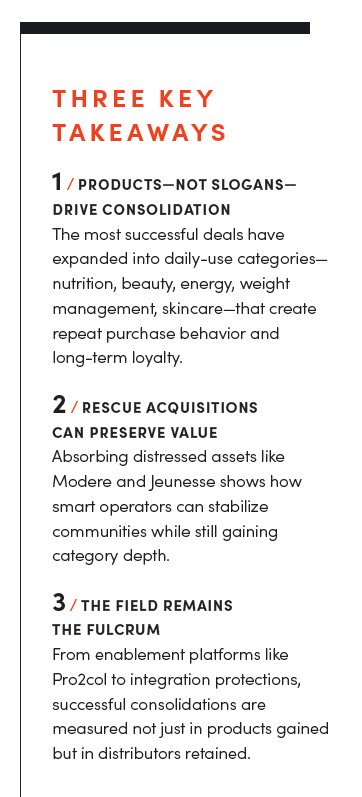
  1. Portfolios are being built around daily-use products, not slogans.
    The material deals above consistently add items customers use every day—nutrition, collagen, energy, weight management, gut health, core skincare/cosmetics. That’s what lifts reorder rates and household lifetime value.
  2. Hybrid portfolios are deliberate plays.
    The USANA–Hiya deal is the clearest example. This was not a consolidationbut a portfolio and channel expansion. By taking a controlling stake while allowing Hiya to remain a standalone DTC business, USANA gained exposure to children’s health and subscription-based retention while preserving the independence and momentum of both brands. It also positioned Hiya to accelerate international growth with USANA’s infrastructure. This hybrid approach is likely to be repeated as companies seek both diversification and stability.
  3. Rescue missions have a place.
    Deals like Greenway’s absorption of Jeunesse assets and Shaklee’s acquisition of Modere’s collagen line show that not all consolidation is proactive. Some moves are designed to preserve value, protect customers and give distributors a viable home. When handled well, rescue acquisitions can stabilize communities while still adding product depth to the acquiring company.
  4. Integration and infrastructure remain decisive.
    Financial terms grab headlines, but continuity wins loyalty. Protecting hero products, ensuring tech fit and keeping the field whole are hallmarks of success. Cross-border compliance, data systems and modern enrollment/ecommerce platforms are now baseline requirements, which is why moves like Herbalife’s Pro2col investment reflect enablement as much as product logic.

The Road Ahead

While some consolidation activity occurred in 2022 and 2023, this article has focused specifically on the last 24 months—when deal-making reached a new level of intensity and strategic clarity.

And the consolidation wave is unlikely to subside anytime soon. Smaller brands will continue to seek shelter under larger umbrellas, while well-capitalized players will look for acquisitions that expand their product breadth, geographic reach, scientific credibility and digital capabilities.

But it’s important to recognize that many of these moves are primarily at their core about field acquisition. Access to experienced distributors and their customer networks remains one of the fastest ways to secure growth. The winners will be those who treat consolidation not only as a financial or product play, but as a strategic move that respects and retains the field.

Not every deal will succeed—cultural mismatches and integration missteps remain real risks. But the throughline is clear: the companies that align product depth with field continuity and distributor trust will come out on top.

Direct selling has always been about community and trust. Consolidation—done well—can strengthen both. The opportunity is to build companies that compete at scale and stay true to the values that make this channel unique.

If leaders approach it with clarity, care and courage, consolidation won’t mark the end of an era, but usher in the beginning of an even stronger one.


Why Products Lead the Way

Consolidation in direct selling isn’t just about scale—it’s about building the right mix of products that keep customers engaged every day.

  1. Everyday use matters
    Nutrition, energy, beauty and weight management products fit naturally into customers’ routines, creating repeat purchase behavior.
    Ask yourself: Will this deal add products customers use daily—or ones they’ll buy once and forget?
  2. Proof drives adoption
    Products with measurable outcomes—better energy, visible beauty results, weight loss—fuel referrals and retention.
    Ask yourself: Can we defend and communicate the results of our combined product line?
  3. Portfolio synergy
    Products that complement each other across categories strengthen relevance, increase customer stickiness and build broader daily-use portfolios.
    Ask yourself: Does this lineup simplify and strengthen our message?
  4. Customer favorites
    From skincare to supplements, customers expect continuity of their hero products. Lose those, and loyalty slips away.
    Ask yourself: Are we protecting the products people love most?
  5. Brand architecture
    Some companies can operate independently, while others thrive under full integration. The key is clarity.
    Ask yourself: Will these brands live side by side or integrate fully—and can the field explain it in one sentence?
  6. Field continuity
    Protecting distributor stability is non-negotiable. Comp changes or unclear migration paths can unravel even the best deal.
    Ask yourself: Have we secured commitments from top leaders and built protections that keep the field whole for the next 6–12 months?
  7. Global readiness
    Products designed for broad appeal and compliance can move more seamlessly across markets, making them natural anchors for consolidation.
    Ask yourself: Are these products ready for international expansion, or will compliance and positioning slow us down?

Focus, Not Consolidation

Not every strategic move in the past two years has been about getting bigger. In fact, some of the most telling developments have been about companies deliberately narrowing their scope. Under mounting economic and operational pressures, leaders are choosing to focus on the markets and portfolios where they hold the greatest strength—rather than stretching resources across geographies or categories that no longer fit.

  • Natura &Co consolidated Avon’s Latin American markets into its own Natura operations, while divesting Avon businesses in Europe, Africa, Asia and Central America. This move underscored Latin America as the company’s anchor region and reflected its strategy of concentrating resources where brand equity and distributor strength are greatest.
  • ACN has taken this approach even further. Over the past several years, the company has fully divested its international operations and now operates exclusively in the US and Canada. By the end of 2024, ACN had exited every other market worldwide. Today, 32 years after its founding, ACN remains profitable and growing, with the founders still at the helm and focused on building a stronger business in its two core geographies.

In a year dominated by consolidation headlines, these examples remind us that sometimes the boldest decision isn’t to acquire, but to double down on core strengths. Focus, like scale, can be a path to resilience—and in some cases, it may be the more sustainable one.


STUART JOHNSON has served the direct selling industry for nearly 40 years. His passion for the channel encompasses a broader commitment to build and connect the direct selling community through exclusive industry events such as Direct Selling University and the DSN Global Celebration. Stuart is arguably the most connected person in direct selling, building and growing a network of executives, thought leaders, strategists and innovators. His advice and counsel are sought after by leaders throughout the channel.

An Online Exclusive from Direct Selling News magazine.

Filed Under: Feature Articles Tagged With: ACN, Amare Global, Beauty Bank, Greenway Global, Herbalife, Hiya Health, Jeunesse, L’Occitane, LifeVantage, Limelife by Alcone, MODERE, Natura, Neora, Prüvit, Scout & Cellar, Shaklee, Stemtech, Stuart Johnson, Tupperware, USANA, Velovita, VIÁGO, Vida Divina, zinzino

Zinzino Acquires Truvy

September 26, 2025 by DSN Staff Writer

Zinzino announced it has officially completed the acquisition of Truvy. With the acquisition of rights to Truvy’s distributor database and associated customer registry, inventory and IP rights, as well as 100% of shares in Truvy’s South Korean subsidiary, Zinzino has increased its distribution capacity in North America, Latin America and South Korea.

Truvy’s brand portfolio primarily focuses on health and weight loss and has a total annual turnover of approximately $12 million. With this collaboration, Zinzino expects growth and profitability through transactions that can utilize Zinzino’s existing technical platform and organization.

“Individual advice and tailor-made solutions are the future, and not just in health and wellness,” said Dag Bergheim Pettersen, CEO of Zinzino, and David Brown, CEO and co-founder of Truvy. “We are delighted to have taken the next step and are now well-equipped to drive the modern, personalized shopping experience forward through direct sales.”

Zinzino stated it will pay a purchase price of $4 million, 100% of which will be settled through newly issued Zinzino shares, with additional purchase prices based on future sales development to a maximum of $16 million.

This acquisition is part of a broader expansion strategy for Zinzino and follows other recent acquisitions, including VMA Life in 2020, Enhanzz in 2022, Xelliss and ACN in 2024, and the asset acquisitions of Zurvita, Valentus, Ecosystem, and Bode Pro in 2025.

Filed Under: International Tagged With: Dag Bergheim Pettersen, Truvy, zinzino

eXp Realty Expands to South Korea

September 25, 2025 by DSN Staff Writer

eXp Realty announced its official launch into South Korea. This expansion is expected to be a market disruptor, as South Korea’s traditional brokerages are still based in rigid hierarchies and fixed office workflows.

“Most brokerages in Korea are running on an old model, built for the boss, not the agent,” said Felix Bravo, eXp Realty Managing Director, International.  “And they’re doing exactly what they were designed to do: control agents, limit upside, and protect the hierarchy. You’ve got people putting up real numbers, doing international business from their phones, and they’re still stuck under office quotas and legacy rules. That’s not a system you fix. It’s one you replace. We’re not here to compete with that model, we’re here to end it. And to give agents a platform that finally sees them as the business.”

A live event in Seoul welcomed agents and shared the eXp global vision and commitment to building agent-led growth through revenue share, equity opportunities, competitive commissions, mentorship and remote culture. Thomas Kim, who has a proven track record as a top producer within Korea’s traditional brokerage system, will lead eXp Korea.

“I know what it’s like to build a career inside a traditional brokerage and how limiting that can be,” Kim said. “eXp gives Korean agents what I never had: a real chance to grow through sales, team building, stock ownership, and even global referrals. But more importantly, it’s growth that benefits them, not just the brokerage. This is a platform where the agent finally comes first.”

This expansion builds upon four previous eXp Realty international launches this year, including Peru, Turkey, Ecuador and Japan.

Filed Under: International Tagged With: EXP REALTY, Felix Bravo, South Korea, Thomas Kim

Shaklee’s Acquisition of Modere Assets Leads to New Zealand Expansion

September 25, 2025 by DSN Staff Writer

Shaklee announced it will open operations within New Zealand as a result of its acquisition of Modere assets in the market. The recent acquisition includes Modere’s rights to all trademarks, patents, and proprietary formulas for all Modere products, including an exclusive license to sell Liquid BioCell in New Zealand and globally.

“We are excited to integrate Modere New Zealand’s products into the Shaklee portfolio–and to open the door to future operations in the region,” said Roger Barnett, Shaklee Chairman and CEO. “Our goal is to ensure customers continue to enjoy the same high-quality formulas they know and trust, while continuing to invest in the Community Marketing model, at home and abroad. Together, we’ll continue our mission to help people live healthier, more vibrant lives.”

The newly formed Shaklee New Zealand will support the market and make both Shaklee and Modere products available in the region.

Filed Under: International Tagged With: MODERE, New Zealand, Roger Barnett, Shaklee

Neora Celebrates 14 Years

September 25, 2025 by DSN Staff Writer

Neora announced its 14th year of continued momentum and record year-over-year sales growth. In August, a traditionally slower sales season, Neora reported nearly 40% sales growth year-over-year. Additionally, in the same month, 450 Brand Partners achieved rank advancements.

The company has been fueling its momentum with its Future Leader Bonus plan, which was designed to guide Brand Partners down a clear path to success and features up to $59,000 in additional bonuses within the first year.

“It’s incredible to look back on the past 14 years and see how far we’ve come,” said Amber Olson Rourke, Neora Co-Founder and CEO. “This journey has only been possible because of our amazing Brand Partners and HQ team. Right now, with the growth we’re experiencing, it truly feels like a time for celebration—and for charting the next 14 years to achieve even greater things together.”

Filed Under: Daily News Tagged With: Amber Olson Rourke, Neora

The Real Brokerage Surpasses 30,000 Agents

September 24, 2025 by DSN Staff Writer

The Real Brokerage, Inc. announced it has surpassed 30,000 agents. This is a significant growth rate from its roster of 20,000 agents in 2024.

“This milestone is a testament to the trust agents continue to place in Real,” said Tamir Poleg, Real Chairman and CEO. “Our commitment from day one has been to build a company that puts agents first—empowering them with technology, transparency and flexibility. Reaching 30,000 agents is a proud moment, but we view it as another step toward building a transformative platform for the next generation of real estate professionals and the clients they serve.”

The company pointed to its proprietary software platform, reZEN, as a contributing factor to its ability to scale rapidly and efficiently, and stated that its investments in AI and workflow automation are “shaping a future where agents can focus on growing their businesses rather than filling out paperwork.”

Real’s proprietary financial platform, Real Wallet, also gives agents quicker access to their earnings and real-time insights into their Real finances through business checking accounts and a Real-branded debit card.

“We’ve built a platform designed not just for today’s agent, but for where the industry is headed,” Poleg said. “The agent of tomorrow demands innovation, support and community. Real delivers all three—and we believe surpassing 30,000 agents is only the foundation for what’s to come.”

Filed Under: Daily News Tagged With: Agents, REAL Brokerage, Tamir Poleg

Made to Order

September 24, 2025 by David Lee

The rise of AI-driven product customization.

Listen to this story starting at 10:20 on the new, revamped The DSN Podcast. Even when your day is packed, we make it easy to stay informed, engaged and one step ahead. Listen now or read below!

Personalized products are no longer a luxury—they’re an expectation. Customers demand experiences tailored to their unique preferences, and businesses across industries are leveraging AI-driven personalization, data analytics and customer-built platforms to meet this demand. From nutrition to finance, product customization has become the norm, reshaping how brands engage with consumers.

Hyper-Personalized and Seamless
Today’s consumers crave relevance. A 2025 Adobe report reveals 76 percent of customers are more likely to purchase from brands offering tailored experiences. Shoppers expect brands to anticipate their needs, deliver seamless interactions across channels and respect their privacy. For instance, Gartner says 71 percent of customers still prefer human interaction for complex issues, even with AI powering most contacts. This blend of automation and authenticity defines modern expectations.

Customers also want control. Whether it’s designing a sneaker or configuring a car, they seek platforms that empower them to co-create products. A McKinsey study shows 62 percent of consumers are more loyal to brands offering customization tools, as these foster a sense of ownership. However, over-personalization can feel invasive, as more than a third of customers distrust brands with their data, according to Adobe.

Anticipating Needs with AI
Machine learning algorithms analyze vast datasets—purchase history, browsing patterns, even weather—to deliver hyper-personalized recommendations in real-time. Spotify’s “Discover Weekly” playlist uses collaborative filtering to curate music with uncanny precision, while Starbucks predicts drink preferences based on time and location, boosting efficiency and sales. In ecommerce, AI-powered recommendation engines increase conversion rates by 10 to 15 percent (Forrester), with 92 percent of businesses reporting growth from such tools in 2025 (Adobe).

Predictive personalization takes this further. By anticipating needs before they’re expressed, brands like Misfits Market auto-add predicted items to carts, streamlining the shopping experience. Dynamic content, such as tailored website layouts or personalized emails, yields six times higher transaction rates, according to Gartner. Meanwhile, dynamic pricing in retail and hospitality adjusts offers based on demand, ensuring relevance while optimizing revenue. These AI-driven tools meet customer expectations for intuitive, proactive service.

Powering Precision
Data is the fuel for personalization. Unified data ecosystems, which 43 percent of executives aim to fully implement in 2025 according to Adobe, break down silos to create consistent experiences across channels. AI segments customers by behavior and demographics, enabling precise targeting. For example, retailers use “promotion propensity” models to offer tailored discounts, improving retention for 62 percent of businesses. In physical stores, brands like Ruti leverage facial recognition to pull customer profiles instantly, recommending products based on past preferences. Privacy remains a hurdle, as brands juggle personalization with trust. Customers expect transparency—opt-in policies and clear data usage terms are non-negotiable.

Customer-Built Products
Customization platforms are normalizing tailored products. Nike’s By You lets customers design sneakers, while automotive brands offer online car configurators. In 2025, augmented reality and virtual reality enhance these experiences, allowing users to “try” clothes or visualize furniture in their homes, reducing returns. Print-on-demand services, powered by AI tools like GPT-4o, enable instant creation of niche merchandise, from event-specific apparel to fan-driven designs.

This trend spans industries. In healthcare, AI crafts patient-specific treatment plans; in finance, personalized investment advice reflects spending habits. Nutrition companies are working with customers to build test-based, customized plans with the help of AI health evaluations. Immersive technologies like AR and voice-based Zero UI make co-creation intuitive, meeting demands for engaging, user-driven experiences.

From the September/October 2025 issue of Direct Selling News magazine.

Filed Under: Forward Thinking Tagged With: personalization

  • « Previous Page
  • 1
  • …
  • 48
  • 49
  • 50
  • 51
  • 52
  • …
  • 637
  • Next Page »
brand-logo
The News You Need.
The Name You Trust.
Subscribe

Breaking global news, emerging trends and powerful stories conveniently curated to help direct selling executives stay informed, engaged and a step ahead.

  • Read
  • Listen & Watch
  • Attend
  • Achieve
  • Research
  • About
  • Connect
5717 Legacy Drive
Suite 250
Plano, Texas 75024
info@directsellingnews.com
Copyright 2026 Direct Selling News | All Rights Reserved
  • Privacy Policy
  • Terms of Use
  • Advertise
  • Subscribe
We use cookies on our website to give you the most relevant experience by remembering your preferences and repeat visits. By clicking “Accept All”, you consent to the use of ALL the cookies. However, you may visit "Cookie Settings" to provide a controlled consent.
Cookie SettingsAccept All
Manage consent

Privacy Overview

This website uses cookies to improve your experience while you navigate through the website. Out of these, the cookies that are categorized as necessary are stored on your browser as they are essential for the working of basic functionalities of the website. We also use third-party cookies that help us analyze and understand how you use this website. These cookies will be stored in your browser only with your consent. You also have the option to opt-out of these cookies. But opting out of some of these cookies may affect your browsing experience.
Necessary
Always Enabled
Necessary cookies are absolutely essential for the website to function properly. These cookies ensure basic functionalities and security features of the website, anonymously.
CookieDurationDescription
cookielawinfo-checkbox-analytics11 monthsThis cookie is set by GDPR Cookie Consent plugin. The cookie is used to store the user consent for the cookies in the category "Analytics".
cookielawinfo-checkbox-functional11 monthsThe cookie is set by GDPR cookie consent to record the user consent for the cookies in the category "Functional".
cookielawinfo-checkbox-necessary11 monthsThis cookie is set by GDPR Cookie Consent plugin. The cookies is used to store the user consent for the cookies in the category "Necessary".
cookielawinfo-checkbox-others11 monthsThis cookie is set by GDPR Cookie Consent plugin. The cookie is used to store the user consent for the cookies in the category "Other.
cookielawinfo-checkbox-performance11 monthsThis cookie is set by GDPR Cookie Consent plugin. The cookie is used to store the user consent for the cookies in the category "Performance".
viewed_cookie_policy11 monthsThe cookie is set by the GDPR Cookie Consent plugin and is used to store whether or not user has consented to the use of cookies. It does not store any personal data.
Functional
Functional cookies help to perform certain functionalities like sharing the content of the website on social media platforms, collect feedbacks, and other third-party features.
Performance
Performance cookies are used to understand and analyze the key performance indexes of the website which helps in delivering a better user experience for the visitors.
Analytics
Analytical cookies are used to understand how visitors interact with the website. These cookies help provide information on metrics the number of visitors, bounce rate, traffic source, etc.
Advertisement
Advertisement cookies are used to provide visitors with relevant ads and marketing campaigns. These cookies track visitors across websites and collect information to provide customized ads.
Others
Other uncategorized cookies are those that are being analyzed and have not been classified into a category as yet.
SAVE & ACCEPT