Monday / October 5. 2026
menu-logo menu-logo
brand-logo
Subscribe
Subscribe
Monday / October 5. 2026
  • Read
    • Daily News
      • Financial
      • Insights
      • U.S.
      • International
    • Digital Issue
    • Executive Announcements
    • Cover Stories
    • Feature Articles
      • Exclusive Interviews
    • International Focus
    • Company Spotlights
    • Forward Thinking
    • Legal Briefs
    • Insights from the Outside
    • For You | For Your Field
    • Working Smart
  • Listen & Watch
    • Direct Approach Podcast
    • What’s Working in Direct Selling
    • BUILT TO LAST
      • Zinzino
      • PM-International
      • LifeWave
    • The DSN Podcast
  • ATTEND
  • Achieve
    • Global 100 List
    • Bravo Awards
    • Best Places to Work
    • Legends
  • Research
    • Stock Watch
    • DSN Supplier Sponsors
    • The DSN Guide
    • Supplier Directory
    • Stock Ticker
    • Resources
  • Engage
    • About DSN
    • Supporter Program
    • Subscribe
    • Advertise
    • VIP Text Alerts
    • Connect
  • Search
Subscribe

OPTAVIA Now Available for HSA and FSA Reimbursement

February 20, 2026 by DSN Staff Writer

OPTAVIA’s comprehensive metabolic health system is now available for reimbursement on select insurance plans using Health Savings Accounts (HSA) and Flexible Spending Accounts (FSA). OPTAVIA clients may now be able to save up to 40% on program costs by working with their medical provider or insurance administrator to use pre-tax medical funds. Medifast, the parent company of OPTAVIA, described the achievement as a milestone that reinforces the company’s position as a science-driven health and wellness leader.

“This is a major moment for our company, and more importantly, for the millions of people across the US seeking solutions for improving their health,” said Nicholas Johnson, Medifast President. “With OPTAVIA’s metabolic health system available on select insurance plans using HSA and FSA funds, we’re encouraging more people to access the innovative tools and science-backed solutions they need to help promote metabolic health.”

OPTAVIA states that its Metabolic Synchronization science “resets the body’s metabolism through healthy, quality weight loss, targeting visceral fat reduction, preserving lean mass and protecting healthy muscle.” The company plans to launch a new system this year that will feature products with clinically studied ingredients to further support metabolic health and help people find solutions that adapt to every stage of their health journey.

“With Metabolic Synchronization, we’re empowering individuals to take control of their metabolic health,” said Dr. Satya Jonnalagadda, Medifast Vice President of Scientific & Clinical Affairs. “Our science-backed solutions achieve more than just weight loss — they improve body composition by reducing visceral fat, preserving lean mass and protecting healthy muscle, which are critical to restoring metabolic balance.”
Filed Under: Daily News Tagged With: Nicholas Johnson, OPTAVIA

Service Companies Quick Poll Results

February 19, 2026 by DSN Staff Writer

What the 2025 survey results reveal about momentum and why services are accelerating.

​Momentum matters—and in services, momentum compounds.

Last fall, I examined the structural rise of services within direct selling and outlined why recurring value, ownership alignment and scalable platforms were reshaping the channel. The 2025 Services Companies Quick Poll results now show that those structural forces have intensified.

The scale is larger. The equity participation is deeper. The demographic reach is broader. The technological investment is more advanced.

Services are no longer emerging within the channel. They are expanding at scale—anchored firmly in the US market, which represents approximately 95 percent of service revenue in the broader North American region. In fact, only one company in the data set, Exit Realty, is based in Canada.

If last fall’s reports and research identified the shift, this year’s data confirms that the shift has matured into sustained acceleration.

Services by the Numbers

This year’s Quick Poll surveyed 29 US-based service companies and one Canadian company with at least $100 million in annual revenue—double the $50 million ARR threshold used in the product companies report.

Company reports combined with independent research place the US services segment at approximately $35 billion in annual revenue. The directional results are clear:

  • 90% demonstrated year-over-year growth based on company reporting and independent research
  • 50% achieved defined momentum growth
  • 10% reported declines

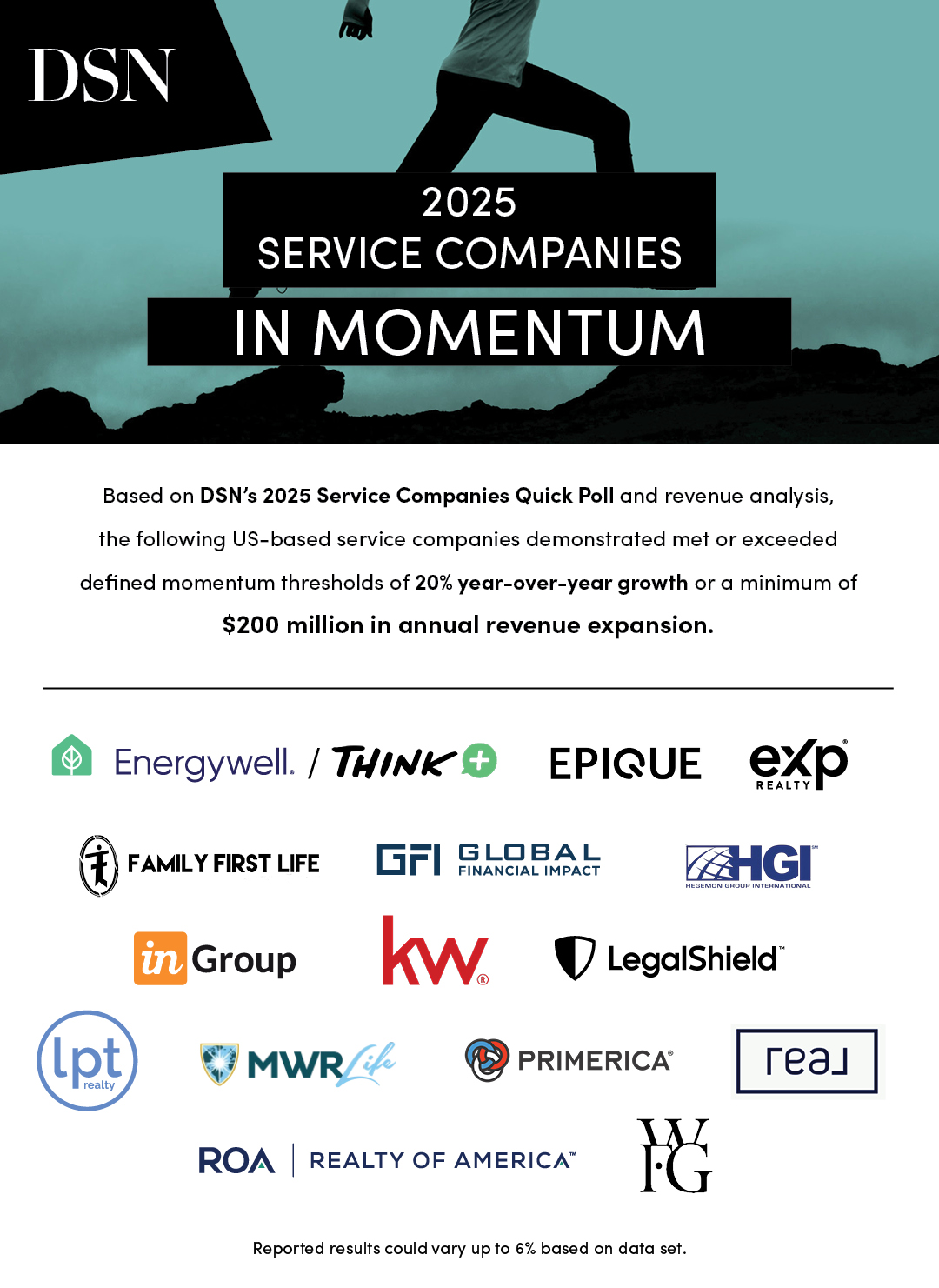
For purposes of this analysis, momentum growth is defined as year-over-year expansion of 20 percent or a minimum of $200 million in annual revenue growth.

The 50 percent cohort—companies growing 20 percent or more or adding substantial revenue—is the group highlighted throughout this report and represents a historically strong concentration of measurable momentum.

In a service-driven model built on recurring value and long-term relationships, having nine out of ten companies growing—and half delivering measurable momentum—is a powerful signal of structural strength.

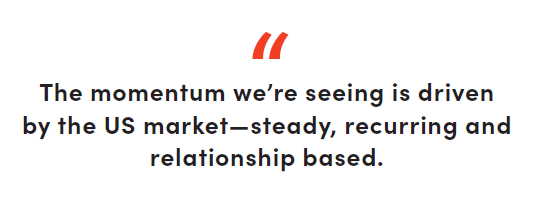
Within this data set, performance was directional—companies either grew or declined. Importantly, this growth is overwhelmingly domestic. With very few exceptions, non-US revenue was not material to overall performance. The momentum we’re seeing is driven by the United States market—steady, recurring and relationship based.

Where Service Momentum is Concentrated

The companies demonstrating the strongest momentum span real estate, financial services, legal protection, energy and lifestyle platforms—categories where recurring value and ongoing relationships are fundamental.

On the real estate side, companies such as eXp Realty (NASDAQ: EXPI), Keller Williams, REAL Brokerage (NASDAQ: REAX), LPT Realty, Epique Realty and Realty of America/ROA continue to show velocity driven by agent-centric platforms, profit share, revenue share, equity participation and scalable technology.

These businesses benefit not only from transaction volume, but from community effects—agents recruiting agents, sharing expertise and building durable networks.

Critical to long-term network cohesion and alignment within many of these platforms is the issuance of restricted stock units (RSUs) and other equity-linked incentives to agents—structures that deepen loyalty and reinforce shared enterprise growth.

Financial services organizations are also prominent among the momentum leaders. Companies including Primerica (NYSE: PRI), World Financial Group (NYSE: AEG), Family First Life, Global Financial Impact and Hegemon Group have benefited from renewed consumer focus on protection, planning and long-term financial confidence.

Other service categories are contributing meaningfully as well. LegalShield continues to demonstrate the strength of subscription-based legal and identity protection services. Energywell/Think+ highlights how everyday utility services can be successfully distributed through relationship-driven models. inGroupand MWR Life show how lifestyle and travel services can generate engagement through membership and community rather than one-time transactions.

Another company in the lifestyle category with notable success is FASTer Way to Fat Loss. Entering its tenth year, FASTer Way’s enhanced affiliate model empowers health coaches, trainers and everyday advocates with digital tools while blurring the line between influencer marketing and direct selling.

Outside the US, Utility Warehouse (LSE: TEP) in the United Kingdom has achieved extraordinary results by consolidating essential household services—energy, broadband and mobile—into a single, simplified monthly bill.

And while not currently in material momentum, no discussion of the energy market would be complete without recognizing the long-term and significant contributions of Ambit at its 20th anniversary and ACN at more than 30 years in operation.

Momentum Among the Established

Conventional wisdom suggests that momentum is typically driven by younger companies. In many categories, that is often true. But services tell a different story. While a handful of younger platforms appear on this year’s momentum list, the majority of companies demonstrating substantial growth are well established—and in several cases, decades old.

Among the real estate platforms in momentum, only three—LPT Realty, Epique Realty and Realty of America (ROA)—have been operating for fewer than six years. The remainder have far longer histories, including Keller Williams, which has been in business for more than four decades.

The pattern is even more pronounced in financial services. With the exception of Global Financial Impact, the momentum companies in this category are all more than 10 years old—some significantly so. Primerica, for example, has been operating for nearly 50 years.

Even among established platforms, scale continues to expand meaningfully. MWR Life surpassed $100 million last year, and inGroup grew almost $100 million in the travel space to reach $350 million—demonstrating that mature service platforms are not plateauing; they are accelerating.

Scale at Speed: The Rise of Emerging Companies

While the majority of momentum companies are well established, the scale achieved by newer entrants is equally notable.

In real estate, LPT Realty is approaching $700 million in annual sales. Realty of America (ROA) crossed the $100 million threshold in its first calendar year, and Epique Realty is also in momentum. These are not incremental startups—they are scaled platforms achieving rapid velocity.

The same pattern appears in financial services. Global Financial Impact has experienced rapid revenue growth in its first two years.

And on the broader list, Energywell/Think+ approached $150 million in its third year.

The longevity of the established leaders is impressive. But the speed at which these emerging platforms have reached scale is equally significant. Services momentum today is being driven by both maturity and velocity.

Scale Requires Context: What Revenue Really Represents

To fully understand services momentum, revenue must be contextualized.

Real estate companies report only the commission revenue they receive—not the full property transaction value. The underlying transaction volume moving through these platforms is approximately 30 times greater than reported revenue, representing well over half a trillion dollars in annual US transaction value.

Insurance and financial services companies report only the premiums and commissions they collect—not the face value of policies or the total coverage provided. In the case of financial investment products, the revenue from financial investment products represents the fees only and not the actual investments.

As a result, the true economic impact of these organizations is significantly understated by reported revenue figures. Services revenue is significant, but its underlying economic footprint is exponentially larger.

Equity Participation Drives Structural Growth

One of the most important accelerants of service momentum is equity participation—and it is more embedded across platforms than ever before.

As outlined in our previous reporting, ownership alignment changes behavior. When agents and advisors participate in equity, revenue share and enterprise value, the relationship shifts from transactional to generational. Independent contractors become stakeholders.

In real estate, stock incentives, revenue sharing and ownership participation are redefining recruiting and retention dynamics. In financial services, aggregation strategies and equity-aligned distribution models are strengthening enterprise durability and long-term alignment.

This is not merely a compensation detail. It is a structural mechanism that shapes culture. Shared rewards foster shared success. Field priorities shift from next month’s commission to long-term enterprise value—driving cooperation, retention and a more stable foundation for growth.

Equity participation creates wealth pathways beyond commissions, reinforces loyalty and deepens commitment to platform growth. It is increasingly clear that ownership alignment is not merely correlated with momentum—it is materially driving it.

In fact, less than 10 percent of real estate professionals operate within modern cloud-based, revenue-sharing/equity-aligned brokerage models—a structure that has existed for little more than 15 years—yet these platforms represent the fastest-growing segment of the industry.

Demographic Reach Is Expanding the Growth Base

Another defining driver of service acceleration is demographic reach. Service platforms are demonstrating strong penetration across African American, Asian American, Hispanic/Latino and many other growing demographic communities across the United States.

Demographic expansion is not limited to ethnicity. A significant and growing portion of service platform growth is being driven by professionals under the age of 35. In financial services in particular, the under-35 segment now represents a dominant and expanding share of new recruiting and field growth. In real estate, the trend is present but less pronounced—emerging steadily rather than leading the category outright.

At a recent Family First Life event, more than 7,000 attendees gathered with an average age under 30—an indicator of how dramatically the age profile differs from traditional product-based direct selling models. Equally notable was the broad ethnic diversity represented in the audience, reflecting the expanding demographic reach of modern service platforms across African American, Hispanic/Latino, Asian American and many other communities.

At a time when younger independent workers have more entrepreneurial options than ever—across digital products, ecommerce, trading platforms and gig models such as Uber—many are gravitating toward the professional status, long-term value proposition and community structure of services-focused social commerce.

We are witnessing a broader trend toward the professionalization of social commerce—centered increasingly around higher-ticket service offerings that require education, licensing and long-term client relationships.

These models provide accessible entry points, flexible entrepreneurial pathways and recurring income potential—combined increasingly with ownership participation. That alignment resonates strongly in communities seeking economic mobility and long-term wealth creation.

The result is measurable recruiting velocity and retention strength across diverse markets. This demographic diversification broadens the base of services growth and strengthens long-term sustainability. Services are not simply expanding in scale—they are expanding in reach.

Technology Is Now Infrastructure

Technology is playing an increasingly central role in services momentum as well. The scale achieved by leading service companies has enabled substantial investment in proprietary internal platforms, onboarding systems, transaction management tools, compliance infrastructure and AI-enabled efficiencies.

Compliance oversight is integrated. Training modules are digitized. Recruiting systems are leveraged through integrated platforms. Productivity metrics operate in real time. These investments are not cosmetic enhancements—they are structural advantages.

Technology now functions as infrastructure. It enables scale, improves margins, accelerates onboarding and enhances customer experience. It widens the competitive gap between established service platforms and smaller competitors without comparable investment capacity.

Why Services Continue to Win

Services align naturally with how consumers live today. They solve ongoing needs rather than episodic ones. They allow representatives to focus on education, trust and long-term engagement—rather than constant product replacement.

Recurring services—energy, legal access, identity protection, utilities, travel memberships and financial planning—create predictable revenue streams and durable customer relationships. Recurring value creates recurring revenue. Recurring revenue creates stability. Stability enables reinvestment.

Real estate operates differently—but it is recurring at scale. While a home transaction is episodic for an individual consumer, mobility within the broader population creates consistent transaction velocity. Buyers become sellers. Sellers become buyers. Families relocate. Investors transact repeatedly.

At scale, real estate functions as a relationship-driven recurring business—even if the cadence differs from subscription-based models. Referrals from prior clients further compound transaction velocity, reinforcing real estate’s long-term relationship-driven economics.

Simply put, services create relationships. And relationships create momentum.

Looking Ahead

As we move through 2026, four primary forces will continue shaping services momentum:

  • Economic normalization after inflationary pressure
  • Increased competition, particularly from hybrid and platform-based models
  • Expanding equity participation across distribution networks
  • Artificial intelligence reshaping service delivery, personalization and customer engagement

AI will not replace relationships—but it will amplify them. The companies best positioned for the future are already using data to improve onboarding, training and customer experience at scale.

Increasingly, time-intensive administrative tasks—contracts, compliance oversight and documentation—are automated or system-managed as value-added support for agents and representatives, freeing them to focus on client relationships and revenue-generating activity.

US Services Revenue on Track to Double by 2030

Based on current structural drivers—equity participation, demographic expansion, technological investment and recurring value models—I believe US service revenue will double again by 2030. That projection implies a compounded annual growth rate of only 15 percent—ambitious, but well within reach given the momentum already visible in the segment.

New players entering emerging service categories—and innovation within both new and existing models—will be a material part of that expansion. At approximately $35 billion today, the segment’s trajectory suggests sustained, structural expansion—not cyclical fluctuation.

Your Key Takeaway

DSN’s 2025 Service Companies Quick Poll makes one point unmistakably clear. Services are not a secondary category within direct selling. They are a rapidly expanding, ownership-driven, technology-enabled growth engine firmly anchored in the US market.

When 90 percent of companies are growing—and 50 percent are achieving defined momentum—the signal is not subtle, it’s structural.


STUART JOHNSON, Founder & CEO, Direct Selling News, has served the direct selling industry for 40 years. His passion for the channel encompasses a broader commitment to build and connect the direct selling community through exclusive industry events such as Direct Selling University and the DSN Global Celebration. Stuart is arguably the most connected person in direct selling. He has built an impressive and growing network of executives, thought leaders, strategists and innovators. His advice and counsel are sought after by leaders throughout the channel.

An Online Exclusive from Direct Selling News magazine.

Filed Under: Feature Articles Tagged With: Energywell, Epique Realty, EXP REALTY, Family First Life, Global Financial Impact, Hegemon Group, inCruises, inGroup, Keller Williams Realty, LegalShield, LPT Realty, MWR Life, Primerica, REAL Brokerage, Realty of America (ROA), Service Companies, Stuart Johnson, Think+, WOrld Financial Group

Leading Through the Messy Middle

February 19, 2026 by Blake Mallen

Why reinvention—not recovery—will define the next era of direct selling.

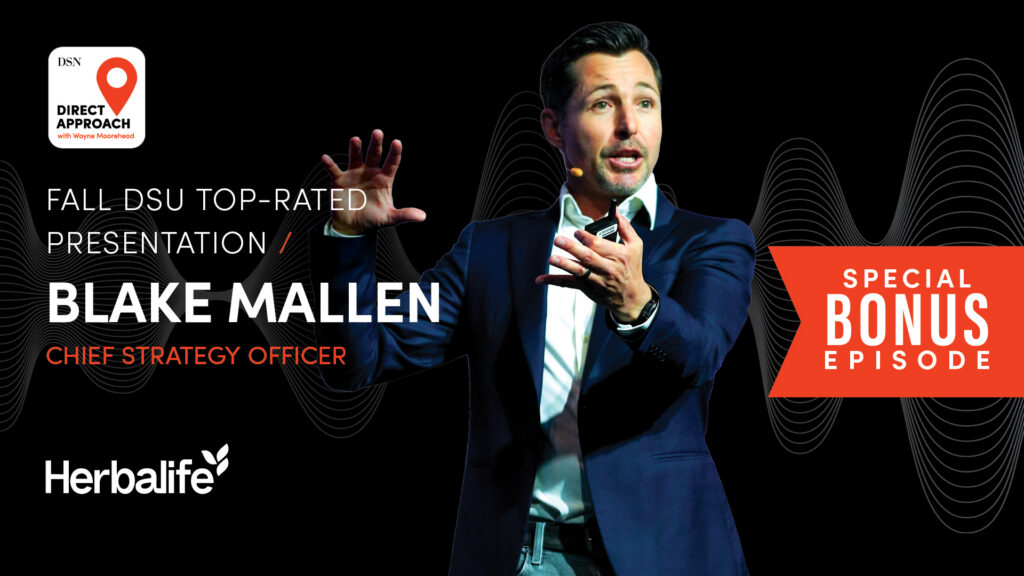
You can also listen to the Direct Selling University presentation that inspired this article! Listen now or read below!

In January of last year, my life changed in a way I never could have planned or prepared for.

Despite doing everything possible, my family became one of more than 7,000 who lost their homes in the Palisades wildfires in Los Angeles. In a matter of hours, the home that represented everything I had worked for—financially, emotionally, professionally—was gone. To make it worse, we had been dropped by our insurance company just months earlier. There was no recovery plan. No safety net.

I watched my home burn.

Six months later, I found myself standing on a very different stage—inside AT&T Stadium in Dallas—sharing a new vision with 15,000 people. The contrast between those two moments was surreal. And it forced a realization that has shaped everything I believe about leadership today.

We do not live in a perpetual “after.”

The Myth of the Forever Breakthrough

Our culture—especially in direct selling—loves before-and-after stories. We celebrate transformation, momentum and peak performance. Social media has conditioned us to believe that success means permanently arriving on the other side.

But that isn’t real. What I’ve learned—personally and professionally—is that there is no such thing as being “done.” There is no forever breakthrough. Life and business don’t work in straight lines. They move in cycles. Seasons overlap. Joy and grief coexist. You can be healing and building at the same time. You can be leading while losing. Most of us don’t live at the peak. We live in the messy middle. And that’s not a detour. It’s the way forward.

Understanding the Seasons of Business

After 26 years in this industry—as a distributor, founder, owner and now executive—I’ve learned that business follows predictable seasons:

  • The Beginning: Vision, hope, excitement
  • The Climb: Hustle, focus, grind
  • Momentum: Expansion, flow, magic
  • Plateau: Same actions, diminishing returns
  • The Dip: Doubt sets in
  • The Valley: Fear replaces confidence
  • Reinvention: Transformation, evolution, renewal

If you’ve been around long enough, you know this cycle doesn’t happen once. It repeats. Momentum never lasts forever. Plateaus are inevitable. Valleys are dangerous—not because they exist, but because staying in them can be fatal. Businesses don’t usually die in dramatic moments. They fade through slow irrelevance.

The leaders who survive are not the ones who avoid valleys. They’re the ones who know how to leave them.

Perspective Changes Everything

Seasons are normal. Wisdom in the season is optional. That distinction matters. Because without perspective, valleys feel like failure. With perspective, they become preparation.

Early in my career, I didn’t understand this. I had to live it. From starting as a distributor in 1999, to being “retired” in my early 20s, to getting a phone call that the company was shutting down—forcing my first reinvention. The only job I’d ever had before that was as a high school lifeguard.

I’ve lived multiple cycles since then. The 2008 recession nearly wiped us out. We lost 90 percent of the business we’d built. We reinvented, climbed again and hit new highs—only to face new valleys later. Each time, the lesson was the same: nothing lasts forever—not even success.

Where Leaders Lose Their Power

In one particularly dark season, a mentor pulled me aside and changed my perspective entirely. He said, “You’re focused on the wrong gap.” Like many leaders, I was fixated on the distance between where we once were and where we had fallen. That comparison creates shame. Guilt. A sense of personal failure.

Instead, he challenged me to look at a different gap: where we started versus where we are now.

That reframing shifts everything. Our power is not in what we achieve. Our power is in what we overcome—and who we become in the process. When leaders tie their identity to scorecards, rankings, revenue or momentum, burnout is inevitable. Because nothing goes up forever.

Resilience Is Not About Going Back

After losing my home, my first instinct was the same one many companies have in a downturn: I need to get back.

Get back to what we had. Get back to where we were. Get back to the peak.

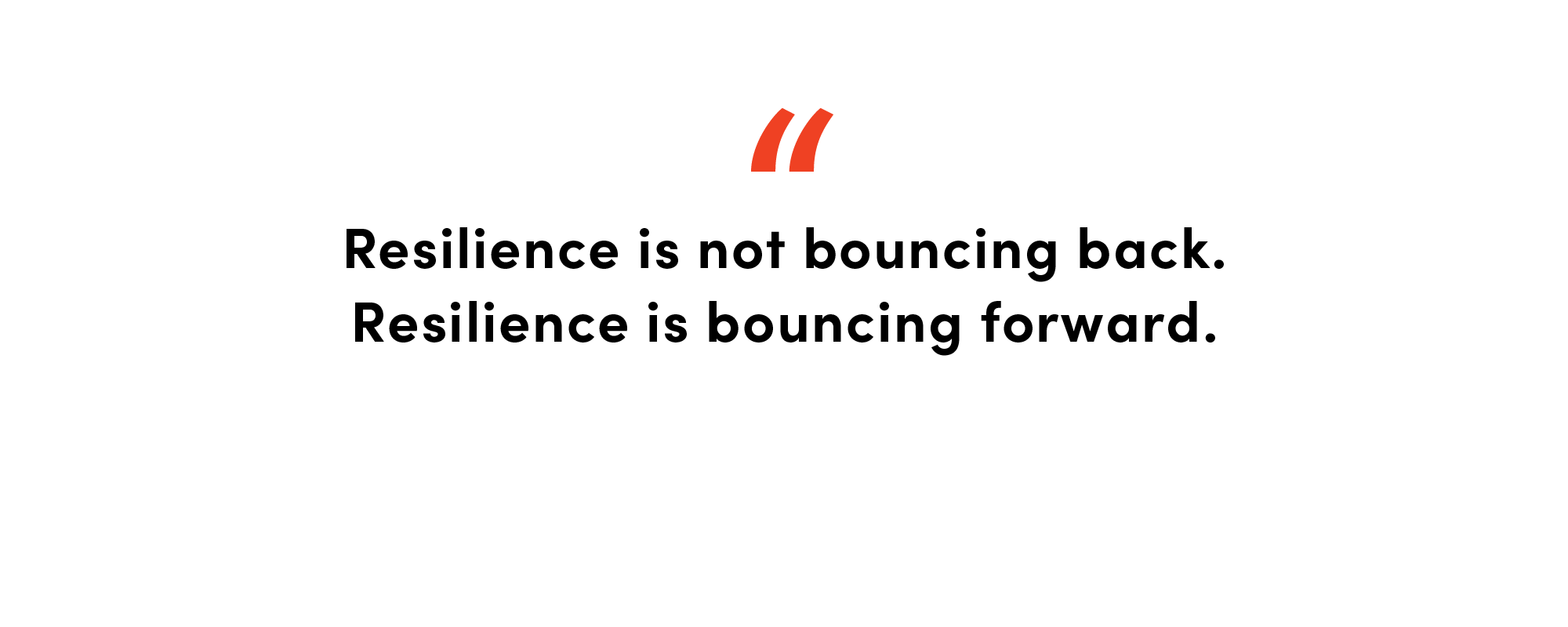
But here’s the truth I had to accept: there was no going back. That life was gone. And the same is true for our industry. Resilience is not bouncing back. Resilience is bouncing forward. It’s the ability to accept where you are; let go of what was; and intentionally design what comes next.

That process begins with three steps:

  1. Letting Go
    You cannot carry an old story into a new season.
  2. Ownership and Acceptance
    Acceptance doesn’t mean approval. It means honesty. You cannot extract wisdom from a season you refuse to acknowledge.
  3. Reframing
    When you ask, “What is this season preparing us for?,” pain becomes power.

The Shift the Future Requires

One of the fastest ways to diagnose whether a leadership team is stuck is to listen to its language.

  • “Remember when we…”
  • “If we could just get back to…”
  • “This is how we did it before.”

That is past-based thinking. The market has shifted. Consumer behavior has shifted. Technology has shifted. Culture has shifted. And the companies that win next will be the ones willing to design forward—not replicate backward.

As Wayne Gretzky said: Skate to where the puck is going, not where it’s been.

Reinvention Begins with Alignment

Transformation doesn’t start with tools. It starts with alignment. The “who” and “what” must be aligned:

  • Who: Board, investors, leadership, field, community
  • What: Mission, vision, values, strategy, execution

When the “who” is misaligned, you get friction. When the “what” is unclear, you get confusion. Most of the challenges facing our channel today trace back to this gap. Alignment is the starting line of reinvention.

Every company will make its own bets. But from my perspective, the future is clear in a few areas:

  • Data-driven and evidence-based decision making
  • High personalization at scale
  • High tech paired with high touch
  • Speed as a core capability—not an advantage
  • Reinvention as a function, not a phase

Technology should amplify relationships, not replace them. Trust and community remain the differentiators—but they must be supported by systems that can evolve as fast as the market does.

The Messy Middle Is Where Creation Happens

There is no going back. We are in a perpetual season of shift—as companies, as leaders, as an industry.

The messy middle is not where we get stuck.

It’s where we build.
It’s where we grow.
It’s where we become.

The next generation of direct selling companies, leaders and models will be created here—not in the comfort of momentum but in the courage of reinvention.

Check out this week’s bonus episode of the Direct Approach podcast to hear more from Blake Mallen on Leading Through Seasons of Reinvention

Available on your favorite platform! Apple, Spotify, Audible, YouTube

Blake Mallen, a billion-dollar brand builder and community marketing expert, has 25+ years of field, ownership and executive experience generating $3B+ in revenue, Blake brings a fresh and unique perspective from across direct selling industry, He is passionate about the power of potential and works with companies and communities to make the shifts needed to discover and develop theirs.

An Online Exclusive from Direct Selling News magazine.

Filed Under: Feature Articles Tagged With: Blake Mallen, leadership

Herbalife Reports Q4 and Full Year 2025 Financial Results

February 19, 2026 by DSN Staff Writer

Herbalife Ltd. announced its financial results for the fourth quarter and full year 2025. Net sales during the quarter were up 6.3% to $1.3 billion with an adjusted net income of $47.5 million and an adjusted EBITDA of $156.1 million. Diluted EPS during the quarter was $0.81.

Gross profit margin during the quarter was 77.5%, down slightly from 77.8% in the previous year’s quarter, and net cash provided by operating activities was $98.3 million. During the quarter, Herbalife’s North America region delivered its second consecutive quarter of double-digit new distributor growth, a 19% year-over-year increase. Its Latin America region achieved its seventh straight quarter of year-over-year growth, up 6%.

Full-year 2025 financial results included net sales of $5 billion, a 0.9% increase year-over-year. Adjusted net income reached $219.4 million with an adjusted EBITDA of $657.6 million. Diluted EPS for the year was $2.20.

In tandem with its financial reports, the company announced that Cristiano Ronaldo, global sports celebrity, has acquired a 10% equity interest in Pro2col Software, which Herbalife acquired in 2025. The company stated that Ronaldo’s $7.5 million investment underscores the sports icon’s “deep personal commitment to health and nutrition, as well as his shared vision to make personalized nutrition and wellness more accessible globally.”

“After more than a decade together, our relationship is built on trust and shared ambition. Investing in Pro2col felt like a natural evolution — in addition to representing Herbalife, this is about helping shape and grow a platform that can truly change how people engage with their health and wellness,” Ronaldo said. “I’ve seen firsthand how Herbalife brings together science, innovation and personal support to make health and wellness more accessible. Working together with Herbalife to create something with lasting impact is what motivates me at this stage of my career.”

Pro2col is part of Herbalife’s long-term strategy to create a more connected, data-driven health and wellness platform that integrates products with community, AI and digital capability to better serve customers. Pro2col is currently in a phased beta rollout with the goal of gathering in-market user insights to support a broader commercial release in the future.

“For more than 45 years, Herbalife’s distributor network has supported millions of customers on their health journeys,” said Stephan Gratziani, Herbalife CEO. “Today, we are building on that legacy—combining science, data, AI, innovation and community to bring the next generation of personalized nutrition and wellness to more people around the world. With Cristiano Ronaldo’s investment in Pro2col, our 2025 acquisitions, and continued investments in product and digital innovation, we are strengthening our platform and expanding our global impact.”

Filed Under: Financial Tagged With: Herbalife, Pro2col, quarterly, Stephan Gratziani

Natural Health Trends Announces Repurchase of all Outstanding Broady Shares

February 19, 2026 by DSN Staff Writer

Natural Health Trends Corp. has entered into an agreement to repurchase all of its shares of common stock beneficially owned by the George K. Broady family. Previously, the George K. Broady 2012 Irrevocable Trust and the Eleanor Jane Broady 2012 Irrevocable Trust collectively held almost 3 million shares of the company’s stock, or 25.5% of its outstanding shares.

With the repurchase of these shares for an aggregate purchase price of approximately $5.9 million, or $2 per share, the company stated it was able to “efficiently retire a large block of shares in a single, orderly transaction at an attractive price, addressing the perceived stock overhang and significantly reducing [its] shares outstanding.

The repurchase was effected pursuant to the company’s previously announced $70 million share repurchase program. Following this transaction, the company stated it expects to have approximately $16 million remaining available for future repurchases. As a result, it now expects annual dividend requirements will decline by approximately $1.2 million.

“The shares being repurchased were not part of the public float, and given their size relative to our trading volume, an open market sale likely would have required a prolonged period of time and could have been disruptive,” said Chris Sharng, Natural Health Trends Corp. President. “This transaction provides certainty and preserves liquidity while enhancing value for all remaining stockholders. We remain committed to financial discipline focusing on growing our free cash flow, maintaining a healthy balance sheet and returning cash to shareholders through our dividend program. We value the long-standing relationship with Mr. Broady and his family and appreciate their support of the company over many years. I am grateful to Mr. Broady for his friendship, advice and support and deeply appreciate his unwavering faith in our company, our products and our members. We wish them the best in their future endeavors.”

Filed Under: Financial Tagged With: Chris Sharng, Natural Health Trends

USANA Reports Fiscal Q4 and Full Year 2025 Financial Results

February 18, 2026 by DSN Staff Writer

USANA Health Sciences, Inc. announced its financial results for its fiscal fourth quarter and fiscal year, ending January 3, 2026. Net sales in fiscal 2025 reached $925 million, an 8% improvement year over year. Net earnings during the year were $10.8 million with a diluted EPS of $0.58 and an adjusted EBITDA of $101.3 million.

“USANA delivered fourth quarter net sales in line with our preliminary results announced on January 12, 2026,” said Kevin Guest, USANA Chairman and Chief Executive Officer. “We began to see signs of stabilization in active customer counts in our core nutritional business as net sales in this segment increased modestly sequentially, led by growth in key markets including mainland China, the United States and Canada. Meanwhile, our omnichannel brands, Hiya and Rise, posted solid year-over-year growth.”

The increase in net sales was primarily driven by a full-year contribution from its Hiya segment, as the company’s core nutritional business declined by 8%. The company continues to execute a diversification strategy towards an omnichannel model designed to support growth beyond its core nutritional business and to restructure and modernize for an evolving marketplace.

Fourth quarter 2025 core nutritional business showed strength in Southeast Asia Pacific, with net sales showing a 17% sequential growth. Americas and Europe were also stable, with 4% sequential improvement in net sales. Fourth quarter Hiya direct to consumer sales resulted in $30 million in net sales and more than 181,000 active monthly subscribers.

“Rise Wellness generated strong momentum with sales tripling, albeit off a small base in 2024, as distribution expanded into key retail outlets,” Guest said. “The business is on pace for a robust year of sales growth supported by the launch of Protein Pop at a large club retailer in the first quarter. Net sales outside of our core nutritional business represented 16% of consolidated net sales in 2025, up from approximately 1% in 2024. We expect this share to increase to more than 20% of consolidated net sales in fiscal 2026.”

The company ended the year with $158 million in cash and cash equivalents with $14 million of debt. Fiscal year 2026 outlook now includes consolidated net sales between $925 million to $1 billion with an adjusted EBITDA of $101.3 million to $109.3 million.

Filed Under: Financial Tagged With: Kevin Guest, quarterly, USANA

Anovité Achieves NSF GMP Certification

February 18, 2026 by DSN Staff Writer

Anovité has received NSF/ANSI 455-2 – 2024 Good Manufacturing Practices (GMP) certification for its exclusive manufacturing and operations facility, Immune Tree, Inc., in Bluffdale, Utah. This certification is confirmation that the company’s systems meet rigorous and audited third-party standards for documentation, traceability, regulatory compliance and quality controls around encapsulation, mixing, packaging, labeling and warehousing operations.

“As someone who has built teams inside this industry for years, I’ve learned that long-term growth isn’t driven by hype,” said Jessica Ellerman, Anovité Director of Sales and Marketing. “It’s driven by operational control. Leaders don’t just evaluate products — they evaluate platforms and longevity. They want to know: Is this company built to last?”

The company stated that the strategic importance of this infrastructure is a reflection of Anovité’s deliberate investment in operational standards and excellence and its commitment to a vertically integrated model that allows for a structurally controlled environment. This scaling empowers the company to manage its own scalability, consistency and sustained expansion, and provides a level of process integrity that the company stated is foundational to scientific credibility.

“Growth without solid infrastructure is fragile,” Ellerman said. “This certification reflects the intentional decisions we are making to build a company leaders can align with long-term.”

Filed Under: Daily News Tagged With: Anovité, Certification, Jessica Ellerman

Medifast Reports Q4 and Full Year 2025 Financial Results

February 18, 2026 by DSN Staff Writer

Medifast announced its financial results for the fourth quarter and full year 2025. Revenue during the fourth quarter reached $75.1 million while full-year 2025 revenue totaled $385.8 million. Coach productivity turned positive year-over-year for the first time since 2022, which the company stated has historically been a lead indicator of broader improvement. There was also a significant increase in coach-led meetings, which reflects a more energized coach base.

“As we enter 2026, Medifast is moving from defining its business transformation strategy to executing on a new path to growth, leading to profitability as we become wholly focused on optimal metabolic health,” said Dan Chard, Medifast Chairman and Chief Executive Officer. “Our foundational work of the past two years has established a direction for future growth, and with these plans in place, we are reinstating annual guidance as we execute against the path we are on to become a metabolic health company.”

Fourth quarter revenue experienced a 36.9% decline, which was primarily driven by a decrease in the number of active earning coaches. The total number of active earning coaches decreased 40.6% year-over-year, driven by continued pressure with client acquisition and rapid adoption of GLP-1 medications for weight loss. Gross profit during the quarter fell 40.9% to $52.1 million. Net loss during the quarter was $18.1 million, or $1.65 loss per diluted share.

Full-year 2025 revenue fell 36% with a net loss of $18.7 million, or $1.70 loss per diluted share. The company ended the year with cash, cash equivalents and investment securities of $167.3 million with no interest-bearing debt. The company now expects first quarter 2026 revenue in the range of $65 million to $80 million.

Filed Under: Financial Tagged With: Dan Chard, Medifast

Amway Sponsors Global Wellness Summit

February 17, 2026 by DSN Staff Writer

Amway served as the exclusive sponsor of the Global Wellness Summit (GWS) Future of Wellness report for the second consecutive year. The GWS organization, which Amway also sponsors, gathers leaders and visionaries to “positively shape the future” of the global wellness economy.

Each year, the report offers a detailed forecast of trends that will impact the health and wellness category in the coming year. This year, the report’s findings identified a strong preference for wellness tools that support real life ideals, with an emphasis on a human, inclusive and resilient vision of wellbeing. This is in contrast to one-size-fits-all solutions or narrow health-related performance metrics of previous product generations.

“Each year, the Future of Wellness report delivers essential insights into the forces reshaping the global wellness landscape,” said Melodie Nakhle, Amway Chief Marketing Officer. “As the exclusive sponsor, we remain committed to advancing credible, science-driven innovation that helps people lead better, more vibrant lives. This research strengthens our ability to deliver meaningful solutions for communities around the world.”

Amway stated that three of the report’s trend themes were particularly relevant to its own product portfolio and brand, including:

  • The Year of Women – industries are abandoning the one-size-fits-all biology and behavior template to reflect women’s distinct health needs, life stages and economic power
  • Longevity Expands in New Directions – aging populations are moving longevity-centered treatments from clinics into daily habits in the home, reshaping how long and how well people live
  • An Over-Optimization Pushback – consumers are pushing back against hyper-tracked, high-pressure wellness models in favor of products that deliver human experiences honoring the emotional, sensory, social and imperfect nature of humanity

Amway sees the GWS insights as “keenly valuable” and plans to leverage science to respond to consumer interests with products and personalized solutions.

Filed Under: Daily News Tagged With: Amway, Melodie Nakhle, report, wellness

Zinzino Expands into Peru

February 16, 2026 by DSN Staff Writer

Zinzino AB, as part of its strategic plan to strengthen its presence in Latin America, announced the launch of operations in Peru. The company has already built a foundation in the region, generating approximately $167,000 in monthly sales through its global web shop. The expansion builds upon the company’s established success in Latin America, creating what it calls “strong cross-border synergies for both partners and customers.”

Zinzino selected Peru because of its favorable environment for direct selling operations, as well as a growing entrepreneurial culture and growing need for flexible income opportunities.

“Peru is a natural next step in our Latin American growth,” says Dag Bergheim Pettersen, Zinzino CEO. “We see strong potential for our Peruvian Partners to build long-term success with our test-based concept.”

Filed Under: International Tagged With: Dag Bergheim Pettersen, Peru, zinzino

MONAT Event Hosts 800 Market Partners in Munich

February 16, 2026 by DSN Staff Writer

MONAT hosted its first major event since launching in Germany last year. The MONAT Unleashed event welcomed more than 800 Market Partners to Munich, Germany for a day of recognition, education and celebration. MONAT described the gathering as a powerful statement of growth, innovation and renewed connection that was fueled by the brand’s accelerating momentum throughout the region.

The event highlighted the official European launch of MONAT’s TikTok Shop, which the company expects will usher in a new era of social commerce and reach, as well as the announcement of expansion into Switzerland, planned for later this year.

“MONAT Unleashed Germany was more than a celebration—it was a triumphant moment,” said Ray Urdaneta, MONAT Co-Founder and CEO. “The passion, professionalism and belief in Munich reflected the strength of our European community and the momentum and exciting future we are building together.”

Filed Under: International Tagged With: Germany, Monat, Ray Urdaneta

Pampered Chef Celebrates International Women’s Day

February 16, 2026 by DSN Staff Writer

Pampered Chef launched Women Who Stir Up Change, a campaign celebrating women who use food to inspire confidence, build community and lead with purpose. The company is partnering with Kat Ashmore, bestselling author and social media personality, to deliver a co-created recipe utilizing Pampered Chef tools to make cooking faster and easier for home cooks.

Ashmore, a chef, shares her daily culinary adventures with her online community and views cooking as an act of self-love and connection. The Women Who Stir Up Change campaign will spotlight this ideal, helping women transform their kitchens into spaces of creativity and empowerment as they make meaningful contributions to their homes and communities.

“At Pampered Chef, we’re inspired by women who are making a difference in their homes and in their communities, transforming their passion into opportunity,” said Nevena Srebreva, Pampered Chef CEO. “Our Women Who Stir Up Change campaign celebrates their impact, not just on International Women’s Day but every single day.”

Filed Under: Daily News Tagged With: Navena Srebreva, Pampered Chef

  • « Previous Page
  • 1
  • …
  • 28
  • 29
  • 30
  • 31
  • 32
  • …
  • 636
  • Next Page »
brand-logo
The News You Need.
The Name You Trust.
Subscribe

Breaking global news, emerging trends and powerful stories conveniently curated to help direct selling executives stay informed, engaged and a step ahead.

  • Read
  • Listen & Watch
  • Attend
  • Achieve
  • Research
  • About
  • Connect
5717 Legacy Drive
Suite 250
Plano, Texas 75024
info@directsellingnews.com
Copyright 2026 Direct Selling News | All Rights Reserved
  • Privacy Policy
  • Terms of Use
  • Advertise
  • Subscribe
We use cookies on our website to give you the most relevant experience by remembering your preferences and repeat visits. By clicking “Accept All”, you consent to the use of ALL the cookies. However, you may visit "Cookie Settings" to provide a controlled consent.
Cookie SettingsAccept All
Manage consent

Privacy Overview

This website uses cookies to improve your experience while you navigate through the website. Out of these, the cookies that are categorized as necessary are stored on your browser as they are essential for the working of basic functionalities of the website. We also use third-party cookies that help us analyze and understand how you use this website. These cookies will be stored in your browser only with your consent. You also have the option to opt-out of these cookies. But opting out of some of these cookies may affect your browsing experience.
Necessary
Always Enabled
Necessary cookies are absolutely essential for the website to function properly. These cookies ensure basic functionalities and security features of the website, anonymously.
CookieDurationDescription
cookielawinfo-checkbox-analytics11 monthsThis cookie is set by GDPR Cookie Consent plugin. The cookie is used to store the user consent for the cookies in the category "Analytics".
cookielawinfo-checkbox-functional11 monthsThe cookie is set by GDPR cookie consent to record the user consent for the cookies in the category "Functional".
cookielawinfo-checkbox-necessary11 monthsThis cookie is set by GDPR Cookie Consent plugin. The cookies is used to store the user consent for the cookies in the category "Necessary".
cookielawinfo-checkbox-others11 monthsThis cookie is set by GDPR Cookie Consent plugin. The cookie is used to store the user consent for the cookies in the category "Other.
cookielawinfo-checkbox-performance11 monthsThis cookie is set by GDPR Cookie Consent plugin. The cookie is used to store the user consent for the cookies in the category "Performance".
viewed_cookie_policy11 monthsThe cookie is set by the GDPR Cookie Consent plugin and is used to store whether or not user has consented to the use of cookies. It does not store any personal data.
Functional
Functional cookies help to perform certain functionalities like sharing the content of the website on social media platforms, collect feedbacks, and other third-party features.
Performance
Performance cookies are used to understand and analyze the key performance indexes of the website which helps in delivering a better user experience for the visitors.
Analytics
Analytical cookies are used to understand how visitors interact with the website. These cookies help provide information on metrics the number of visitors, bounce rate, traffic source, etc.
Advertisement
Advertisement cookies are used to provide visitors with relevant ads and marketing campaigns. These cookies track visitors across websites and collect information to provide customized ads.
Others
Other uncategorized cookies are those that are being analyzed and have not been classified into a category as yet.
SAVE & ACCEPT