Monday / October 5. 2026
menu-logo menu-logo
brand-logo
Subscribe
Subscribe
Monday / October 5. 2026
  • Read
    • Daily News
      • Financial
      • Insights
      • U.S.
      • International
    • Digital Issue
    • Executive Announcements
    • Cover Stories
    • Feature Articles
      • Exclusive Interviews
    • International Focus
    • Company Spotlights
    • Forward Thinking
    • Legal Briefs
    • Insights from the Outside
    • For You | For Your Field
    • Working Smart
  • Listen & Watch
    • Direct Approach Podcast
    • What’s Working in Direct Selling
    • BUILT TO LAST
      • Zinzino
      • PM-International
      • LifeWave
    • The DSN Podcast
  • ATTEND
  • Achieve
    • Global 100 List
    • Bravo Awards
    • Best Places to Work
    • Legends
  • Research
    • Stock Watch
    • DSN Supplier Sponsors
    • The DSN Guide
    • Supplier Directory
    • Stock Ticker
    • Resources
  • Engage
    • About DSN
    • Supporter Program
    • Subscribe
    • Advertise
    • VIP Text Alerts
    • Connect
  • Search
Subscribe

The Real Brokerage Announces Q4 and Full-Year 2025 Financial Results

March 4, 2026 by DSN Staff Writer

The Real Brokerage, Inc. reported its financial results for the fourth quarter and full-year 2025. Revenue during the fourth quarter increased 44% year-over-year to $505.1 million with a gross profit of $39 million. Adjusted EBITDA during the quarter was $14.2 million, compared to $9.1 million in the same quarter of 2024. Cash provided by operating activities during this period was $149,000.

Full-year 2025 revenue was $2 billion, a 56% increase from 2024. Gross profit grew 44% to $165.7 million with an adjusted EBITDA of $62.9 million. The company repurchased 9 million common shares during 2025 for $39.4 million.

”Throughout 2025, we scaled our platform with discipline, with growth in revenue and gross profit outpacing growth in operating expenses,” said Jenna Rozenblat, Real Chief Operating Officer. “As we enter 2026, we remain focused on investing in technology and expanding adoption of our ancillary services to enhance agent productivity and deepen engagement across our network.”

The total number of agents in the company’s North American brokerage increased to 31,739 in Q4 2025, an increase of 31% from Q4 2024. Transactions closed in this market during the fourth quarter totaled 48,903, an increase of 38% year-over-year.

Revenue for Real Wallet, the company’s fintech platform designed to centralize agent access to company-branded financial products, totaled $339,000 in the fourth quarter. Full-year Reall Wallet revenue was $889,000, up from $42,000 in 2024.

“Real delivered strong fourth quarter results, with revenue increasing 44% year-over-year and closed transactions growing 38%,” said Tamir Poleg, Real Chairman and Chief Executive Officer. “We ended 2025 with revenue up 56% for the full year and 31,739 agents on our platform, reflecting continued organic share gains despite a tepid housing environment. Our differentiated agent value proposition and expanding ecosystem of products and services continue to attract productive agents seeking greater flexibility, technology and financial opportunity.”

Filed Under: Financial Tagged With: Jenna Rozenblat, REAL Brokerage, Tamir Poleg

Mary Kay Manufacturing Facility Achieves ISO 22716 Certification

March 4, 2026 by DSN Staff Writer

Mary Kay Inc. announced its manufacturing facility has received the ISO 22716 certification, an internationally recognized standard for cosmetic Good Manufacturing Practices (GMP). This certification is based on comprehensive global guidelines that align with EU standards for production, storage and shipment of cosmetics to ensure safety and quality throughout the manufacturing process.

This ISO certification required rigorous documentation, traceability of every batch, structured training, supplier quality management and clearly defined processes.

 “At Mary Kay, quality is not a checkbox – it is a promise, an operational framework and a culture,” said Chaun Harper, Mary Kay Chief Supply Chain Officer. “ISO 22716 certification matters as it is a global standard recognizing what we have always strived for: manufacture products with care, consistency and accountability from raw materials to finished goods. It reflects our culture of empowering people to do things the right way every day and reinforces our long-term commitment to safe, reliable and responsibly made beauty products.”

Mary Kay’s global manufacturing infrastructure includes its Richard R. Rogers Manufacturing and R&D Center (R3), located in Lewisville, Texas. The 453,000-square-foot building was a $100 million investment for the company and can produce up to one million units of product each day.

Filed Under: Daily News Tagged With: Certification, Chaun Harper, Mary Kay

Mastering Marketing in an Evolving Channel

March 4, 2026 by Lisa Robertson

Trends, takeaways and top tips from our recent deep dive event.

At DSN’s Marketing Mastery Deep Dive—held February 25 in Lehi, Utah—we addressed the marketing realities facing direct selling companies today. Hosted by DSN Founder & CEO Stuart Johnson and emceed by CMO and Speaker Kathleen Ross, this event brought together candid executive perspectives, practical education and real-word case studies from leaders successfully navigating the same complex marketing landscape you face every day.

Interactive and tactical by design, the event featured live Q&As and open discussions—creating a true workshop environment where attendees engaged with speakers, asked questions and connected with peers in a relaxed, informative setting where attendees heard directly from executives about their wins, their missteps and the lessons learned along the way.

Here’s a recap of the speakers’ presentations:

Marketing in 2026 isn’t about choosing between digital acceleration and human connection—it’s about mastering both. Kathleen Ross, CMO of Kathleen Ross Creative, outlined the five major shifts shaping the landscape.

First, the “AI slop rebellion.” While adoption is high, low-effort AI content is eroding trust. The advantage no longer comes from using AI but from using it well, with discernment, originality and strong brand voice.

Second, generative engine optimization (GEO) is reshaping search. Instead of chasing clicks, brands must become credible, citable sources.

Third, the creator economy is moving from flat-fee influence to performance-based accountability—an area where direct selling already has structural strength.

Fourth, social commerce is accelerating. The feed is the storefront, and live shopping is scaling rapidly, presenting both opportunity and competitive pressure.

Finally, amid digital saturation, an “IRL renaissance” is underway. Community, immersive events and authentic connection are resurging as strategic differentiators—areas where direct selling holds a natural advantage.

Kathleen’s Building Block: Build discernment into your strategy.
Elevate AI with human originality. Become a credible source in search. Align creators with performance. And design community experiences that digital competitors can’t replicate.


In a year filled with hundreds of emails, posts and campaigns, 4Life CMO Brian Gill posed a question: is volume really the advantage—or is influence?

Brian argued that marketing extends far beyond content calendars. Influence begins with adaptability—adjusting communication styles to meet people where they are. When leaders create space for others to feel heard, respected and empowered, engagement deepens. That moment of brand-to-brand connection is marketing at its most human.

Influence also lives outside the marketing department. Gill shared how a single customer service email from another company reshaped his perception of the brand. Clear, empathetic language turned a negative product experience into loyalty.

Finally, data can reveal not just what to say, but who needs to hear it. When his company discovered that top leaders—not new distributors—questioned compensation perception, 4Life built a simple “rank card” tool consolidating earnings, perks and requirements in one transparent snapshot. The result was clarity, alignment and stronger recruitment conversations.

Brian’s Building Block: Build influence beyond your department.
Adapt your communication to individuals, elevate friction points across the organization and use data to create simple, transparent tools that strengthen trust. Volume communicates. Influence transforms.


Neora Co-Founder and Co-CEO Amber Olson Rourke shared how her company achieved 47 percent organic growth by committing to one clear, dominant message—and refusing to move off it.

Her team made a decisive shift: instead of promoting a broad portfolio, they chose a single tip-of-the-spear product to lead every conversation. The criteria were simple but disciplined—it had to deliver a compelling transformation, clearly differentiate from competitors and naturally open the door to complementary products.

From there, everything aligned around that story. Marketing assets were reorganized. Field leaders gave full buy-in. Promotions, messaging and onboarding all reinforced the same narrative. Even operational pressures to shift focus were weighed against the cost of diluting the message. The result wasn’t just stronger performance for the featured product—it lifted the entire portfolio by bringing more customers in through a clear, repeatable front door.

Good marketing, Amber noted, is saying the same thing a million times—not saying a million different things.

Amber’s Building Block: Build around your best “yes.”
Choose one transformational product, align every asset and leader behind it and repeat the message relentlessly. Clarity creates confidence. Confidence scales.


Marketing isn’t the hard part—alignment is. Andrew Armstrong, Senior Director of North American Field Development at Partner.co, shared he approaches the conversation from a field-first lens, arguing that confusion—not creativity—kills momentum.

With more channels, more tools and more campaigns than ever, the field is often asked to juggle competing messages. The result is dilution. As he put it: if the field can’t repeat it, it’s not a campaign—it’s noise.

Andrew urged companies to shift from “more marketing” to partnership marketing. Instead of layering initiative upon initiative, brands should rally around one dominant message that the field helps shape and then confidently repeat.

He illustrated this through Partner.Co’s “Invite to Ignite” global Zoom series—one clear message, one simple invite and a unified follow-up path across more than 50 markets. Corporate provided the framework and guardrails; the field supplied the energy. The repetition created clarity, community and momentum that carried beyond a single event.

Andrew’s Building Block: Build one dominant message the field wants to share.
Align corporate structure with field energy, simplify the invite and repeat it consistently. When thousands say the same thing with confidence, momentum multiplies—and noise disappears.


As artificial intelligence becomes table stakes, the real differentiator is no longer access to AI—it’s how it’s used. ACN CMO Jeff Hildebrandt challenged leaders to resist the race to deploy the most tools and instead design marketing organizations that amplify humanity.

Consumer data already shows fatigue with obvious AI-generated communication and a growing preference for real human interaction. In a channel built on trust, that signal matters.

Direct selling’s point of difference, Jeff theorized, is human-centered marketing—where trust, relationship and lived experience replace traditional advertising. AI excels at research, drafting, personalization at scale and performance insights. It struggles with emotional nuance, brand instinct and trust-based judgment. Confusing those roles erodes credibility.

Jeff outlined a layered approach: AI-powered enablement for analytics and operations; human creators to protect brand voice and storytelling; and leadership to safeguard meaning, boundaries and trust. The goal is not replacing people—but scaling what makes them powerful.

Jeff’s Building Block: Build for humanity first.
Design your marketing organization around trust and human connection, then deploy AI where it accelerates insight, efficiency and scale—without replacing judgment.


VP of Marketing Brian Cameron shared how rapid early success at New U Life masked fractures between product, messaging, field storytelling and internal teams. The company began with a clear hormone-health focus, but as new products and markets were added, that story splintered.

The field told one narrative. Corporate told another. Retention suffered—not because the products lacked power, but because the brand lacked cohesion. The decision to rebrand wasn’t cosmetic. It was corrective.

Brian emphasized that a rebrand is not a logo swap—it is a reset of purpose, voice and consistency across every touchpoint. The company recommitted to a singular identity: the hormone health company. From visual design to website language, from international messaging to internal departments, every element was aligned around one clear story.

That clarity eliminated confusion, strengthened global consistency and helped drive roughly 30 percent organic growth. Just as importantly, it unified product strategy, sales alignment and internal culture.

Brian’s Building Block: Build alignment before acceleration.
Clarify who you are, simplify your core story and ensure every department—product, sales, customer service and marketing—reinforces it consistently.


Marketplace Global’s Chief Sales Officer Justin Call challenged leaders to stop blaming execution and start examining whether their campaigns can live in real life. Corporate often builds polished strategies that look strong in boardrooms but stall in the field. The issue isn’t budget or creativity. It’s whether the message moves naturally from conversation to conversation.

He introduced the “Core Four” lens: simple, social, mainstream and cool.

Simple means it can be explained in 30 seconds without slides or training. Social means it can be shared anywhere—at a soccer game or backyard barbecue—without sounding awkward or scripted. Mainstream ensures messaging avoids insider language and appeals beyond a narrow niche. Cool adds the final filter: confidence, relevance and attraction that people want to associate with.

Justin argued that direct selling doesn’t have a relevance problem—it has a translation problem. The companies that grow aren’t the ones with the biggest budgets, but the ones whose message spreads organically because it fits naturally into everyday life.

Justin’s Building Block: Build campaigns that translate.
Before launching anything, run it through the Core Four filter. If it isn’t simple to explain; natural to share; broad enough to attract; and cool enough to join—refine it until it is. Growth follows messages that move.


According to Young Living CMO/Wyld Notes CEO Gaya Samarasingha, marketing is no longer a support function in direct selling—it’s the operating system.

For decades, the field controlled the customer journey through in-person conversations, personalized recommendations and follow-up. The pandemic compressed that model into digital channels almost overnight. Kitchen-table conversations became landing pages. Follow-ups became automated emails. And customer journeys moved into platforms the field cannot see or control.

That shift moved responsibility upstream. Corporate marketing teams now control the funnel—awareness, education, conversion and retention. If that system is weak, even top leaders struggle. If it is strong and data-driven, even average brand partners can duplicate success.

Gaya emphasized behavior-based messaging, automation and personalized digital journeys as essential capabilities. She pointed to Young Living’s Wyld Notes affiliate experiment and the Balance & Burn launch as proof: structured marketing systems drove significant gains in new customers and reactivations.

Gaya’s Building Block: Build the system that builds the field.
Stop treating marketing as support. Own the funnel—design personalized, behavior-driven journeys that handle awareness, conversion and retention at scale. When corporate marketing becomes the operating system, the field can focus on belief, relationships and sharing—while the system drives measurable growth.


Consultant and Built to Last podcast host Rob Sperry challenged the industry’s reflex to fix stalled growth with another launch or incentive. While new products can spark short-term spikes, they often create “hype fatigue” and reset the duplication cycle. Leaders spend months mastering one story—only to be handed another.

Drawing from field surveys of top earners, Rob noted the most common frustration wasn’t compensation or tools—it was the absence of a clear three- to five-year vision. Constant pivots signal uncertainty. Quick promos become band-aids. And over time, even legacy leaders disengage.

He pointed to companies that sustain growth not by reinventing themselves annually, but by refining and recommitting to a core product and message. Enhancements, reformulations and better positioning strengthen the existing story instead of replacing it. Recognition, collaboration and genuine field input also rebuild trust where it has eroded.

The lesson? Short-term wins cannot substitute for long-term clarity.

Rob’s Building Block: Build a three- to five-year vision and protect it.
Refine and enhance your core story instead of constantly replacing it. Reduce hype fatigue, collaborate with leaders and commit to sustainable direction over quick fixes.


The core message of Herbalife’s SVP of Strategy and Innovation Wayne Moorehead’s presentation was that the future of direct selling lies at the intersection of direct selling and direct-to-consumer.

Consumers no longer think in channels—they expect convenience, speed and seamless buying experiences. At the same time, distributors are building personal brands, representing multiple companies and bringing brands into their worlds. Competition now includes DTC startups, influencer brands and retail players leveraging community-driven commerce.

Wayne urged leaders to think in terms of “and,” not “or.” The relational power of direct selling must be strengthened with modern performance marketing.

That begins with a frictionless ecommerce foundation. Public storefronts should be product-focused and conversion-driven—not overloaded with opportunity language. Paid acquisition is now essential. Organic reach is shrinking, and creative velocity drives revenue velocity. Each platform serves a role: Facebook builds trust; YouTube validates decisions; and TikTok Shop collapses the funnel into real-time commerce.

Wayne’s Building Block: Build the intersection.
Don’t choose between direct selling and direct-to-consumer—integrate them. Invest first in a modern, frictionless ecommerce foundation, then layer in disciplined paid acquisition and creative velocity. The brands that combine community-driven selling with performance marketing execution will win the social commerce era.


What Leaders Need to Understand Now

Across every presentation—whether focused on brand, field alignment, AI, social commerce or long-term growth—a clear pattern emerged. The tactics varied, but the leadership implications were remarkably consistent:

  • Clarity outperforms complexity. Simple, repeatable messages scale faster than clever campaigns.
  • Alignment is a growth lever. Brand, field, product and corporate must reinforce the same story.
  • Translation matters more than volume. If the message doesn’t move naturally from conversation to conversation, it stalls.
  • Short-term hype erodes long-term trust. Sustainable direction beats constant reinvention.
  • Technology amplifies—but does not replace—human connection. AI, social commerce and performance marketing must strengthen trust, not dilute it.
  • Community remains a competitive advantage. While other industries attempt to manufacture belonging, direct selling is built on it.

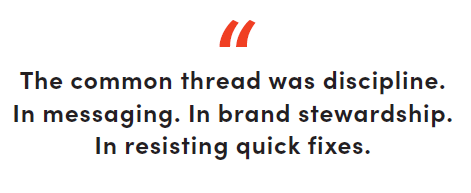
The common thread could best be distilled down to discipline. In messaging. In brand stewardship. In resisting quick fixes.

Filed Under: Feature Articles Tagged With: 4Life, Aber Olson Rourke, ACN, Andrew Armstrong, Brian Cameron, Brian Gill, event, Gaya Samarasingha, Herbalife, Jeff Hildebrandt, Justin Call, Kathleen Ross, MarketPlace Global, Neora, New U Life, Partner.Co, Rob Sperry, Wayne Moorehead, Wyld Notes, Young Living

Sunrider Honored at 2026 Universal Beauty Awards

March 3, 2026 by DSN Staff Writer

Sunrider International was honored at the 2026 Universal Beauty Awards, which recognizes innovation and exemplary performance from brands across the global beauty industry. Winning products are chosen from an analysis of all types of beauty brands, including hair care, fragrance, makeup, skincare and beauty devices.

Sunrider’s products selected for their obvious dedication to high-performance, ingredient-conscious beauty include the following:

  • Gold – Best Hydrating Face Mask (Sheet): Kandesn Pure Bio Cellulose Mask
  • Silver – Best Luxury Antioxidant / Protective Serum: Dr. Chen UrbanShield Nourishing Serum
  • Bronze – Best Hydrating Eye Product: Oi-Lin Eye Cream
  • Highly Commended – Best Lip Balm: Kandesn Lip Dew Balm

“We’re extremely proud that four of our products have been recognized at the 2026 Universal Beauty Awards,” said Sunny Beutler, Sunrider International CEO. “This recognition honors the hard work and dedication of our team and underscores our commitment to creating clean, plant-based high-performance formulations that help people look and feel their best.”

Filed Under: Daily News Tagged With: Award, Sunny Beutler, Sunrider

Bravenly Global Hosts Record-Setting Conference

March 3, 2026 by DSN Staff Writer

Bravenly Global welcomed more than 2,000 Brand Partners to its Charleston BNC26 event, marking the largest national conference in company history. The event highlighted the company’s significant milestones, including the more than 100,000 new Brand Partners and customers who joined in the last year; the recent $3.6 million single-day sales record; the more than 1.6 million product shipped to-date and the company’s inclusion in the Inc. 5000 list.

The event hosted defining moments, including the product launch of two new digestive wellness products, red carpet recognition for high-achieving Brand Partners and educational keynotes and leadership panels from more than 30 of the company’s top field leaders who shared their strategies regarding social selling, product awareness and customer retention behaviors.

“We are all just getting started,” said Aspen Emry, Bravenly CEO and Co-Founder. “What’s ahead is bigger than anything we’ve seen so far — and you are building it the right way: with integrity, with courage, with heart. Keep serving and leading. You are here for a purpose – on purpose.”

The second day of the event featured an optional worship service, which the company said reflects its foundation of faith, family values and serving others, followed by an opportunity to give back through the Bravenly Foundation to help provide for children, veterans and families in need.

Filed Under: Daily News Tagged With: Aspen Emery, Bravenly, event

7K Metals Transitions to Direct Retail and Affiliate Model

March 2, 2026 by DSN Staff Writer

7K Metals announced a strategic transition from multi-level marketing to a direct retail and affiliate-driven model. The company stated that this switch reflects the “broader evolution of the global marketplace toward direct-to-consumer engagement and the rising influencer economy.”

“Our mission has always been to get gold and silver into the hands of those who need it most,” said Blake Davis, 7K Metals Chief Executive Officer. “By simplifying our model, we are making participation easier and more aligned with where the global marketplace is heading. We are removing the complications of legacy compensation structures and replacing them with a framework that is more accessible, more sustainable and ultimately better for the vast majority of people involved.”

Established in 2016, 7K Metals united coin collectors, turning a tight-knit community into a global metals platform that served tens of thousands of customers around the globe. As it transitions into this new structure, the company said it will continue to focus on accessibility, simplicity and expanding precious metals education and ownership to a broader public audience.

“We are optimistic about the future,” Davis said. “This transition allows us to reach more people around the world who are looking for a simpler, more direct path to learning about and owning gold and silver. We are excited to double down on building a global community of people who support each other in accumulating tangible assets.”

The company is also continuing its expansion into fintech-oriented platforms and modern retail infrastructure, including the public launch of its fully integrated digital gold and silver marketplace through its platform SoundMoney. This addition moves beyond a limited community of precious metals collectors into broad customer availability and follows several years of real-world testing and platform refinement.

Through this marketplace, individuals will be able to buy and sell fractional gold and silver, or smaller portions of physical gold or silver, which is expected to lower barriers for entry while still maintaining ownership of tangible precious metals.

“Often compared to the role digital exchanges played in bringing new asset classes into the mainstream, the platform enables users to acquire fractional amounts of gold and silver with the click of a button, monitor holdings in real time through the SoundMoney Wallet and execute sell transactions within the same secure ecosystem,” the company wrote in a statement. “The platform provides transparent buy and sell-back pricing directly within the wallet interface for real-time visibility. All metals purchased through the platform are physically acquired on behalf of the customer and securely stored in insured, independently audited third-party vault facilities through a dedicated storage partnership. In addition to purchasing through the platform, individuals may also ship in their existing gold and silver to be deposited into the secure storage facility, where those holdings are reflected within their SoundMoney account.”

The company stated that the SoundMoney technology will enter the mainstream marketplace as a leader in a new generation of gold and silver ownership because of its alignment with traditional sound money principles and modern digital infrastructure.

“The public launch of SoundMoney represents an important step in making sound money principles practical for everyday consumers,” said Zach Davis, SoundMoney Managing Partner. “For years, we have refined our technology with a limited audience to ensure it is secure, intuitive and scalable. We believe the market is ready for a modern platform that makes gold and silver ownership accessible without sacrificing simplicity or security.”

Filed Under: Daily News Tagged With: 7K Metals, Affiliate, Blake Davis

MONAT Named #1 Direct Seller of Premium Haircare

March 2, 2026 by DSN Staff Writer

MONAT Global Corp has been certified as the World’s #1 Direct Seller of Premium Haircare for the fourth consecutive year by independent market research authority Euromonitor International. Euromonitor’s certification is verified using comprehensive global market analysis to determine MONAT’s continued leadership within the premium haircare category, as well as its illustration of strong international growth, consumer demand and an innovative product portfolio.

“This recognition is a powerful validation of our mission to redefine haircare through innovation, performance and community,” said Ray Urdaneta, MONAT CEO and Co-Founder. “To be named the world’s #1 direct seller of premium haircare for four years in a row reflects not only the strength of our products, but also the passion and dedication of our global Market Partner and VIP customer community.”

Filed Under: Daily News Tagged With: Award, Euromonitor, Monat, Ray Urdaneta

Melaleuca Named to Forbes’ List of America’s Best Midsize Companies

March 2, 2026 by DSN Staff Writer

For the fourth consecutive time, Melaleuca has been named to Forbes’ list of America’s Best Midsize Companies. This recognition is given based on employee feedback about compensation, culture, stability and sense of purpose.

Melaleuca has more than 546 Team Members and focuses on development programs, mentorship and hands-on experience across the organization to enhance employee satisfaction rates. The company launched the Longevity & Long-Term Contribution Bonus in 2007, paying almost $45 million in longevity bonuses to Team Members, and has an employee tenure rate that is more than twice the national average.

“Our dedicated, hard-working team members are the ones who have built this company and made it such a great success,” said Frank VanderSloot, Melaleuca Executive Chairman. “Many of them have been with us for more than 20 or 30 years. We are truly going through life together. I am so grateful for their loyalty to our mission of enhancing lives.”

Forbes partners with independent research firm Statista to determine these annual rankings through anonymous employee feedback and public information.

Filed Under: Daily News Tagged With: Award, Forbes, Frank VanderSloot, Melaleuca

PM-International Upgrades Car Incentive Program Bonuses by Up to 50%

March 2, 2026 by DSN Staff Writer

PM-International announced a significant upgrade to its Car Incentive Program. Originally introduced to help distributors cover monthly car payments as they reinvest in their businesses, the program has become an important pillar of the company’s Team Partner benefits. PM-International’s global partnership with the BMW Group has also provided access to premium automotive brands.

Now, PM-International is enhancing this offering by increasing Car Incentive Program bonuses by up to 50%, an initial investment of approximately $9.3 million worldwide. The company stated that this new strategic move reinforces its dedication to partnership, stability and lasting growth for its global distributor community.

“Our distributors are at the heart of everything we do,” said Adrien Rincheval, PM-International Junior CSO Europe Sales. “When the company grows, they benefit directly. This upgrade reflects our philosophy and our commitment to sustainable, shared success.”

The company also expanded its income plan earlier this year, increasing product points worldwide by an average of 3.3% to boost earnings for distribution partners across all markets.

“In my 31 years with PM-International, I have experienced the company’s growth from the very beginning,” said Joachim Heberlein, one of PM-International’s Top Leaders. “What makes this company truly exceptional is that success is always shared. This Car Program upgrade is not just an adjustment – it is a strong commitment to us as leaders. It proves that the company invests long term, believes in its distribution partners and creates real financial advantages for those who build the business.”

Filed Under: International Tagged With: Adrien Rincheval, PM-International

RIMAN Wins iF Design Award 2026

March 2, 2026 by DSN Staff Writer

RIMAN was honored with the iF Design Award 2026 in the Packaging Design category for its ICD Dermatology Line. The winning product line features boosters, serums and creams and is packaged in a way that reimagines RIMAN’s signature ingredient, Giant BYoungPool, through minimalist design.

The company described the design as distinctive and inspired by Lava BYoungPoolWater, which symbolizes clarity and vitality and the synergy between Jeju Lava Energy Water and Giant BYoungPool. The products’ uniquely textured caps have a unique surface inspired from Jeju’s volcanic basalt, and the color palette is reflective of the company’s positioning at the “convergence of heritage ingredients and advanced research.”

“As well as representing a design achievement, this award also validates our ingredient-centered philosophy and long-term commitment to integrating research, innovation and brand identity,” said Youngsu Hwang, RIMAN Global Chief Sales Officer. “We will continue elevating RIMAN as a differentiated global K-beauty brand.”

Filed Under: Daily News Tagged With: Design Award, RIMAN, Youngsu Hwang

A World in Motion

March 1, 2026 by LISA ROBERTSON

Direct Selling’s Global Snapshot

Direct selling has always reflected the moment it operates in—shaped by consumer confidence, economic realities, cultural norms and the everyday needs of people looking for flexibility, income and connection.

In 2024, that reflection was complex, uneven and unmistakably human. The World Federation of Direct Selling Associations’ (WFDSA) latest global data shows an industry that has stopped sliding, even if it hasn’t yet surged forward.

WFDSA found that sales were essentially flat year-over-year, representative counts stabilized and—in many markets—the sense is not one of retreat but of recalibration1.

In the past, we’ve used WFDSA’s data and report to focus solely on billion-dollar markets, but this year we’ve decided to take a fresh approach based on WFDSA’s findings and insights—one that provides a snapshot of how direct selling feels on the ground right now: cautious in some regions, quietly resilient in others and—in select pockets around the world—newly energized.

Against a backdrop of inflation hangovers, geopolitical tension, regulatory scrutiny and economic uncertainty, direct selling continues to do what it has always done—adapt locally while thinking globally.

What follows is a regional look at where the channel stands today; what pressures are shaping it; and where opportunity still lives.

Evdokimov Maxim/shutterstock.com

Asia Pacific—Scale, Shifts and a New Center of Gravity

Asia Pacific is still the largest and most influential region in direct selling, according to WFDSA’s report.. But it most certainly is not a monolith, and the forces shaping mature East Asian markets differ dramatically from those driving growth across South and emerging Asia.

In East Asia and the more developed Pacific markets, direct selling is navigating maturity. Japan and South Korea, long-standing industry leaders, are experiencing softer growth as populations age; consumer behavior shifts; and digital-first commerce reshapes how products are discovered and purchased2. These are not markets in decline so much as markets in transition—where loyalty, quality and brand trust matter more than rapid expansion.

China sits in a category of its own. After several years of contraction, WFDSA reported that the market returned to growth in 20243, offering a meaningful signal of renewed momentum ahead of the 20th anniversary of the resumption of direct selling4. Regulatory oversight remains significant, but WFDSA’s report suggests that the rebound means the rebound suggests that both companies and consumers are re-engaging cautiously.

elwynn/shutterstock.com

As Sun Xuanzhong, Professor and Ph.D. at China University of Political Science and Law, explained, “The industry is shifting from traditional off-line sales to an expanded direct selling model that combines off-line and on-line approaches as well as digital tools. This change centers on consumers and urges a reconstruction of the core values of good products, good models and good culture. Consequently, the industry is developing higher-quality international markets.”

Across these markets, wellness and nutrition continue to anchor product portfolios, though companies are increasingly challenged to modernize engagement models and attract younger participants.

Regional Snapshot:
Asia Pacific (East & Developed Asia)

  • 40% of global direct selling sales originate in Asia overall
  • 8 of the world’s 21 billion-dollar markets are in Asia Pacific
  • Mature markets face slower growth and demographic pressure
  • Wellness remains dominant, but competition from digital retail is intense5

Asia Beyond the Pacific—India, South Asia & Emerging Asia

If Asia Pacific reflects maturity and recalibration, the rest of Asia tells a story of momentum still forming.

India stands out not just for its current growth, but for its long runway. With one of the world’s largest populations of working-age adults and a deeply ingrained entrepreneurial culture, direct selling increasingly appeals as a low-risk entry point to business ownership. Digital adoption, mobile commerce and social selling are accelerating reach well beyond major urban centers.

Elsewhere in South and Southeast Asia—markets such as the Philippines, Vietnam and Indonesia—direct selling remains closely tied to wellness, nutrition and household essentials. These markets can be economically sensitive, but they are also highly responsive when consumer confidence improves. Even modest increases in participation or spend can translate into significant gains due to population size.

Taken together, Asia is best understood not as a monolith, but as two parallel realities: established markets redefining their value propositions and emerging markets still discovering the full potential of the channel.

Regional Snapshot:
INDIA, SOUTH ASIA & Emerging Asia

  • India ranks among the fastest-growing large markets globally
  • Hundreds of millions of potential entrepreneurs across the region
  • Mobile-first commerce is a primary growth driver
  • Wellness and personal care lead product demand6

North America—Rebuilding Confidence in a Mature Market

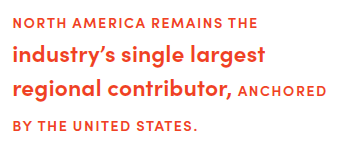
North America remains the industry’s single largest regional contributor7, according to WFDSA’s data, anchored by the United States. But size brings scrutiny, and 2024 was another year of adjustment.

In the US, WFDSA found that post-pandemic normalization continues8. Consumer spending has been selective, inflation-sensitive and value-driven. Direct selling companies are navigating a more skeptical consumer, increased regulatory attention and competition from every corner of the digital marketplace. Canada faces similar pressures, compounded by trade uncertainty and economic headwinds9.

Yet beneath the surface, the fundamentals that built the channel remain intact. Wellness, personal care and household products continue to resonate, according to WFDSA’s findings, particularly when paired with authenticity and clear value propositions. Layoffs and corporate restructuring—often driven by automation and AI—have also quietly renewed interest in flexible income options.

Peter Maddox, President of DSA Canada, is optimistic about the channel’s future in North America. He feels direct selling’s ability to pair personal connection with quality products is the industry’s superpower in a world crowded with AI noise and distraction.

“Personal recommendation and trust are what sets us apart. I believe the path to short- and long-term growth in our market is leaning into this differentiator.”

The challenge in North America is less about demand and more about perception. Companies that can modernize their narratives, simplify entry points and demonstrate real-world income relevance are finding traction. The opportunity here is not explosive growth, but durable reinvention.

Regional Snapshot:
North America

  • Largest single regional sales contributor globally
  • Post-pandemic sales normalization continues
  • Wellness and personal care remain core categories
  • Growing interest in flexible income amid layoffs and AI-driven disruption

Latin America—Volatility Meets Momentum

Latin America tells one of the most dynamic stories in global direct selling right now. It is a region where economic instability and opportunity coexist—sometimes within the same market.

Brazil and Mexico continue to anchor the region10, supported by large populations, established field infrastructures and strong cosmetics and personal care demand.

“In Mexico, we believe that sales will continue to grow, although at moderate rates, likely in the single digits and close to 5 percent,” said Adelfo Enríquez, President of the Mexico DSA, “This performance would be consistent with what has been observed over the past two years.”

Xavier Lorenzo/shutterstock.com

Colombia stands out as a market where direct selling remains closely tied to informal employment and household economics11, offering resilience even amid broader uncertainty, according to the report.

According to Elizabeth Acuna of the Colombia DSA, “The direct selling sector in Colombia continues to consolidate itself as one of the fundamental pillars of the collaborative economy and the livelihood of thousands of families.”

WFDSA notes in its report that Argentina’s headline growth in 2024 is inseparable from inflation dynamics, but it also reflects renewed activity following regulatory and monetary shifts. While volatility remains a defining feature across the region, direct selling’s adaptability—low barriers to entry, immediate earning potential and community-based selling—keeps it relevant.12

As Gonzalo Falcón, Executive Director of the Argentine DSA explained, “2026 is projected as a period of economic realignment with international estimates anticipating GDP growth between three and four percent. This presents a clear opportunity for direct selling.”

Product preferences skew heavily toward beauty and personal care, but wellness is gaining ground as consumers prioritize health amid economic stress. Latin America’s opportunity lies in its entrepreneurial spirit: direct selling is often not supplemental income here—it is essential income.

Regional Snapshot:
Latin America

  • One of the most volatile—but dynamic—regions
  • Beauty and personal care dominate, with wellness gaining ground
  • Direct selling often represents primary income, not supplemental
  • High responsiveness to economic shifts and regulatory change

Europe­—Resilience Under Pressure

Europe’s direct selling landscape is shaped by regulation, maturity and fragmentation. Overall sales dipped slightly in 2024, according to WFDSA’s research, according to WFDSA’s research, but the region’s story is more nuanced than the top line suggests.

Rawpixel.com/shutterstock.com

Germany remains Europe’s cornerstone market13, even as it navigates softer growth. France and Italy reflect broader economic caution, while markets like the United Kingdom and Poland face their own mix of consumer restraint and structural change.

At the same time, pockets of resilience are evident. Some Eastern and Southern European markets are showing renewed energy, driven by entrepreneurial necessity and changing workforce expectations.

Across Europe, sustainability, transparency and compliance are not optional—they are table stakes. European consumers tend to be discerning and value-driven, favoring quality, trust and longevity over hype.

Susannah Schofield OBE, Director General of the Direct Selling Association for the UK and Ireland, characterized the region as having a renewed emphasis on human connection.

“As consumers navigate economic uncertainty and digital fatigue, we are seeing a growing appreciation for trusted, person-to-person retail models. Ultimately, the future of our sector lies in proving the innovation and human connection are not opposites but partners.”

For companies willing to operate within a tighter regulatory framework, Europe still offers stable, long-term opportunity—particularly in wellness, home and personal care.

Regional Snapshot:
Europe

  • Most regulated direct selling environment globally
  • Germany anchors regional sales, but growth is uneven
  • Consumers prioritize trust, quality and sustainability
  • Long-term opportunity favors stability over speed14

Africa—High Potential, High Volatility

While WFDSA found that Africa remains the smallest region by sales15, it is also one of the most compelling from a long-term perspective. The continent’s direct selling markets are early stage, fragmented and deeply influenced by local economic conditions.

wavebreakmedia/shutterstock.com

Armand Friess, Direct Selling and MLM Expert for the African continent, shared his thoughts on the market. “Africa plays by different rules and does not develop efficiently from a distance. Today, two relatively stable and structured entry points stand out for serious players: Morocco and South Africa.”

South Africa continues to serve as a regional hub, even as it faces economic strain16. Elsewhere, informal economies, youthful populations and limited access to traditional employment make direct selling a meaningful pathway to income.

Infrastructure challenges, currency volatility and regulatory inconsistency remain real barriers. Yet digital adoption—particularly mobile commerce—offers a leapfrogging opportunity. In many African markets, direct selling’s person-to-person model aligns naturally with cultural norms around trust and community.

As Friess explained, “By 2050, Africa is expected to host around 1.4 billion urban residents, including roughly 800 million people of working age, concentrated in megacities such as Lagos, Nairobi and Cairo. Within 20 to 30 years, Africa will become one of the world’s primary engines of human and entrepreneurial growth.”

Regional Snapshot­:
Africa

  • Smallest region by sales, but high long-term upside
  • Direct selling closely tied to informal economies
  • Mobile technology enables leapfrogging traditional retail
  • Education and infrastructure remain key growth barriers

Middle East—Selective Growth, Structural Complexity

The Middle East occupies a unique position in the global direct selling landscape. While regional sales remain relatively small, certain markets show signs of selective, high-quality growth—often tied to wellness, premium personal care and digitally enabled selling models.

In countries such as the United Arab Emirates17, high digital penetration, diverse expatriate populations and strong logistics infrastructure support newer, more agile direct selling approaches. Elsewhere in the region, regulatory complexity and market fragmentation require careful navigation.

Overall, the Middle East favors precision: targeted products, culturally attuned messaging and strong compliance frameworks rather than broad-based expansion.

metamorworks/shutterstock.com

Regional Snapshot­:
The Middle East

  • Small share of global sales, but above-average digital readiness
  • Growth concentrated in select, well-regulated markets
  • Wellness and premium categories outperform mass-market goods
  • Opportunity favors focused, compliant market entry

Oceania­—Small Markets, Sharp Adjustments

Oceania’s direct selling markets are modest in size but revealing in trend. Australia and New Zealand—long considered stable and predictable—have faced sharper adjustments in recent years, based on WFDSA’s data. Rising cost of living, cautious consumer spending and competition from subscription-based and influencer-led models have pressured traditional approaches.

Yet these markets also illustrate how quickly direct selling can pivot. Digital tools, social commerce and hybrid models that blend retail, community and content are gaining traction. While sales volumes may be lower, the experimentation happening here often foreshadows broader industry shifts.

Geoff Mulham, CEO of Direct Selling Australia believes that this blended approach is working well in the market. “In Australia and New Zealand, we are seeing real growth in our member companies that are focusing on the right mix of traditional direct selling (face-to-face) combined with social media interaction and promotion.”

Opportunity in Oceania is less about scale and more about sophistication—rethinking engagement, modernizing field support and meeting consumers where they already are.

Regional Snapshot:
Oceania

  • Highly developed but economically sensitive consumer base
  • Digital-first engagement outpaces traditional in-person models
  • Strong experimentation with hybrid and social commerce strategies
  • Opportunity favors innovation over scale

A Moment, not a Verdict

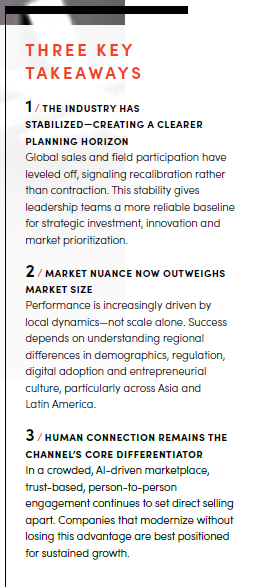
Globally, direct selling in 2024 felt like a pause—not a plateau. The channel absorbed pandemic-era distortions, weathered economic shocks and emerged more clear eyed about what growth will require next.

The global sales force has stabilized. The industry remains overwhelmingly powered by women, according to WFDSA’s report findings. WFDSA’s report also found that younger participation has softened, but older cohorts—often with stronger purchasing power and relationship networks—are increasingly engaged. Product innovation, particularly in wellness and personal care, continues to evolve alongside consumer expectations18.

Most importantly, as WFDSA’s report notes, direct selling remains grounded in relationships. Whether those relationships are built in living rooms, WhatsApp groups or livestreams, the core value proposition remains unchanged: products shared through trust; opportunity created through connection.

This moment in time is defined not by exuberance, but by resilience. And for an industry that has thrived through decades of change, that may be the most hopeful sign of all.


Learn more in-depth market analysis from global experts.

DSN wishes to thank WFDSA for the use of its data and insights from the annual STATS report, and the service it provides to the direct selling industry. For more insights on channel dynamics, download the World Federation of Direct Selling’s Global Statistical Data Report.


Sources:
1 WFDSA 2024 Stats Report, pp. 9, 16
2 WFDSA 2024 Stats Report, p. 16
3 WFDSA 2024 Stats Report, p. 13
4 WFDSA 2024 Stats Report, pp. 14, 21
5 WFDSA 2024 Stats Report, pp. 14,16
6 WFDSA 2024 Stats Report, pp. 16-17, 38-39
7 WFDSA 2024 Stats Report, p. 21
8 WFDSA 2024 Stats Report, p. 22
9 WFDSA 2024 Stats Report, p. 22
10 WFDSA 2024 Stats Report, p. 13
11 WFDSA 2024 Stats Report, p. 22
12 WFDSA 2024 Stats Report, p. 19
13 WFDSA 2024 Stats Report, pp. 14, 24
14 WFDSA 2024 Stats Report, p. 39
15 WFDSA 2024 Stats Report, p. 24
16 WFDSA 2024 Stats Report, p. 24
17 WFDSA 2024 Stats Report, p. 35
18 WFDSA 2024 Stats Report, p. 16

From the March/April 2026 issue of Direct Selling News magazine.

Filed Under: Cover Stories Tagged With: Billion Dollar Markets, Global Report, World Federation of Direct Selling Associations

DSA Releases Statement Regarding US Department of Labor Proposed Worker Classification Rule

February 27, 2026 by DSN Staff Writer

The Direct Selling Association (DSA) said it “welcomes” the recent announcement from the US Department of Labor proposing a rule that would clarify the distinction between employees and independent contractors. A 2024 rule previously made it harder for companies to classify workers as contractors, requiring them to offer benefits like insurance, minimum wage, overtime and other costly benefits.

The DSA stated this new proposal would “rescind the Department’s 2024 independent contractor regulation and restore an analysis grounded in economic reality and longstanding principles recognized by federal courts.”

The direct selling industry has long been a viable entrepreneurial pathway for Americans to pursue financial and occupational independence, and contractor status, the DSA says, is key to allowing direct sellers full discretion over their level of participation in the marketplace.

“The Department of Labor’s proposed rule reinforces a fundamental distinction that has long defined direct selling: individuals choose to pursue building independent businesses on their own terms,” said Dave Grimaldi, Direct Selling Association CEO. “Direct sellers are not assigned work or directed in the manner of employees. They decide whether, when and how to engage, and their success is driven by their own initiative. Clear and consistent standards grounded in economic reality help ensure that millions of American direct sellers can continue to operate independently, with the autonomy that defines our business model.”

The DSA called the new proposal “an important step toward reinforcing clarity and predictability for direct selling,” and that regulatory frameworks should accurately reflect how direct sellers operate while enabling companies to maintain compliance with federal law.

“Direct selling is a well-established component of the American economy, supporting millions of individuals who value the ability to pursue entrepreneurship with minimal barriers to entry and complete control over how they engage,” the DSA wrote in a statement. “DSA looks forward to continued engagement with the Department of Labor and federal policymakers throughout the rulemaking process.”

Filed Under: U.S. Tagged With: Dave Grimaldi, Department of Labor, Direct Selling Association, DSA, independent contractor

  • « Previous Page
  • 1
  • …
  • 26
  • 27
  • 28
  • 29
  • 30
  • …
  • 636
  • Next Page »
brand-logo
The News You Need.
The Name You Trust.
Subscribe

Breaking global news, emerging trends and powerful stories conveniently curated to help direct selling executives stay informed, engaged and a step ahead.

  • Read
  • Listen & Watch
  • Attend
  • Achieve
  • Research
  • About
  • Connect
5717 Legacy Drive
Suite 250
Plano, Texas 75024
info@directsellingnews.com
Copyright 2026 Direct Selling News | All Rights Reserved
  • Privacy Policy
  • Terms of Use
  • Advertise
  • Subscribe
We use cookies on our website to give you the most relevant experience by remembering your preferences and repeat visits. By clicking “Accept All”, you consent to the use of ALL the cookies. However, you may visit "Cookie Settings" to provide a controlled consent.
Cookie SettingsAccept All
Manage consent

Privacy Overview

This website uses cookies to improve your experience while you navigate through the website. Out of these, the cookies that are categorized as necessary are stored on your browser as they are essential for the working of basic functionalities of the website. We also use third-party cookies that help us analyze and understand how you use this website. These cookies will be stored in your browser only with your consent. You also have the option to opt-out of these cookies. But opting out of some of these cookies may affect your browsing experience.
Necessary
Always Enabled
Necessary cookies are absolutely essential for the website to function properly. These cookies ensure basic functionalities and security features of the website, anonymously.
CookieDurationDescription
cookielawinfo-checkbox-analytics11 monthsThis cookie is set by GDPR Cookie Consent plugin. The cookie is used to store the user consent for the cookies in the category "Analytics".
cookielawinfo-checkbox-functional11 monthsThe cookie is set by GDPR cookie consent to record the user consent for the cookies in the category "Functional".
cookielawinfo-checkbox-necessary11 monthsThis cookie is set by GDPR Cookie Consent plugin. The cookies is used to store the user consent for the cookies in the category "Necessary".
cookielawinfo-checkbox-others11 monthsThis cookie is set by GDPR Cookie Consent plugin. The cookie is used to store the user consent for the cookies in the category "Other.
cookielawinfo-checkbox-performance11 monthsThis cookie is set by GDPR Cookie Consent plugin. The cookie is used to store the user consent for the cookies in the category "Performance".
viewed_cookie_policy11 monthsThe cookie is set by the GDPR Cookie Consent plugin and is used to store whether or not user has consented to the use of cookies. It does not store any personal data.
Functional
Functional cookies help to perform certain functionalities like sharing the content of the website on social media platforms, collect feedbacks, and other third-party features.
Performance
Performance cookies are used to understand and analyze the key performance indexes of the website which helps in delivering a better user experience for the visitors.
Analytics
Analytical cookies are used to understand how visitors interact with the website. These cookies help provide information on metrics the number of visitors, bounce rate, traffic source, etc.
Advertisement
Advertisement cookies are used to provide visitors with relevant ads and marketing campaigns. These cookies track visitors across websites and collect information to provide customized ads.
Others
Other uncategorized cookies are those that are being analyzed and have not been classified into a category as yet.
SAVE & ACCEPT