Saturday / October 3. 2026
menu-logo menu-logo
brand-logo
Subscribe
Subscribe
Saturday / October 3. 2026
  • Read
    • Daily News
      • Financial
      • Insights
      • U.S.
      • International
    • Digital Issue
    • Executive Announcements
    • Cover Stories
    • Feature Articles
      • Exclusive Interviews
    • International Focus
    • Company Spotlights
    • Forward Thinking
    • Legal Briefs
    • Insights from the Outside
    • For You | For Your Field
    • Working Smart
  • Listen & Watch
    • Direct Approach Podcast
    • What’s Working in Direct Selling
    • BUILT TO LAST
      • Zinzino
      • PM-International
      • LifeWave
    • The DSN Podcast
  • ATTEND
  • Achieve
    • Global 100 List
    • Bravo Awards
    • Best Places to Work
    • Legends
  • Research
    • Stock Watch
    • DSN Supplier Sponsors
    • The DSN Guide
    • Supplier Directory
    • Stock Ticker
    • Resources
  • Engage
    • About DSN
    • Supporter Program
    • Subscribe
    • Advertise
    • VIP Text Alerts
    • Connect
  • Search
Subscribe

USANA Reports Q2 2026 Financial Results

August 5, 2026 by DSN Staff Writer

USANA Health Sciences, Inc. announced its financial results for the second quarter of 2026. Net sales during the quarter were $223 million, compared to $236 million in Q2 2025. Net loss during the quarter was $21.4 million with an adjusted EBITDA of $27.8 million. The number of core nutritional active customers was 384,000, down from 418,000 in the same period last year, while Hiya active monthly subscribers fell to 166,000 from 200,400.

“Our consolidated second quarter results reflect mixed performance as the Core Nutritional business delivered results generally in line with our expectations, while our ventures businesses performed below expectations,” said Kevin Guest, USANA Chairman and Chief Executive Officer. “Specifically, Hiya continued to experience a challenging digital marketing environment, which pressured topline performance, subscriber growth and margins. Additionally, Rise Wellness experienced a packaging-related disruption that impacted its commercial execution during the quarter. While we believe that these challenges for Hiya and Rise are temporary, and both companies remain well positioned to execute their growth strategies, we now expect net sales for these businesses during the full year to be below our prior expectations and are updating our outlook accordingly. We remain confident in USANA’s strategic transformation from a single-channel direct sales business into a diversified, omnichannel health and wellness company built on consumer acquisition and loyalty. We are continuing to evolve our Brand Partner incentive plan, accelerate product innovation and modernize our technology infrastructure. We remain confident that these initiatives will lead to long-term sustainable growth.”

Net sales of the company’s core nutritional segment fell 6% sequentially and 4% year-over-year, with all markets showing decreased sales. Rise Wellness posted $3 million in net sales, a 75% decrease sequentially but a 40% growth rate year-over-year.

“Hiya’s talented management team continues to embrace the opportunity to leverage their brand across additional channels to reach a broader consumer base, while continuing to build on strong performance at a major national retailer, early-stage international expansion and encouraging momentum in additional e-commerce channels. Rise Wellness’ high growth protein beverage brand, Protein Pop, is just a year old, and continues to attract new retailers, expand its presence with existing retailers and create the foundation for an exciting and expanded product pipeline. We recognize this progress will not always be linear quarter to quarter, and as we manage the business with that expectation in mind, our focus remains on building long-term loyalty from the consumers and Brand Partners who depend on our brands.”


Filed Under: Financial Tagged With: Kevin Guest, quarterly, USANA

Don’t Be the FTC’s Next Target

August 5, 2026 by Katrina Eash, Branko Jovanovic, PhD & Juliet Bellin Warren

Listen to this story on this episode of The DSN Podcast. Even when your day is packed, we make it easy to stay informed, engaged and one step ahead.

Make sure your Income Disclosure Statement stands up to scrutiny.

A direct seller’s Income Disclosure Statement (IDS) is a resource used to set earning and expense expectations. It is vital that direct sellers accurately disclose the business experience in their IDS. And the Federal Trade Commission (FTC) has made it clear that it is laser-focused on—and has high expectations for—the contents and use of an IDS.

Here, we’ll discuss the current regulatory environment surrounding deceptive earnings claims and identify best practices direct sellers should consider in order to avoid becoming the low-hanging fruit accused of making (or facilitating) deceptive claims.

Those best practices include:

  • Using reliable proxies to identify distributors engaging in business-building activities within a defensible look-back period and including all such distributors in the IDS;
  • Accurately representing distributor earnings by, for example, reporting median earnings, the earnings distribution and earnings/share of distributors by highest rank achieved;
  • Clearly and conspicuously disclosing the number of distributors who had no documented earnings;
  • Clearly and conspicuously disclosing that the earnings represented are gross;
  • Clearly and conspicuously disclosing business-related expenses readily identifiable in the data, including the amount thereof (e.g., registration/renewal fees, website fees, shipping, conference fees) and other expenses not readily identifiable (e.g., travel, lodging, food, internet); and
  • Implementing a robust IDS compliance program and providing distributor training on the proper use of the IDS and strict enforcement thereof.

Best practices will look different for each direct seller, as the FTC has recognized that “what constitutes a reasonable basis is fact-specific and depends on the claim that is being made and the surrounding circumstances.” Each company should work with experienced counsel in creating an IDS that is both accurate and fully substantiated.

Regulatory Focus on Deceptive Claims and Disclaimers

In the FTC’s battle against Neora, the FTC alleged Neora violated the FTC Act “by making deceptive representations that Neora [distributors] are likely to earn a substantial income.” In 2023, the Neora court soundly rejected that allegation, relying in part on the fact that Neora created an IDS; instructed its distributors how to use it; and policed such use. The court also noted that the FTC neither challenged the substance of Neora’s IDS nor provided evidence related to its impact on distributor decision making.

PaeGAG/shutterstock.com

Reading the court’s tea leaves, the FTC took action. In April 2024, the FTC published its updated Business Guidance Concerning Multi-Level Marketing, which emphasizes that earnings representations should reflect the experience of a typical distributor and must be based on reliable evidence. The 2024 Guidance details the FTC’s view of the proper substance of an IDS.

Shortly after, Bosley et al. published research on the adoption of self-regulatory guidance in direct selling “as it relates to earnings claims and disclaimers.” Their key finding: “actual disclaimers [direct sellers were using at the time of Bosley et al.’s research] have no impact, while guidance-aligned disclaimers do impact consumer judgments and interest.” The FTC will likely rely on this research in arguing that direct sellers must ensure their distributors are instructed on proper IDS use and strictly police them.

Clearly, the FTC and other regulators are laser-focused on curing perceived deficiencies exposed in Neora. And they’re not just talking—they’re taking decisive action. In April 2026 alone, the FTC entered consent judgments with Forever Living Products, Stormy Wellington and Steven and Gina Merritt, with deceptive earning claims driving each enforcement action.

So, what best practices can direct sellers employ to avoid becoming the next target?

The FTC’s IDS Guidance and Compliance

Since early 2024, the FTC has published three documents summarizing its views on IDS. Boiling the guidance down, the FTC considers the following when assessing a direct seller’s IDS:

  1. Has the direct seller included all participants except those who do not exhibit behaviors consistent with a desire to pursue the earnings opportunity?
  2. Has the direct seller accurately represented the experience of a typical distributor by, for example, reporting median earnings, the earnings distribution and earning/share of distributors by highest rank achieved?
  3. Has the direct seller clearly disclosed the number of distributors who had no documented earnings?
  4. Has the direct seller clearly disclosed whether earnings are inclusive of costs and disclosed typical business expenses, such as costs of travel for conferences, sales aids or trainings?

Where a direct seller cannot reliably capture the experience of a typical distributor, the FTC demands that it “refrain from making any earnings claims and ensure its participants do the same.”

We do not take a position as to whether the FTC’s guidance aligns with the law. Rather, we have taken it at face value and identified best practices that direct sellers should consider in crafting (or updating) their IDS. Every company is different, but where appropriate, deploying the practices identified in the introduction can significantly reduce exposure to deceptive claims allegations.

Robust IDS Compliance Programs Are Vital

Turning from substance to use, direct sellers can further reduce their exposure through IDS compliance training and enforcement. Best practices include:

  • Strict prohibitions on misleading earnings claims, with examples of prohibited claims;
  • Mandatory use of clear, conspicuous and prominent disclaimers where truthful claims are permitted, with examples of proper IDS use; and
  • Records demonstrating strict enforcement of these prohibitions and guidance.

Direct sellers engaging in these compliance practices are much less likely to become the target of deceptive claim allegations. Our client’s goals always align as to at least one thing—reduce exposure to costly regulatory investigations wherever possible. We hope this article provides practical guidance in doing so.


Katrina Eash is a Partner at King & Spalding, LLP. She has substantial experience defending direct selling companies in high-stakes, bet-the-business disputes. She has successfully defended dozens of direct sellers facing class claims and regulatory investigations. She also regularly advises direct sellers on best practices and regulatory compliance.

Branko Jovanovic, Ph.D. is a Partner, and Juliet Bellin Warren is a Managing Consultant at Edgeworth Economics which offers testimony and consulting services to direct sellers facing regulatory and litigation challenges. They combine innovative economic analysis, combined with in-depth industry experience, to assist clients in complex matters.

Filed Under: Legal Briefs Tagged With: Branko Jovanovic, Edgeworth Economics, Federal Trade Commission, FTC, Juliet Bellin Warren, Katrina Eash, King & Spalding

LR Health & Beauty Releases 2025 Annual Report

August 4, 2026 by DSN Staff Writer

LR Health & Beauty published its final annual report for 2025. Included in the report were preliminary full-year 2025 sales totals, which reached $319 million, down from $333 million in 2024. EBITDA for 2025 is reported at $19 million, compared to $31 million in 2024. Normalized EBITDA for the year was approximately $25.9 million.

LR stated that it is prioritizing in-house production and investing more than $2 million in a new, high-performance production line that will centralize the manufacture of its 5in1 product category at its Ahlen site. The new production facility is expected to have an annual capacity of up to 40 million units and will allow the company to expand future product innovations in the modern nutritional supplements category.

“The 2026 financial year is a transitional year for LR, during which we have laid the groundwork – both financially and strategically – for sustainable business growth and performance,” said Jörg Körfer, LR Health & Beauty SE CEO. “The newly established financing structure gives us the momentum we need to continue to consistently pursue the initiatives we have launched in production, logistics and sales in the second half of the year. In this context, we are committed to working closely with our partners and are continuing to expand these relationships internationally.”

Filed Under: Financial Tagged With: Jorg Korfer, LR Health & Beauty

Plexus Convention Raises $117,500 to Fight Food Insecurity in Ohio

August 3, 2026 by DSN Staff Writer

At its Columbus, Ohio Convention, Plexus Worldwide raised more than $117,500 for the Mid-Ohio Food Collective (MOFC) initiative. These donations will provide approximately 294,125 meals to families and children facing food insecurity in eastern Ohio.

All funds raised during the event will go directly to MOFC as part of the company’s Nourish One initiative and its long-standing partnership with Feeding America and Mary’s Meals. Since establishing the philanthropic campaign in 2018, the company has contributed the equivalent of more than 49 million meals.

“Giving back is at the heart of our community, and we wanted to create an opportunity to help children facing food insecurity during the summer months.” said Elizabeth Woods, Plexus Director of Philanthropy. “Summer can be one of the most challenging times for families who rely on school meal programs, and we’re grateful to partner with Mid-Ohio Food Collective to help address this need and make a meaningful impact in the Columbus community through this activation.”

Plexus also hosted an interactive pop-up activation, called the Plexus Giving Grocery, where volunteers worked together to pack more than 2,000 snack packs for local children. Attendees at the convention contributed more than $58,000, which Plexus matched, bringing the donation total to $117,500.

“We’re incredibly grateful to Plexus Worldwide for selecting Mid-Ohio Food Collective as a beneficiary of their convention,” said Craig Truax, MOFC Director of Corporate Partnerships. “Each day, we provide enough food for more than 166,000 meals across our 20-county footprint in central and eastern Ohio. Partnerships like this, where organizations come to central Ohio and choose to make a meaningful impact, are truly invaluable in helping us advance our mission.”

Filed Under: Daily News Tagged With: Elizabeth Woods, event, Plexus

Coway Releases 2025 Sustainability Report

August 3, 2026 by DSN Staff Writer

Coway Co., Ltd. published its 21st sustainability report, providing an overview of its environmental, social and governance (ESG) goals as of the end of 2025. To lead its vision to become a “Company Caring for a Better Earth,” Coway established its ESG Committee in 2021, which has set and monitored the company’s mid- to -long-term goals.

Among those goals is the desire to be Net Zero by 2050. In 2025, the company completed its third on-site solar power plant in South Korea, which is expected to increase total annual solar power generation across all business sites by 29%, and exceeded its initial target for recycled raw materials through its closed-loop resource circulation system.

As part of its social initiatives, the company has prioritized customer feedback, leading to the development of its Smart Moving Faucet and its incorporation into the Icon Water Purifier 3, which enhanced hygiene and safety. The company also reinforced its security architecture and monitoring capabilities to ensure statutory compliance, operational stability and customer trust.

To further improve transparency in its governance and boost shareholder value, the company introduced a Senior Independent Director system in 2025, as well as a Related Party Transaction Committee and a Compensation Committee. The company also debuted its new Corporate Value-Up Plan, which is committed to enhancing shareholder value by doubling its target shareholder return rate from 20% to 40%.

“Amid ongoing global economic uncertainty, Coway has achieved record-high revenue and is continuing to deliver solid growth,” said Jangwon Seo, Coway CEO. “By synthesizing our economic performance with our closely-held ESG values through the development of innovative new products and continued investment in R&D, we are establishing ourselves as a sustainable corporate competitor within the global market.”

Filed Under: International Tagged With: Coway, Jangwon Seo, sustainability

Side Hustle to Skillset

July 31, 2026 by Susannah Schofield OBE

Can retail’s D2C help solve the UK’s youth unemployment challenge?

As the UK enters a new political chapter, led by a new Prime Minister, policymakers are under significant and growing pressure to address some of the country’s most persistent economic challenges, not least of which is youth unemployment and skills development.

With growth, productivity and workforce participation high on the political agenda, there is renewed focus on finding innovative ways to help young people gain practical experience, build careers and contribute to the economy. This creates an opportunity to look beyond traditional employment models and consider the role that alternative pathways, including direct-to-consumer (D2C) retail and entrepreneurship, can play in supporting the next generation.


The UK’s youth employment outlook is becoming increasingly concerning. New data from the Office for National Statistics outlines that the number of young people not in work or education is at a 12-year high, and persistent skills gaps as well as reduced access to traditional career pathways are leaving many young people unsure where to start. For a generation navigating economic uncertainty, debt and a rapidly evolving labour market, the idea of a stable, linear career is no longer guaranteed or—in many cases—even desirable.

Against this backdrop, a different kind of career path is quietly gaining momentum: direct-to-consumer (D2C) retail. Long associated with entrepreneurship and flexible working, this channel of retail is emerging as a practical and accessible entry point for young people seeking real-world experience—and income—on their own terms.

One of the defining advantages of D2C retail is its low barrier to entry. Unlike many traditional roles that require prior experience, formal qualifications or lengthy recruitment processes, D2C pathways allow individuals to get started quickly and with minimal upfront investment. Whether it involves building a personal brand, selling products through social media platforms or partnering with established direct selling companies, young people can begin small, experiment in a supported environment and develop at their own pace.

Retail brands such as Avon and Oriflame are increasingly recognising the value of attracting younger representatives, whilst young people can access structured opportunities to enter the world of sales and entrepreneurship with built-in support systems, as well as the opportunity to be creative and entrepreneurial, particularly in areas such as social commerce, influencer marketing and community-building online.

In addition to income generation, participation in this area of retail can equip young people with a practical and transferable skillset. Core competencies such as sales, digital marketing, financial management and customer engagement are developed in real time, often far earlier than in traditional career environments. Rather than being confined to a single function, individuals in D2C roles gain exposure to multiple aspects of running a business, from branding and promotion to logistics and budgeting.

Crucially, this learning is not theoretical; it is experiential. Running even a modest side hustle demands problem-solving, adaptability and self-motivation. Sellers must respond to customer feedback, refine their approach and manage the inevitable challenges that come with building something from the ground up. In doing so, they also develop confidence, resilience and a sense of ownership over their progress, traits that are invaluable in any professional setting.

Another strength of the D2C model is its emphasis on community and mentorship. Many direct selling brands provide peer networks, training programs and ongoing support to help people succeed. This can be particularly valuable for young people who may lack access to traditional professional networks or role models. In effect, D2C retail creates informal learning environments where individuals can gain guidance, share experiences and build connections that support both personal and professional growth.

As the UK continues to grapple with youth unemployment and widening skills gaps, the potential contribution of retail’s D2C channel—as with entrepreneurship more broadly—deserves greater recognition. It aligns closely with broader shifts in the economy and labour market, including the rise of platform-based work, digital commerce and portfolio careers.

The evidence suggests this shift is already well underway: Deloitte reported in 2023 that 42 percent of Gen Z already have a side hustle, while research from global online gig marketplace Fiverr indicates that more than a third (36 percent) of UK 16-26 year-olds see owning a business or freelancing as their ultimate career goal. Together, these trends point to a generation actively reshaping traditional employment models and a growing role for D2C as an accessible route into work, skills development and entrepreneurship.

However, for its potential to be fully—and responsibly—realised, a more coordinated approach is needed. Greater collaboration between industry, policymakers and educators would help formalize and scale these opportunities, while stronger governance through existing trade bodies such as The Direct Selling Association would help to promote responsible practice. This might include integrating D2C experiences into career guidance programs, recognising informal learning and skills development or providing incentives for companies that support youth participation and training.

There is also an opportunity to challenge outdated perceptions of retail and direct selling, which simply do not accurately reflect the sector today. Rather than viewing these roles as temporary or purely entry-level, they should be seen as dynamic and evolving pathways that can provide meaningful entry points into the world of entrepreneurship.

In a labour market where traditional pathways—both in retail and more broadly—are no longer working for many young people, alternative models must be taken more seriously. D2C retail offers not just a side hustle but a practical way to build skills, confidence and independence. With the right recognition and support, this type of entrepreneurialism could become a vital part of the solution to the UK’s youth employment challenge.


SUSANNAH SCHOFIELD OBE is the Director General of the Direct Selling Association UK & Ireland, an industry which is worth over £1billion. Prior to her appointment as leader of the DSA, Susannah spent 18 years at Royal Mail, culminating in her holding the Board-level role of Commercial & Innovation Director, where she led a team of over 800 people. A passionate advocate for women and young people in business, Susannah was awarded an OBE for her work in this area in the 2015 New Year’s Honours List.

An Online Exclusive from Direct Selling News magazine.

Filed Under: Feature Articles Tagged With: DSA UK & Ireland, Susannah Schofield OBE

Mary Kay 2026 Sustainability Report Celebrates Positive Social Impact

July 30, 2026 by DSN Staff Writer

Mary Kay Inc. released its 2026 Sustainability Report, an annual report of the company’s efforts and achievements in social, economic and environmental sustainability. According to the report, Mary Kay is making significant progress toward its 2030 goals and showed a strong commitment to women’s empowerment, digital innovation, biodiversity and product stewardship.

In 2025, the company directed efforts to resource conservation, sustainable sourcing and responsible packaging. As a result, the company reduced plastic intensity, increased post-consumer recycled content (PCR), prioritized the use of sustainable paper sources and reaffirmed its support of the Global Shea Alliance and The Nature Conservancy.

To continue its decades-long commitment to positive social impact, the brand participated in impact partnerships, including the awarding of grants to next-gen innovators in diverse STEM categories, supporting empowerment initiatives that develop entrepreneurs and provide community development, funding cancer research, helping survivors of domestic violence and creating opportunities for women and their families around the world. Since 1996, the company has now donated $230 million in monetary and in-kind donations to company-sponsored global foundations.

From an economic standpoint, Mary Kay is now present in 40 markets, is engaged in more than 100 trade organizations and is leading the way in gender parity. In its top ten markets, 60% of its leadership positions are held by women. Overall, 63% of its executive team, 64% of its Research and Development Scientists and 79% of its Global Brand and Global Creative Team are women. This is reflective of its global workforce, of which 63% are women.

“Mary Kay’s commitment to enriching women’s lives continues to guide how we operate, innovate and create sustainable impact across the beauty industry while advancing women’s entrepreneurship for all generations around the world,” said Ryan Rogers, Mary Kay Chief Executive Officer. “This report reflects the measurable progress we are making against our 2030 commitments and the transformative social, economic and environmental change we are helping create for people, communities and the planet.”

Filed Under: Daily News Tagged With: Mary Kay, sustainability

Natural Health Trends Reports Q2 2026 Financial Results

July 29, 2026 by DSN Staff Writer

Natural Health Trends Corp. announced its financial results for the second quarter of 2026. The company stated that its recently implemented restructuring program has shown positive progress and is reducing costs for the organization and creating savings that is expected to be realized later this year.

Revenue during the quarter was $7.6 million, a 23% year-over-year decrease. Operating loss during the quarter was $643,000, compared to $333,000 during the same period of 2025. Active member numbers fell to 26,000, down from 29,260 at the end of Q2 2025.

“The operating environment remains challenging,” said Chris Sharng, Natural Health Trends Corp. President. “In China, consumers continue to be cautious about spending and investing, while regulatory uncertainty caused some members to pause activities during the quarter. We also identified conduct by certain members that violated the company’s Hong Kong policies, procedures and professional code of conduct. These activities disrupted our business and adversely affected second quarter revenue and operating results. At the same time, the restructuring program implemented late last year has already reduced costs and streamlined our organization, and we expect to realize additional savings in the second half of the year. We are also developing programs and campaigns to more aggressively support our members while continuing to invest in products and technology.”

For the first six months of 2026, revenue fell 18% to $16.8 million, with an operating loss of $1.1 million. Net loss was $605,000, or $0.06 per diluted share, compared to a net income of $137,000, of $0.01 per diluted share, in the first six months of 2025.

“We’re looking forward to celebrating our 25th anniversary in Hong Kong in the third quarter with a full lineup of prizes and rewards that customers can qualify for leading up to and during the event,” Sharng said. “We expect more than 1,000 attendees from around the world and plan to reconfirm our strategies and commitment at this event.”

Filed Under: Financial Tagged With: Chris Sharng, Natural Health Trends, NHT Global

Choose the Story

July 28, 2026 by Blake Mallen

Transformation isn’t something that happens to great companies—it’s a decision they make before the future forces their hand.

Transformation has always been part of direct selling. Every company that has endured for decades has reinvented itself more than once. Markets change. Technology evolves. Consumer expectations shift. The companies that last aren’t the ones that resist change—they’re the ones that learn to transform before they have to.

What’s different today is that it feels like every company is standing at the same crossroads at the same time. Artificial intelligence is changing how we work. Social commerce is redefining influence. Entrepreneurship is evolving. Consumer behavior continues to shift beneath our feet. Every conversation seems to begin with disruption, uncertainty and what’s coming next.

The temptation is to see all of that as something happening to us.

I don’t. I think this is one of the greatest opportunities our channel has ever seen.

The question isn’t whether change is coming. It’s whether we’ll intentionally shape what comes next—or simply react to it. That lesson became deeply personal for me over the past year.

The Meaning We Choose

Last January, my family lost our home—and everything inside it—in the Palisades Fire. Like so many moments in life, it wasn’t something we chose. It simply happened. And when something like that happens, you discover very quickly that while you can’t control the circumstances, you can control the meaning you give them.

There were days filled with uncertainty, disappointment and questions without answers. Eventually my wife and I made peace with the idea that perhaps it simply wasn’t the right time to rebuild. We decided to stop forcing the outcome and wait to see what doors might open.

Within weeks, something remarkable happened.

A postcard arrived in our mailbox advertising the vacant lot next to ours. Curious, we met with the real estate agent. During that meeting we discovered that a home two doors down—one with the exact same floor plan as the house we had lost—had just come on the market. In what still feels like an unbelievable series of events, we sold our lot, purchased that home and moved back onto our street before Christmas.

The house isn’t really the story. The story is the choice that came before it. At every crossroads, I had to decide whether to become bitter or hopeful. Whether to focus on what had been lost or remain open to possibilities I couldn’t yet see.

Business works the same way.

Every company will encounter seasons it didn’t choose. Markets shift. Competitors emerge. Technology changes the rules. The organizations that endure aren’t necessarily the ones with the fewest challenges. They’re the ones that refuse to let difficult seasons define their future.

Two Stories, One Industry

I believe direct selling is living through one of those moments right now. Depending on who you ask, our industry is either under tremendous pressure or standing on the edge of enormous opportunity.

One story says our products are becoming commodities. Influencers are replacing distributors. The gig economy has changed everything. Artificial intelligence will disrupt traditional business models, and younger generations simply aren’t interested.

The other story looks at those exact same facts and reaches a completely different conclusion. Flexible work has become mainstream. Entrepreneurship has never been more accessible. Technology allows independent business builders to scale in ways that were unimaginable a decade ago. Human connection has become more valuable precisely because so much of life has become digital.

Same facts. Completely different future.

The story we choose matters because stories shape decisions, and decisions ultimately shape results. The greatest risk facing our companies isn’t AI. It isn’t social commerce or changing consumer behavior. Our biggest roadblock is believing we’re victims of change instead of architects of it.

Transformation Requires Design

At Herbalife, we’re in the middle of our own transformation. After 46 years of success, it would be easy to assume the safest strategy is simply protecting what already exists. Instead, we’ve been asking ourselves a much more difficult question: What is the business that could put us out of business?

Then we ask an even harder one: How do we become that business before someone else does?

Everything begins with vision. Not a slogan on the wall, but a clear destination that every employee and every field leader understands. If ten people inside your organization described where you’re headed, would they all tell the same story?

Vision establishes direction. Strategy determines the path.

Too often, companies mistake tactics for strategy. A collection of projects isn’t a strategy. Strategy requires making difficult choices about what matters most over the next three to five years and—just as importantly—deciding what doesn’t.

Culture then determines whether any of it actually happens.

You can have a compelling vision and a brilliant strategy, but if trust is missing, progress stalls. Healthy cultures are built on reliability, honest communication and shared responsibility. Those qualities don’t develop through mission statements. They develop through difficult conversations, accountability and leaders willing to model the behaviors they expect from everyone else.

Building a Business Worth Joining

Even with the right culture, companies still have to earn the market’s attention. That starts with a value proposition that genuinely matters.

One of the biggest lessons I’ve learned throughout my career is that you cannot outwork a weak value proposition. You can ask distributors to make more calls, attend more meetings and work harder, but eventually the market decides whether what you’re offering is compelling.

Everything behind your value proposition either sharpens the spear or dulls it. Our responsibility as corporate leaders isn’t simply asking the field to sell more effectively. It’s making those conversations easier because the value is clearer. That’s a much more sustainable advantage.

The same principle applies internally. People don’t commit their time, energy and reputation to organizations because they’re perfect. They commit because they believe in where those organizations are going. Every decision we make should strengthen that belief rather than weaken it.

The Future Is Ours to Build

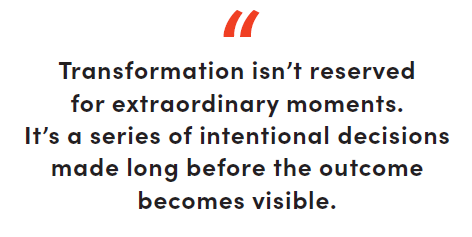
The most encouraging realization I’ve had over the past year is that transformation isn’t reserved for extraordinary moments. It’s a series of intentional decisions made long before the outcome becomes visible.

That’s true whether you’re rebuilding a home, an organization or an entire industry.

The future of direct selling isn’t going to happen to us. It’s going to be created by us. Each of us has an opportunity to influence what the next decade looks like—not simply by adopting new technology, but by choosing how we approach and adapt to change.

The future doesn’t belong to the companies that cling most tightly to the past. It belongs to the leaders willing to design tomorrow before tomorrow demands it.

The world needs entrepreneurship. It needs community. It needs meaningful opportunity. Those have always been the strengths of direct selling. Our job now is to build organizations bold enough to carry those strengths into the future.

The season has changed. Now it’s our turn to transform.


BLAKE MALLEN is an entrepreneur, podcast host, speaker and the marketing mind behind brands that have generated billions of dollars in revenue. After originating the Challenge-based marketing model to build and sell one of the world’s most recognized weight loss brands, Blake is currently Chief Strategy Officer of Herbalife, President of Pro2Col and the Managing Director of BAM Ventures. His TED Talk on how to ‘Shift the Script’ has already reached 1M+ views.

An Online Exclusive from Direct Selling News magazine.

Filed Under: Feature Articles Tagged With: AI, artificial intelligence, Blake Mallen, transformation

Oriflame Reports Q2 2026 Financial Results

July 28, 2026 by DSN Staff Writer

Oriflame announced its financial results for the second quarter of 2026. Sales in Latin America saw a 6% boost, while sales in Türkiye and Africa declined 13% and sales in Europe and Asia fell 12% and 11% respectively. Adjusted EBITDA was -$5.3 million, reflecting lower sales. Adjusted gross margin fell by 480 bps year-over-year and was primarily driven by lower sales volume, an increase in inventory provisions and excess inventory liquidation to generate cash.

Ongoing cost-control initiatives and reductions in selling and administrative expenses helped mitigate the impact on profitability, while the company’s negative EBITDA impact was compensated by a strong working capital performance, particularly through a $17 million improvement in inventories and a $8 million contribution from receivables. 

The company stated that it is rapidly progressing on its transformation agenda known as “Real Products, Real Prices and Real People,” including a new pricing strategy to improve value for money perception and a simplification of its opportunity offering. The planned transition to a network of European manufacturing partners is ahead of schedule, now expected to be completed by the third quarter, with 316 products awarded to new partners and 198 products already in production. To ensure a lean and results-focused organization, the company has also instituted a savings program and shifted to a modern, digital-first commercial planning.

Filed Under: Financial Tagged With: Oriflame, quarterly

LATAM’s Next Powerhouse Opportunity

July 28, 2026 by Alex Hoffmann

Listen to this story on this episode of The DSN Podcast. Even when your day is packed, we make it easy to stay informed, engaged and one step ahead.

Are you underestimating the Mexican market?

As global direct selling companies search for their next major growth engine, one market continues to separate itself from the rest: Mexico.

After more than 25 years working in Mexico and over three decades across LATAM, Europe and the Americas, I continue to see the same pattern: companies underestimate Mexico at the beginning, then later realize it became one of their largest and most profitable markets.

Mexico sits at the intersection of demographics, entrepreneurship, culture and digital acceleration. It has the scale of a major global economy; the relationship-driven culture that direct selling thrives in; and the strategic advantage of being directly connected to the United States.

Demographic and Historical Strength

Mexico is not an emerging experiment for direct selling. It is already one of the largest and most established markets in the world. According to the Asociación Mexicana de Ventas Directas (AMVD), the industry generates approximately 100 billion pesos annually—approximately $6 billion in US dollars—and Mexico ranks as the #8 direct selling market globally.

skyNext/shutterstock.com

With more than 130 million people, Mexico is also one of the largest consumer markets in Latin America. Its population is young, increasingly digital and highly social—creating ideal conditions for ecommerce, social selling and hybrid direct-to-consumer models.

Historically, Mexico has always been a center of commerce and entrepreneurship. From the legacy of the Maya and Aztec civilizations to today’s manufacturing and export economy, the country has consistently demonstrated resilience and adaptability. Combined with its proximity and economic integration with the United States, Mexico continues to strengthen its position as one of the most strategic markets in the Western Hemisphere.

A Massive and Engaged Sales Force

One of Mexico’s greatest strengths is its people. More than three million individuals actively participate in direct selling across the country, with some estimates placing the broader network closer to four million distributors nationwide.

This makes Mexico one of the largest direct selling workforces in the world. More importantly, it reflects a culture that embraces entrepreneurship, flexibility and income diversification.

For many families, direct selling is not simply extra income. It is a pathway to financial mobility, independence and ownership. During difficult economic periods, the channel has consistently adapted faster than many traditional industries because of its entrepreneurial nature.

A Culture Built for Direct Selling

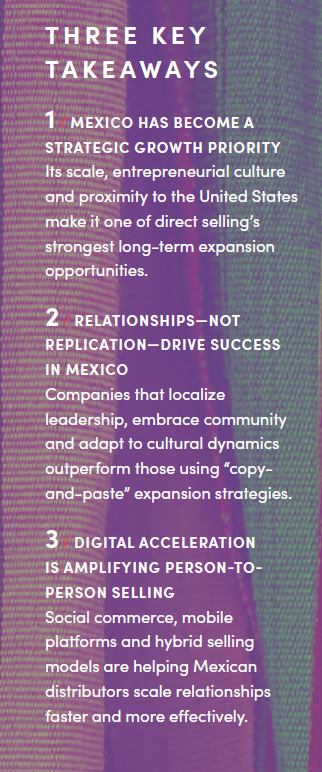
One of the biggest mistakes international companies make is trying to apply a “copy-and-paste” strategy from the US or Europe into Mexico. Mexico operates differently because relationships function differently.

This is a country built around family, community and trust. Consumers prefer buying from people they know. Recommendations carry enormous weight. Word-of-mouth still outperforms many expensive marketing campaigns.

Direct selling in Mexico is not a foreign concept—it is part of everyday life. A large percentage of Mexicans grew up surrounded by family-run businesses, known locally as abarrotes. These neighborhood businesses range from small grocery stores and restaurants to salons, repair shops, construction businesses and local services. Entrepreneurship is deeply embedded in the culture, often out of both opportunity and necessity.

Beyond economics, Mexico’s strong cultural identity, cuisine, music and sense of community create fertile ground for brands that localize effectively and connect emotionally with consumers.

AlessandroBiascioli/shutterstock.com

A Global Economic Power

From a macroeconomic perspective, Mexico combines market scale with economic resilience. By early 2026, it ranked as the world’s 13th largest economy by nominal GDP and the second largest in Latin America after Brazil. Its growth is fueled by a robust manufacturing base, accelerating digital adoption, competitive labor costs and an expanding middle class that continues to strengthen consumer demand.

This is one of the reasons many global executives now refer to Mexico as the “China of the Americas.” The comparison is not just about manufacturing. Like China during its rapid growth phase, Mexico combines scale, entrepreneurship and digital acceleration. But Mexico has one major advantage over China for American companies: proximity.

The Biggest Strategic Advantage

I often describe this dynamic as a “two-way freeway.” The rapid growth of the Hispanic population in the United States is creating a powerful cross-border bridge where brands, talent, trends and revenue move in both directions. Did you know that remittances from the US to Mexico rank as the third largest source of income for the country? This is significant because these funds are sent back by Mexicans to support their families, and those same individuals will be the ones advocating for your business in Mexico.

Companies that understand this early can scale much faster than competitors trying to treat the two markets separately. When expansion is planned strategically, Mexico and the US Hispanic market can become one of the strongest combined revenue engines in the channel.

Digital Acceleration and Social Commerce

Mexico is experiencing rapid digital transformation, particularly among Millennials and Gen Z entrepreneurs. Social media penetration is extremely high; mobile commerce continues to expand aggressively; and platforms like TikTok, Instagram, Facebook and WhatsApp are no longer considered mere communication tools—they are business-building platforms.

Digital tools are not replacing direct selling; they are amplifying it. The future of direct selling in Mexico is hybrid: personal relationships build trust while digital platforms create scale.

MONAT Global is a strong example of this evolution. The company entered Mexico with a streamlined logistics structure and a TikTok-first strategy that helped generate profitability almost immediately while producing sustained double-digit monthly growth during its first several months of operation.

DavideAngelini/shutterstock.com

What Success Looks Like Now

Several companies have already demonstrated what success in Mexico looks like—here’s some key strategies they follow.

1 / Community Creates Scale
Herbalife has built one of the strongest direct selling operations in Mexico by shifting from simple transactional selling to community-based consumption. Its nutrition club model transformed the business by creating daily engagement, recurring consumption and strong social connection. Those clubs became communities, not just sales locations, and this model has been replicated across multiple markets globally.

The lesson is clear: in Mexico, community-driven engagement often outperforms traditional selling models.

2 / Local Culture Wins
Founded in Guadalajara, Omnilife understands something many foreign companies initially miss: Mexican consumers connect emotionally before they connect commercially.

The company has built its success around entrepreneurship, personal growth and emotional connection. Today, Omnilife remains one of the strongest nutrition players in the region because it understands the culture first.

3 / Mexican Heritage Meets Global Scale
Celebrating its 30th anniversary, NICE has grown into one of the most influential direct selling companies in the Americas. Built on more than 80 years of jewelry manufacturing expertise across three generations, the company operates one of the world’s largest jewelry factories, exporting millions of pieces to more than 27 countries.

With a network of more than 2 million independent entrepreneurs across Mexico, the United States and Costa Rica, NICE combines relationship-driven selling with ecommerce scale. Its success demonstrates how Mexican brands can compete globally through manufacturing strength, cultural authenticity and entrepreneurial opportunity.

Navigating Challenges: Political and Regulatory Realities

Like every international expansion market, Mexico comes with challenges. Political uncertainty, regulatory complexity and security concerns in certain regions require careful planning and experienced local leadership.

Companies that underestimate localization often struggle operationally. However, these challenges are manageable with the right structure, compliance systems and local expertise.

Organizations like the AMVD continue to play an important role in supporting ethical standards and industry stability.

A Strategic Imperative

Over the past several years, I have helped multiple companies enter and scale within Mexico, and the pattern is remarkably consistent: once companies truly understand the culture and adapt their strategy to the local market, growth accelerates rapidly.

Mexico is no longer a secondary expansion play—it is a strategic priority. However, success requires more than simply launching operations. Companies must understand the market’s complexity; empower local leadership; and execute against a clear short-, mid- and long-term expansion strategy.

The combination of a deeply entrepreneurial culture, significant distributor potential, rapid digital adoption, economic scale and close proximity to the United States creates one of the most compelling and balanced growth opportunities in the global direct selling industry today.

For future-focused companies, the question is no longer whether to invest in Mexico, but how quickly they can scale within it. The companies that win will be the ones willing to think boldly, invest aggressively and demonstrate long-term commitment to the market. That means hiring strong local talent, putting experienced teams on the ground, investing in products, compensation structures and operations—and giving local leadership the authority to build momentum and trust with the field.

When distributors see that corporate leadership believes in the market and is committed for the long term, growth follows. Mexico represents a massive opportunity, but success depends on having local expertise, empowering teams and adapting the business model to the realities of the market. Viva México!


ALEX HOFFMANN is a seasoned executive with more than 33 years of experience in the direct selling space across LATAM, the Americas and Europe, including over 25 years of experience operating in Mexico.

From the July/August/September 2026 issue of Direct Selling News magazine.

Filed Under: Feature Articles Tagged With: Alex Hoffmann, expansion, Latam, Mexico

4Life Opens New Office in Mexico

July 27, 2026 by DSN Staff Writer

4Life celebrated the grand opening of a new office in Villahermosa, Tabasco. 4Life General Manager Octavio Escalante led the ribbon-cutting ceremony for the office, which is part of an ongoing investment in the Latin American market and a symbol of the company’s shared commitment with local leadership to continue strengthening and supporting the 4Life community and opportunities in southeastern Mexico.

The company selected this location due to the region’s growing 4Life community. The new facility will provide a larger, more comfortable and accessible place where 4Life Affiliates can host meetings, training sessions, business presentations and other activities that showcase the products and support the growth of their organizations.

Filed Under: International Tagged With: 4Life, Mexico, Octavio Escalante

  • « Previous Page
  • 1
  • …
  • 6
  • 7
  • 8
  • 9
  • 10
  • …
  • 636
  • Next Page »
brand-logo
The News You Need.
The Name You Trust.
Subscribe

Breaking global news, emerging trends and powerful stories conveniently curated to help direct selling executives stay informed, engaged and a step ahead.

  • Read
  • Listen & Watch
  • Attend
  • Achieve
  • Research
  • About
  • Connect
5717 Legacy Drive
Suite 250
Plano, Texas 75024
info@directsellingnews.com
Copyright 2026 Direct Selling News | All Rights Reserved
  • Privacy Policy
  • Terms of Use
  • Advertise
  • Subscribe
We use cookies on our website to give you the most relevant experience by remembering your preferences and repeat visits. By clicking “Accept All”, you consent to the use of ALL the cookies. However, you may visit "Cookie Settings" to provide a controlled consent.
Cookie SettingsAccept All
Manage consent

Privacy Overview

This website uses cookies to improve your experience while you navigate through the website. Out of these, the cookies that are categorized as necessary are stored on your browser as they are essential for the working of basic functionalities of the website. We also use third-party cookies that help us analyze and understand how you use this website. These cookies will be stored in your browser only with your consent. You also have the option to opt-out of these cookies. But opting out of some of these cookies may affect your browsing experience.
Necessary
Always Enabled
Necessary cookies are absolutely essential for the website to function properly. These cookies ensure basic functionalities and security features of the website, anonymously.
CookieDurationDescription
cookielawinfo-checkbox-analytics11 monthsThis cookie is set by GDPR Cookie Consent plugin. The cookie is used to store the user consent for the cookies in the category "Analytics".
cookielawinfo-checkbox-functional11 monthsThe cookie is set by GDPR cookie consent to record the user consent for the cookies in the category "Functional".
cookielawinfo-checkbox-necessary11 monthsThis cookie is set by GDPR Cookie Consent plugin. The cookies is used to store the user consent for the cookies in the category "Necessary".
cookielawinfo-checkbox-others11 monthsThis cookie is set by GDPR Cookie Consent plugin. The cookie is used to store the user consent for the cookies in the category "Other.
cookielawinfo-checkbox-performance11 monthsThis cookie is set by GDPR Cookie Consent plugin. The cookie is used to store the user consent for the cookies in the category "Performance".
viewed_cookie_policy11 monthsThe cookie is set by the GDPR Cookie Consent plugin and is used to store whether or not user has consented to the use of cookies. It does not store any personal data.
Functional
Functional cookies help to perform certain functionalities like sharing the content of the website on social media platforms, collect feedbacks, and other third-party features.
Performance
Performance cookies are used to understand and analyze the key performance indexes of the website which helps in delivering a better user experience for the visitors.
Analytics
Analytical cookies are used to understand how visitors interact with the website. These cookies help provide information on metrics the number of visitors, bounce rate, traffic source, etc.
Advertisement
Advertisement cookies are used to provide visitors with relevant ads and marketing campaigns. These cookies track visitors across websites and collect information to provide customized ads.
Others
Other uncategorized cookies are those that are being analyzed and have not been classified into a category as yet.
SAVE & ACCEPT