
Listen to this story on this episode of The DSN Podcast. Even when your day is packed, we make it easy to stay informed, engaged and one step ahead.
Are you underestimating the Mexican market?
As global direct selling companies search for their next major growth engine, one market continues to separate itself from the rest: Mexico.
After more than 25 years working in Mexico and over three decades across LATAM, Europe and the Americas, I continue to see the same pattern: companies underestimate Mexico at the beginning, then later realize it became one of their largest and most profitable markets.
Mexico sits at the intersection of demographics, entrepreneurship, culture and digital acceleration. It has the scale of a major global economy; the relationship-driven culture that direct selling thrives in; and the strategic advantage of being directly connected to the United States.
Demographic and Historical Strength
Mexico is not an emerging experiment for direct selling. It is already one of the largest and most established markets in the world. According to the Asociación Mexicana de Ventas Directas (AMVD), the industry generates approximately 100 billion pesos annually—approximately $6 billion in US dollars—and Mexico ranks as the #8 direct selling market globally.

With more than 130 million people, Mexico is also one of the largest consumer markets in Latin America. Its population is young, increasingly digital and highly social—creating ideal conditions for ecommerce, social selling and hybrid direct-to-consumer models.
Historically, Mexico has always been a center of commerce and entrepreneurship. From the legacy of the Maya and Aztec civilizations to today’s manufacturing and export economy, the country has consistently demonstrated resilience and adaptability. Combined with its proximity and economic integration with the United States, Mexico continues to strengthen its position as one of the most strategic markets in the Western Hemisphere.
A Massive and Engaged Sales Force
One of Mexico’s greatest strengths is its people. More than three million individuals actively participate in direct selling across the country, with some estimates placing the broader network closer to four million distributors nationwide.
This makes Mexico one of the largest direct selling workforces in the world. More importantly, it reflects a culture that embraces entrepreneurship, flexibility and income diversification.
For many families, direct selling is not simply extra income. It is a pathway to financial mobility, independence and ownership. During difficult economic periods, the channel has consistently adapted faster than many traditional industries because of its entrepreneurial nature.
A Culture Built for Direct Selling
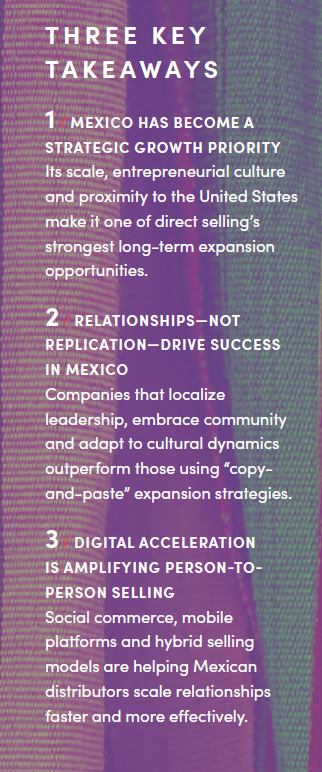
One of the biggest mistakes international companies make is trying to apply a “copy-and-paste” strategy from the US or Europe into Mexico. Mexico operates differently because relationships function differently.
This is a country built around family, community and trust. Consumers prefer buying from people they know. Recommendations carry enormous weight. Word-of-mouth still outperforms many expensive marketing campaigns.
Direct selling in Mexico is not a foreign concept—it is part of everyday life. A large percentage of Mexicans grew up surrounded by family-run businesses, known locally as abarrotes. These neighborhood businesses range from small grocery stores and restaurants to salons, repair shops, construction businesses and local services. Entrepreneurship is deeply embedded in the culture, often out of both opportunity and necessity.
Beyond economics, Mexico’s strong cultural identity, cuisine, music and sense of community create fertile ground for brands that localize effectively and connect emotionally with consumers.
A Global Economic Power
From a macroeconomic perspective, Mexico combines market scale with economic resilience. By early 2026, it ranked as the world’s 13th largest economy by nominal GDP and the second largest in Latin America after Brazil. Its growth is fueled by a robust manufacturing base, accelerating digital adoption, competitive labor costs and an expanding middle class that continues to strengthen consumer demand.
This is one of the reasons many global executives now refer to Mexico as the “China of the Americas.” The comparison is not just about manufacturing. Like China during its rapid growth phase, Mexico combines scale, entrepreneurship and digital acceleration. But Mexico has one major advantage over China for American companies: proximity.
The Biggest Strategic Advantage
I often describe this dynamic as a “two-way freeway.” The rapid growth of the Hispanic population in the United States is creating a powerful cross-border bridge where brands, talent, trends and revenue move in both directions. Did you know that remittances from the US to Mexico rank as the third largest source of income for the country? This is significant because these funds are sent back by Mexicans to support their families, and those same individuals will be the ones advocating for your business in Mexico.
Companies that understand this early can scale much faster than competitors trying to treat the two markets separately. When expansion is planned strategically, Mexico and the US Hispanic market can become one of the strongest combined revenue engines in the channel.
Digital Acceleration and Social Commerce
Mexico is experiencing rapid digital transformation, particularly among Millennials and Gen Z entrepreneurs. Social media penetration is extremely high; mobile commerce continues to expand aggressively; and platforms like TikTok, Instagram, Facebook and WhatsApp are no longer considered mere communication tools—they are business-building platforms.
Digital tools are not replacing direct selling; they are amplifying it. The future of direct selling in Mexico is hybrid: personal relationships build trust while digital platforms create scale.
MONAT Global is a strong example of this evolution. The company entered Mexico with a streamlined logistics structure and a TikTok-first strategy that helped generate profitability almost immediately while producing sustained double-digit monthly growth during its first several months of operation.

What Success Looks Like Now
Several companies have already demonstrated what success in Mexico looks like—here’s some key strategies they follow.
1 / Community Creates Scale
Herbalife has built one of the strongest direct selling operations in Mexico by shifting from simple transactional selling to community-based consumption. Its nutrition club model transformed the business by creating daily engagement, recurring consumption and strong social connection. Those clubs became communities, not just sales locations, and this model has been replicated across multiple markets globally.
The lesson is clear: in Mexico, community-driven engagement often outperforms traditional selling models.
2 / Local Culture Wins
Founded in Guadalajara, Omnilife understands something many foreign companies initially miss: Mexican consumers connect emotionally before they connect commercially.
The company has built its success around entrepreneurship, personal growth and emotional connection. Today, Omnilife remains one of the strongest nutrition players in the region because it understands the culture first.
3 / Mexican Heritage Meets Global Scale
Celebrating its 30th anniversary, NICE has grown into one of the most influential direct selling companies in the Americas. Built on more than 80 years of jewelry manufacturing expertise across three generations, the company operates one of the world’s largest jewelry factories, exporting millions of pieces to more than 27 countries.
With a network of more than 2 million independent entrepreneurs across Mexico, the United States and Costa Rica, NICE combines relationship-driven selling with ecommerce scale. Its success demonstrates how Mexican brands can compete globally through manufacturing strength, cultural authenticity and entrepreneurial opportunity.
Navigating Challenges: Political and Regulatory Realities
Like every international expansion market, Mexico comes with challenges. Political uncertainty, regulatory complexity and security concerns in certain regions require careful planning and experienced local leadership.
Companies that underestimate localization often struggle operationally. However, these challenges are manageable with the right structure, compliance systems and local expertise.
Organizations like the AMVD continue to play an important role in supporting ethical standards and industry stability.
A Strategic Imperative
Over the past several years, I have helped multiple companies enter and scale within Mexico, and the pattern is remarkably consistent: once companies truly understand the culture and adapt their strategy to the local market, growth accelerates rapidly.
Mexico is no longer a secondary expansion play—it is a strategic priority. However, success requires more than simply launching operations. Companies must understand the market’s complexity; empower local leadership; and execute against a clear short-, mid- and long-term expansion strategy.
The combination of a deeply entrepreneurial culture, significant distributor potential, rapid digital adoption, economic scale and close proximity to the United States creates one of the most compelling and balanced growth opportunities in the global direct selling industry today.
For future-focused companies, the question is no longer whether to invest in Mexico, but how quickly they can scale within it. The companies that win will be the ones willing to think boldly, invest aggressively and demonstrate long-term commitment to the market. That means hiring strong local talent, putting experienced teams on the ground, investing in products, compensation structures and operations—and giving local leadership the authority to build momentum and trust with the field.
When distributors see that corporate leadership believes in the market and is committed for the long term, growth follows. Mexico represents a massive opportunity, but success depends on having local expertise, empowering teams and adapting the business model to the realities of the market. Viva México!

ALEX HOFFMANN is a seasoned executive with more than 33 years of experience in the direct selling space across LATAM, the Americas and Europe, including over 25 years of experience operating in Mexico.
From the July/August/September 2026 issue of Direct Selling News magazine.