Monday / October 5. 2026
menu-logo menu-logo
brand-logo
Subscribe
Subscribe
Monday / October 5. 2026
  • Read
    • Daily News
      • Financial
      • Insights
      • U.S.
      • International
    • Digital Issue
    • Executive Announcements
    • Cover Stories
    • Feature Articles
      • Exclusive Interviews
    • International Focus
    • Company Spotlights
    • Forward Thinking
    • Legal Briefs
    • Insights from the Outside
    • For You | For Your Field
    • Working Smart
  • Listen & Watch
    • Direct Approach Podcast
    • What’s Working in Direct Selling
    • BUILT TO LAST
      • Zinzino
      • PM-International
      • LifeWave
    • The DSN Podcast
  • ATTEND
  • Achieve
    • Global 100 List
    • Bravo Awards
    • Best Places to Work
    • Legends
  • Research
    • Stock Watch
    • DSN Supplier Sponsors
    • The DSN Guide
    • Supplier Directory
    • Stock Ticker
    • Resources
  • Engage
    • About DSN
    • Supporter Program
    • Subscribe
    • Advertise
    • VIP Text Alerts
    • Connect
  • Search
Subscribe

Tocara Acquires Swarovski’s Touchstone Crystal

April 1, 2026 by DSN Staff Writer

Tocara Group announced its acquisition of Touchstone Crystal, the US-based direct selling branch of Swarovski. Tocara has a distributor network across Canada and parts of the US, and has built its brand reputation across almost two decades of operations focusing on creating quality jewelry that is timeless and trend-relevant.

“We are thrilled to welcome Touchstone Crystal into the Tocara family,” said Randall Markus, Tocara Founder & CEO. “This partnership builds on Touchstone Crystal’s strong heritage and loyal US customer base, while combining it with Tocara’s 40-plus years of jewelry expertise and modern direct-selling strategies. Together, we see significant opportunity to expand the offering and deliver even greater value for brand partners and customers in the years ahead.”

Swarovski stated the transition is part of its commitment to enhance focus on its own portfolio and brand strategy and stated the acquisition “supports Swarovski’s continued focus and reinforces our core areas of strength.”


Filed Under: Daily News Tagged With: Randall Markus, Swarovski stones, TOCARA, Touchstone Crystal

Juice Plus+ Named Best Superfood Supplement

April 1, 2026 by DSN Staff Writer

Juice Plus+ Superfood Powder was named the Best Superfood Supplement at the 2026 NewBeauty Awards. This 16th annual awards ceremony honored the best products and treatments, curating the list through testing, investigation and reporting. NewBeauty staff and judges conducted thorough product testing, statistical research and expert interviews, including the survey of 150 board-certified dermatologists and plastic surgeons, who offered their opinions on the best in-office treatments and effective at-home products.

Juice Plus+ Superfood Powder is a blend of 30 fruits and vegetables that includes no added sugar, and is designed to support whole health, from cardiovascular wellness to skin hydration.

“I’ve been drinking this for about six months now and I absolutely love it,” said Britt Fallon, NewBeauty Director of Beauty. “It tastes good, reduces the guilt I have as a busy mom who doesn’t always eat a balanced diet and is backed by brilliant minds who have done the scientific legwork to prove its efficacy.”

Filed Under: Daily News Tagged With: Award, Juice Plus+

In Memoriam: Richard Rogers

April 1, 2026 by DSN Staff Writer

Richard Rogers, son of Mary Kay Ash and former Co-Founder and Chairman Emeritus of Mary Kay, has passed away.

Rogers was born April 15, 1943, and attended North Texas State University before serving in the Marine Corps Reserve. Together with his mother and siblings, Rogers launched Mary Kay Cosmetics in 1963, helping turn the brand into a cultural icon and legacy recognizable around the world. He was named CEO in 1968, and in 1976 led the company through public listing on the New York Stock Exchange. In 1985, he led the leveraged buyout that returned the company to privately-held status.

During his tenure, Rogers was essential to creating the company’s signature pink Cadillac program. He was named chairman in 1987, and then returned as CEO in 2001.

“The entire Mary Kay family—including millions of independent sales force members across 40 markets—mourns this loss,” the company wrote in a statement. “Richard ensured the company was placed in excellent hands many years ago. The Mary Kay Leadership Team, including his son, Ryan Rogers, serving as Chief Executive Officer, remains firmly committed to upholding Mary Kay’s vision, principles and enduring opportunity for women around the world. On behalf of our Board of Directors, Executive Team and Employees, we extend our deepest sympathies to Richard’s family and friends during this difficult time.

Filed Under: Daily News Tagged With: Mary Kay, Mary Kay Ash, Richard Rogers

Amway Reports Full-Year 2025 Financial Results

March 31, 2026 by DSN Staff Writer

Amway announced its financial results for 2025. Sales in 2025 were $7.3 billion. The company stated that “while sales were modestly lower than the previous year, the company advanced key priorities across the business, with many markets and product launches outperforming forecasts and building positive traction heading into 2026.”

The company has seen positive responses to its latest products and expects its strong, connected community of Amway Business Owners will drive momentum in the coming year.

“As we look to the future, we are in a strong position to make the most of the possibilities ahead,” said Michael Nelson, Amway President and CEO. “Firmly rooted in our foundation, we will continue to answer societal needs with clarity and confidence, supporting the success of ABOs and the lives of customers around the world.”

Amway described its business opportunity as a bridge that addresses the gap between entrepreneurial dreams and the challenge of overcoming limited capital and support. The company’s low-cost path to business ownership and user-friendly tools and education have been helping people build flexible income for decades.

“Beyond income potential, the Amway opportunity also fosters personal growth and meaningful connections,” Nelson said. “This is increasingly important at a time when loneliness is recognized as a growing global concern. In 2025, more than one million people around the world chose Amway to help them build businesses and relationships, and we believe that number will only continue to grow.”

Holistic health and wellbeing with an emphasis on “healthspan,” helping people live healthy for as long as possible, has been a major focus of the company as it expands its product portfolio. New products in 2025 included: Nutrilite AmCell, the company’s first cellular health product; Artistry LongXevity, a skincare collection designed with botanical and science-backed ingredients; and the eSpring Water Purifier system, which uses an advanced e3 Carbon Filter and UV-C LED technology to reduce contaminants while retaining beneficial minerals.

“Amway offers solutions to some of today’s most pressing needs,” Nelson said. “We combine a low-risk opportunity to business ownership, products that support health and wellbeing, and a connection to community that so many are seeking – all rooted in our timeless values. In 2025, we focused on leveraging our long-standing strengths while pursuing new opportunities for growth. These intentional efforts position us for strong, sustainable performance in the years ahead.”

Filed Under: Financial Tagged With: Amway, Michael Nelson, quarterly

Natura Reconfigures Board of Directors

March 31, 2026 by DSN Staff Writer

Following the conclusion of its capital structure reorganization and corporate streamlining phase, Natura announced the reconfiguration of its board of directors, transitioning to a new Advisory Board that will focus on “preserving the company’s essence.” As part of the restructuring, Fábio Barbosa will step down as Chairman to join the Advisory Board alongside the company’s founders. The Advisory Board will hold no decision-making powers but will work to safeguard the values, culture and business methods that are distinctly Natura.

Alessandro Carlucci, who has been a Natura executive for more than two decades, has been appointed Chairman of the Board of Directors. The new board will include the following members:

  • Pedro Villares
  • Guilherme Passos
  • Luiz Guerra
  • Flávia Almeida
  • Gabriela Comazzetto
  • Duda Kertesz
  • João Paulo Ferreira
  • Gilberto Mifano

These changes are part of Natura’s strategy to accelerate a new and robust cycle of expansion with a focus on business growth in Latin America. In support of this new cycle, Natura also announced the signing of a new agreement between its founders and other signatories for a term of 10 years.

“Natura has completed a fundamental phase in strengthening its structure,” said Fábio Barbosa, Natura Chairman. “We close this chapter with a more agile, streamlined and resilient company, and begin a natural transition that has been carefully planned over the course of months. I will continue to work alongside the founders, supporting a new generation of board members and leaders. Together, we will drive a cycle of growth and innovation, always guided by the values that make Natura a unique company.”

Along with this leadership restructuring, Natura announced that private equity fund Advent International has purchased an 8-10% equity stake in the company. This purchase is subject to a target average price of $1.86 per share and will be carried out in the secondary market over a six-month period. As part of the agreement, Advent will be entitled to appoint two members to Natura’s board of directors.

Filed Under: International Tagged With: Fabio Barbosa, Natura

Atomy Recognized for its Electric-Based Beauty Device

March 30, 2026 by DSN Staff Writer

Atomy was honored at the 51st International Exhibition of Inventions of Geneva in Switzerland. The company took home three awards, including the Special Prize, Bronze Prize and a Saudi Arabia Special Prize for its EPRI Skin Cleansing Device.

The beauty device, jointly developed with the company’s partner Electri Co, Ltd., combines electroporation and reverse iontophoresis to form microscopic channels in the skin barrier through electrical stimulation. A silicone brush enhances the removal of fine and ultrafine pollutants. This design allows waste products to be expelled externally, which the company says overcomes the common limitations of conventional physical cleansing.

“These awards are a result of international recognition of our technological capabilities and innovation,” said Hong Jin-hyuk, Atomy Head of Global Home Appliance Business Division. “We will continue research and development to secure competitiveness in the global market.”

The Atomy EPRI Skin Cleansing Device is scheduled for release later this year, and Atomy stated that this honor is proof of the commercialization potential of its electric-based skin cleansing technology.

Filed Under: International Tagged With: Atomy, Award, Hong Jin-hyuk

Realty of America Adds 3,000 Agents in 17 Months

March 27, 2026 by DSN Staff Writer

Realty of America (ROA) has become one of the fastest growing brokerages in the nation, reaching 3,016 agents in 17 months. The company launched in September 2024 and has since surpassed more than $4.6 billion in closed volume and more than $5.5 million in revenue share to its agents. These milestones, the company believes, reflect strong national adoption.

ROA’s model is designed to be nimble, with no corporate debt or outside investors, so it can remain focused on driving agent success and staying aligned with its mission of alleviating the burden of recruitment, operations, technology and support for brokers who want an alternative environment built for production, collaboration and growth.

“Reaching 3,000 agents in 17 months confirms that agents across the country were ready for a platform built on collaboration and ownership,” said Eddie Garcia, Realty of America Founder and CEO. “When agents align under one vision, growth accelerates.”

ROA will host its first national convention in Dallas, Texas later this year as it works toward its goal of reaching 7,000 agents by the end of 2026.

Filed Under: Daily News Tagged With: Eddie Garcia, Realty of America, ROA

Herbalife Acquires Bioniq Assets

March 26, 2026 by DSN Staff Writer

Herbalife Ltd. announced an agreement to acquire certain assets from UK-based personalized supplement company Bioniq. Bioniq’s offerings are expected to complement Herbalife’s previous acquisitions of Pro2col and Link BioSciences as it expands its range of personalized nutritional supplements and delivery formats.

Bioniq’s personalized supplement formulas use a patented product personalization engine, as well as an individual’s health data and a proprietary database of biomarkers to design supplement options that address a wide range of needs, from everyday wellness to elite athletic performance. Cristiano Ronaldo, who has been a Herbalife global nutrition partner since 2013 and is a Bioniq shareholder, is supportive of the acquisition and Herbalife’s vision to accelerate the availability of personalized nutritional supplements at scale through a global distributor network.

“Throughout my career, biometrics and personalized nutrition have been central to helping me perform and compete at the highest level,” Ronaldo said. “As a longtime Herbalife and Bioniq user, I’ve experienced firsthand how a tailored approach to nutrition can help optimize performance. I’m delighted to see Bioniq’s personalized supplements become part of Herbalife’s expanding access to nutritional supplements, helping people take a more informed approach to their health, wellness and performance.”

The transaction is expected to close in the second quarter of 2026 and will include a purchase price of $55 million, to be paid across five years, with contingent payments up to $95 million based on future performance. Herbalife also obtained a call option to acquire Bioniq LAB, a separate platform focused on small molecules and peptides, which the company stated will provide strategic flexibility to evaluate potential longer-term opportunities in a capital-efficient manner.

“The future of health and wellness is becoming more personalized and informed by data,” said Stephan Gratziani, Herbalife Chief Executive Officer. “By combining Bioniq’s personalized supplement technology with Pro2col and the power of our global distributor network, we are expanding our ability to deliver personalized wellness at global scale.”

Bioniq supplements are expected to be available through Herbalife distributors for customers in Europe and the US later this year.

Filed Under: Daily News Tagged With: Bioniq, Herbalife, Stephan Gratziani

USANA CellSentials Earns ConsumerLab.com Seal of Approval

March 25, 2026 by DSN Staff Writer

USANA announced that its flagship CellSentials supplement has been awarded the ConsumerLab.com Seal of Approval, a third-party certification that uses rigorous standards to test for purity, potency and label accuracy. CellSentials went through extensive independent testing and was determined successful at delivering its stated nutrient levels and passed all contaminant screenings.

“Independent verification from ConsumerLab.com provides added confidence that CellSentials delivers the quality, potency, and label accuracy our customers expect,” said Brent Neidig, USANA Chief Commercial Officer. “As the foundation of our product portfolio and often the first product customers experience, it’s vital that we consistently deliver a clean, high-quality supplement exactly as promised.”

CellSentials is formulated with more than 40 essential vitamins, minerals and antioxidants and was designed to support the body’s natural ability to respond to occasional stress and maintain healthy function through targeted cell-signaling pathways. The product also includes USANA’s patented InCelligence Complex, that now features pyrroloquinoline quinone (PQQ), a sophisticated ingredient known to support mitochondrial biogenesis, or new mitochondria production.

“ConsumerLab.com’s approval reinforces USANA’s reputation as a leader in scientific innovation and product quality,” the company wrote in a statement. “Through continuous investment in research, state-of-the-art manufacturing and gold-standard testing protocols, USANA remains committed to delivering premium nutritional products that not only meet but exceed industry expectations.”

Filed Under: Daily News Tagged With: Brent Neidig, ConsumerLab, ConsumerLab.com, USANA

Social Commerce Is the New Revenue Driver

March 24, 2026 by DSN Staff Writer

This year, social commerce is expected to account for approximately 20% of all online retail sales, according to global data analytics and market research company Statista. This type of selling, which drives purchases through social platforms like TikTok Shop, LTK and influencer links, enables instant shopping for potential customers who can browse and buy without leaving their platform of choice.

The key for brands seeking to capitalize on this movement is to create shoppable content, whether through original content that connects with followers, like livestreamed testimonials and product demos, or collaborations with influencers who align with company mission. These types of partnerships can be invaluable, and last year Shopify reported that almost 75% of buyers believed that influencer recommendations affected their buying decisions.

Influencer partnerships aren’t a replacement for the personal distributor relationship, but rather an expansion that builds authenticity and trust through real customer experiences and brand communities. User-generated content (UGC), or tagged content on a personal account, can be a valuable tool in this category because the photos and videos are about real shoppers and their authentic customer experiences, rather than a promotional push by the brand.

Shopify recommends capitalizing on this evolution through omnichannel campaigns that behave “like one continuous conversation, no matter where the swipe, tap or scan happens.” Most social platforms have integrated “buy” buttons now, but it’s critical to develop content that feels native to the platform. That means rotating formats, creating content with entertainment value that stands out in a saturated market and making sure that everything from discovery to checkout feels friction-free.

Filed Under: Insights Tagged With: Shopify, social commerce, Statista

Social Commerce 101

March 23, 2026 by Stuart Johnson

Digging deeper into what it means for direct selling right now.

In the months following our initial discussion of social commerce, I have continued to approach this topic not as a trend to be observed, but as a system to be understood. That distinction matters, particularly in a channel where behavior often precedes language.

That process has involved conversations with executives, consultants, platform experts and thought leaders working at the intersection of content, community and transaction. I am grateful to those who contributed their thinking, including Fractional CMO Kathleen Ross and several industry sources who are actively operating in this space. Their perspectives reinforce a central idea: before we determine how to respond to social commerce, we need to be precise about what it is—and equally precise about what it isn’t.

Our first article established a working definition. This article continues the conversation. The question for this channel is no longer definitional. It is directional. What matters now is understanding what social commerce represents in practice; how it aligns with the underlying principles of direct selling; and what leadership teams should be doing in response.

What Social Commerce Actually Is

There remains a tendency to reduce social commerce to a set of tactics—posting content, sharing links or hosting live streams. While those activities are part of the ecosystem, they do not define it. Framing social commerce that way risks treating it as an extension of marketing, when it represents a shift in how the customer journey now takes place.

As Kathleen explains, “Social commerce recognizes that the entire customer journey—from discovery and recommendation through purchase—is increasingly taking place within a social environment.”

That distinction is more than semantics. In traditional ecommerce, discovery happens in one place; evaluation in another; purchase in yet a third. Social commerce compresses those steps into a single environment, often within a single platform. The conversation, the recommendation and the transaction are no longer separated by design. They exist in a continuous flow. That shift changes not just where transactions happen, but how they are influenced.

For many areas of retail, this represents a meaningful departure from established patterns. For direct selling, it should feel far more familiar, because the channel has always operated in a space where trust and transaction are closely linked.

The Spectrum of Social Commerce

For leaders new to the concept, it is important to recognize that social commerce does not operate in a single, fixed format. It exists on a spectrum.

On one end, a distributor’s content—such as an Instagram Reel or short-form video—drives discovery, and the customer completes the purchase through a company website. On the other end, some organizations have established direct platform integrations where the entire transaction occurs within the social environment itself.

Most direct selling companies fall somewhere in between these two extremes, combining social-driven discovery with traditional purchasing pathways. All these scenarios represent social commerce. Understanding that range is essential, because it allows companies to engage with the model progressively rather than feeling pressure to adopt a single, fully integrated approach.

The Kitchen Table, Reimagined

Direct selling has historically taken place in environments defined by proximity and trust. Whether in a home, a small group setting or a one-on-one conversation, the structure of the interaction allowed for storytelling, demonstration and relationship-building to drive purchasing decisions.

The defining characteristic was not the setting itself, but the dynamic within it: people making decisions based on trust in the person presenting the product.

What’s happening now is not the replacement of that dynamic, but its expansion. As one industry source working closely with field-driven social commerce activity described it, the kitchen table did not disappear—it moved into the digital feed.

That shift is significant not because it changes how people buy, but because it dramatically changes how many people can be reached within a single interaction. A conversation that once extended to a small group can now extend to a much broader audience without losing the relational context that makes it effective.

Kathleen reinforces this continuity, noting that “direct selling has always been built on personal recommendations and trust. Social commerce is the connective tissue that closes the loop.”

In that sense, social commerce is not introducing a new model of behavior. It is scaling an existing one, allowing the same trust-based interactions to occur in environments that are more fluid, more visible and significantly larger in reach.

Why It’s Accelerating

The speed at which social commerce is developing is not the result of a single innovation, but of several forces that have been building independently and are now reinforcing each other. At the center of that convergence is a shift in consumer behavior. Increasingly, people are relying on recommendations, demonstrations and shared experiences rather than traditional forms of advertising.

This shift is not theoretical. Research from Boston Consulting Group shows that social media influencers have become the top source of purchasing influence, surpassing traditional search and advertising. At the same time, more than 80 percent of consumers now use social platforms as part of their product research process. These behaviors are not emerging—they are already embedded in how customers discover and evaluate products.

At the same time, platforms have invested heavily in infrastructure designed to support that behavior. Features such as in-app checkout, shoppable content and creator storefronts have reduced the friction between interest and purchase, allowing consumers to act on recommendations immediately rather than navigating through multiple steps.

Layered onto this is the rise of a creator economy, where individuals are not only influencing purchasing decisions but actively monetizing that influence. The result is an ecosystem where content, trust and transaction are increasingly interconnected.

This distinction matters. Social commerce is not a technology in search of adoption; it is a response to how consumers already prefer to discover and evaluate products.

Why Direct Selling Hesitates

Despite the alignment between social commerce and the core principles of direct selling, many executives continue to approach the topic with caution. The concerns that surface most frequently are not without merit. Questions around customer ownership, platform dependency, compensation integrity and compliance are grounded in real operational considerations.

Kathleen highlights one of the most immediate challenges when she notes that transactions occurring within social platforms often limit a company’s direct access to customer data. This introduces a layer of dependency that must be managed deliberately rather than ignored.

At the same time, many of the broader concerns stem from an assumption that social commerce represents a competing model rather than an adjacent one. That assumption tends to frame the conversation in terms of replacement—what is lost—rather than in terms of expansion—what is added.

Most of these concerns are not reasons to delay engagement. They are design considerations—and they can be addressed.

What Most Leaders Get Wrong

The most persistent misconception surrounding social commerce is the belief that it bypasses or replaces the distributor. In practice, the opposite dynamic is emerging. Social commerce is proving to be highly effective at expanding reach and accelerating product discovery at scale, but it does not eliminate the need for trust, education or community. Those functions remain central to the model and continue to be delivered through human relationships.

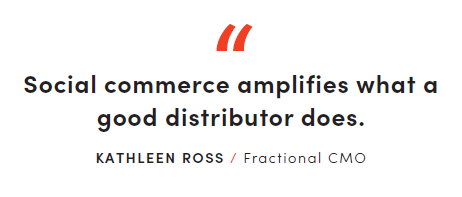
Kathleen addresses this directly, noting that “the fear that social commerce somehow replaces the need for a distributor—I actually think it’s the opposite. Social commerce amplifies what a good distributor does.”

What we are seeing is not a replacement dynamic, but a more integrated structure already taking shape across the market. Social commerce is not confined to discovery alone—it increasingly supports both acquisition and ongoing engagement, introducing products to new audiences while reinforcing continued interaction through content, community and repeat exposure.

The distributor relationship remains central, particularly in providing guidance, context and long-term connection, but it now operates alongside platform-driven touchpoints that influence both initial and repeat purchasing behavior.

Rather than separating acquisition and retention into distinct functions, social commerce is extending across the full customer journey—from initial discovery through ongoing engagement—often within the same environment. The opportunity for companies is not to assign these roles to different parts of the model, but to understand how they now overlap and reinforce each other.

When viewed through that lens, social commerce is not a disruption to the channel. It is a validation of the underlying principle that has always driven it: people buy from people they trust.

Where It’s Already Happening

One of the more important realizations for executive teams is that social commerce is not something that needs to be introduced into the model. In many cases, it is already present, operating across the field in ways that are not always fully recognized or measured.

Distributors are creating content, hosting live demonstrations, building audiences and driving product interest across multiple platforms. These activities are often treated as isolated efforts rather than as components of a broader system, but collectively they represent a meaningful level of participation in social commerce.

Kathleen captures this dynamic clearly when she observes that “these behaviors are already happening at scale. The question is whether the company has recognized it and built a strategy around it.”

This creates a situation where innovation is frequently occurring at the edge of the organization, driven by the field, while the systems designed to support and scale that innovation are still evolving. The gap between those two realities is where both opportunity and risk currently reside.

The Platform Reality

It is tempting to view social commerce through the lens of a single platform, particularly one that is receiving significant attention. That approach, however, tends to produce narrow strategies that are difficult to sustain.

TikTok currently represents one of the most integrated social commerce environments in the US market, but it is not the only one that matters, nor is it universally applicable across categories. Kathleen notes that “it would be a mistake to build a strategy around any single platform,” emphasizing the importance of understanding where products and audiences naturally align.

It is also important to recognize that TikTok is not the right fit for every category. Products that require deeper explanation, longer consideration cycles or more structured purchasing paths may perform better in environments that support more deliberate engagement.

For many direct selling organizations, Meta’s ecosystem remains a central environment simply because of the level of existing field activity. At the same time, other platforms contribute in different ways.

YouTube supports deeper product education and long-form trust-building, while affiliate and marketplace-driven environments like Amazon Live, LTK, ShopMy and TikTok Shop connect content directly to high-intent purchasing behavior.

Amazon Live operates differently because purchase intent is already present. Rather than driving discovery, it captures demand at the point of consideration, where customers are closer to deciding and conversion rates are typically higher.

In practice, the most effective strategies span multiple platforms rather than relying on one. Organizations that approach social commerce through a platform-specific lens will find themselves continually reacting to change. Those that focus instead on aligning product, audience and behavior across platforms will be better positioned to adapt as the ecosystem evolves.

What Leaders Should Be Doing Now

The response required at this stage is not a wholesale reinvention of the model, but a more deliberate alignment between what is already happening and how the organization is structured to support it.

In practical terms, this begins with visibility. Leadership teams need a clear understanding of how demand is being generated through social activity; how that demand is converting; and where the disconnects exist between field behavior and corporate infrastructure.

From there, the focus shifts to enablement. The foundational skills of direct selling—storytelling, demonstration and relationship-building—remain directly applicable, but the venues have changed. Communicating effectively in short-form video or live environments requires a different level of fluency, and that fluency must be developed intentionally—not assumed.

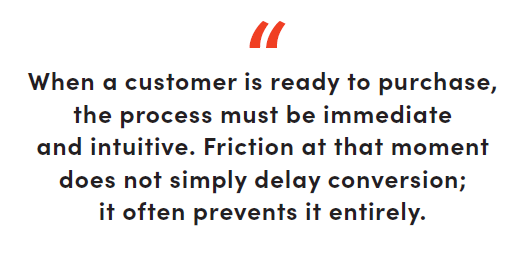
Equally important is the design of the path from content to transaction. Social commerce compresses time, reducing the distance between interest and action. When a customer is ready to purchase, the process must be immediate and intuitive. Friction at that moment does not simply delay conversion; it often prevents it entirely.

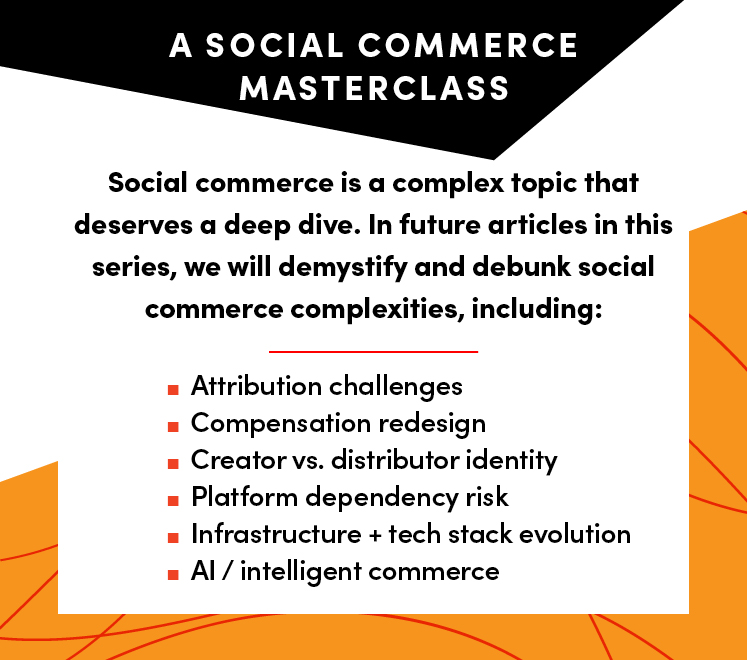
The most complex and, in many cases, least developed area is attribution. As interactions become more distributed across platforms, understanding how a specific piece of content or conversation leads to a transaction becomes more difficult. It also becomes more important, as compensation, motivation and strategic clarity rely on that understanding.

In more advanced implementations, companies are beginning to see how activity across platforms can reinforce each other—for example, how live shopping content can drive incremental demand in adjacent channels or how first-party data can be used to nurture customers after initial discovery.

Kathleen offers a practical perspective. “The field is already out there doing this. The fastest wins come from removing barriers for the people who are already active.”

Where This Is Going

Over time, the term “social commerce” will likely become less distinct, not because the concept will fade, but because it will become embedded in how commerce is generally understood. Consumers will move fluidly between content, conversation and transaction, often without distinguishing between them.

At the same time, the line between distributors, creators and influencers will continue to narrow. The underlying activity—building trust, creating content and recommending products—is already converging across those roles.

For direct selling, this evolution presents both a challenge and an opportunity. While systems and structures may need to adapt, the core competencies of the channel remain aligned with where commerce is heading.

The Real Question

Direct selling has always operated on a simple premise: relationships drive transactions. What is changing now is not that principle, but the environment in which those relationships are formed and expressed.

The shift we are witnessing is not from direct selling to social commerce. It is from a defined environment to a distributed one. Social commerce does not change the model. It extends it.

The question is no longer whether social commerce will shape the future of retail—it already is. The real question is whether direct selling companies will choose to lead that evolution or allow others to.


Where to Start—A Practical First 90-Day Focus

For executives looking to move from observation to action, the first step is not building something new—it is developing familiarity with how social commerce works. This begins with experiencing the platforms as a consumer: how products are discovered; how content drives interest; and how transactions occur within or alongside social environments. Without that perspective, strategy tends to be built on assumptions rather than experience.

From there, companies can begin developing clarity around what already exists internally. In most organizations, social commerce activity is already taking place across the field but is often fragmented and largely unmeasured.

A focused first phase should begin with a structured assessment of where and how distributors are engaging on social platforms. This includes:

  • identifying which platforms are most active
  • what types of content are generating engagement
  • where product interest is being created

The goal is not to evaluate performance in detail, but to establish visibility into behavior that is already influencing the business.

From there, companies should identify a small group of field leaders who are already effective in these environments. These individuals can serve as both a learning resource and a testing ground for new tools, training and systems.

At the same time, it is important to evaluate the current path from content to transaction. How many steps exist between interest and purchase? Where are potential customers encountering friction? In a social commerce environment, even small barriers can significantly impact conversion.

Finally, leadership should begin mapping how social-driven activity connects to revenue. Attribution does not need to be perfect in the early stages, but there must be a deliberate effort to understand how demand generated through content translates into measurable outcomes.


STUART JOHNSON, Founder & CEO, Direct Selling News, has served the direct selling industry for nearly 40 years. His passion for the channel encompasses a broader commitment to build and connect the direct selling community through exclusive industry events such as Direct Selling University and the DSN Global Celebration. Stuart is arguably the most connected person in direct selling. He has built an impressive and growing network of executives, thought leaders, strategists and innovators. His advice and counsel are sought after by leaders throughout the channel.

An Online Exclusive from Direct Selling News magazine.

Filed Under: Feature Articles Tagged With: Fractional, Kathleen Ross, social commerce, Stuart Johnson

The Real Brokerage Wins FinTech Breakthrough Award

March 23, 2026 by DSN Staff Writer

The Real Brokerage Inc. was recognized with the Business Lending Innovation Award at the 10th annual FinTech Breakthrough Awards. The honor celebrates the company’s embedded finance ecosystem Real Wallet, which centralizes agent access to financial tools like banking, tax planning and integrated lending through Real Wallet Capital. This embedded fintech helps agents manage cash flow, access their earnings fasters and secure working capital to invest in growing their businesses.

“Winning the Business Lending Innovation Award validates the unique experience we’ve built for agents,” said Dominic Parikh, Real Wallet General Manager. “With Real Wallet, agents have seamless access to on-demand funding to manage cash flow and invest in growth, with repayments that directly align with their earnings. This recognition from FinTech Breakthrough reinforces our vision of building the leading financial platform in real estate that is designed specifically around agents’ businesses and their long-term success.”

More than 7,000 agents across the US and Canada now use Real Wallet Business Checking Accounts, with total deposits reaching $22.5 million. To date, more than 1,100 agents have accessed more than $13.5 million in funding through the program’s embedded capital products.

“Traditional banking systems treat commissions as irregular income, with legacy brokerage and banking systems causing delays in getting paid, understanding an agent’s financial picture and even obtaining working capital,” said Steve Johansson, FinTech Breakthrough Managing Director. “Real Wallet introduces a new standard for B2B payments and lending: fast, automated, customizable and designed for the modern, independent entrepreneur in the competitive space of real estate. That makes Real Wallet from the Real Brokerage our choice for the ‘Business Lending Innovation Award.’”

Filed Under: Daily News Tagged With: Award, Dominic Parikh, REAL Brokerage

  • « Previous Page
  • 1
  • …
  • 23
  • 24
  • 25
  • 26
  • 27
  • …
  • 636
  • Next Page »
brand-logo
The News You Need.
The Name You Trust.
Subscribe

Breaking global news, emerging trends and powerful stories conveniently curated to help direct selling executives stay informed, engaged and a step ahead.

  • Read
  • Listen & Watch
  • Attend
  • Achieve
  • Research
  • About
  • Connect
5717 Legacy Drive
Suite 250
Plano, Texas 75024
info@directsellingnews.com
Copyright 2026 Direct Selling News | All Rights Reserved
  • Privacy Policy
  • Terms of Use
  • Advertise
  • Subscribe
We use cookies on our website to give you the most relevant experience by remembering your preferences and repeat visits. By clicking “Accept All”, you consent to the use of ALL the cookies. However, you may visit "Cookie Settings" to provide a controlled consent.
Cookie SettingsAccept All
Manage consent

Privacy Overview

This website uses cookies to improve your experience while you navigate through the website. Out of these, the cookies that are categorized as necessary are stored on your browser as they are essential for the working of basic functionalities of the website. We also use third-party cookies that help us analyze and understand how you use this website. These cookies will be stored in your browser only with your consent. You also have the option to opt-out of these cookies. But opting out of some of these cookies may affect your browsing experience.
Necessary
Always Enabled
Necessary cookies are absolutely essential for the website to function properly. These cookies ensure basic functionalities and security features of the website, anonymously.
CookieDurationDescription
cookielawinfo-checkbox-analytics11 monthsThis cookie is set by GDPR Cookie Consent plugin. The cookie is used to store the user consent for the cookies in the category "Analytics".
cookielawinfo-checkbox-functional11 monthsThe cookie is set by GDPR cookie consent to record the user consent for the cookies in the category "Functional".
cookielawinfo-checkbox-necessary11 monthsThis cookie is set by GDPR Cookie Consent plugin. The cookies is used to store the user consent for the cookies in the category "Necessary".
cookielawinfo-checkbox-others11 monthsThis cookie is set by GDPR Cookie Consent plugin. The cookie is used to store the user consent for the cookies in the category "Other.
cookielawinfo-checkbox-performance11 monthsThis cookie is set by GDPR Cookie Consent plugin. The cookie is used to store the user consent for the cookies in the category "Performance".
viewed_cookie_policy11 monthsThe cookie is set by the GDPR Cookie Consent plugin and is used to store whether or not user has consented to the use of cookies. It does not store any personal data.
Functional
Functional cookies help to perform certain functionalities like sharing the content of the website on social media platforms, collect feedbacks, and other third-party features.
Performance
Performance cookies are used to understand and analyze the key performance indexes of the website which helps in delivering a better user experience for the visitors.
Analytics
Analytical cookies are used to understand how visitors interact with the website. These cookies help provide information on metrics the number of visitors, bounce rate, traffic source, etc.
Advertisement
Advertisement cookies are used to provide visitors with relevant ads and marketing campaigns. These cookies track visitors across websites and collect information to provide customized ads.
Others
Other uncategorized cookies are those that are being analyzed and have not been classified into a category as yet.
SAVE & ACCEPT