
From five years to eight decades, direct selling companies share what they’ve learned about resilience, reinvention & lasting success.
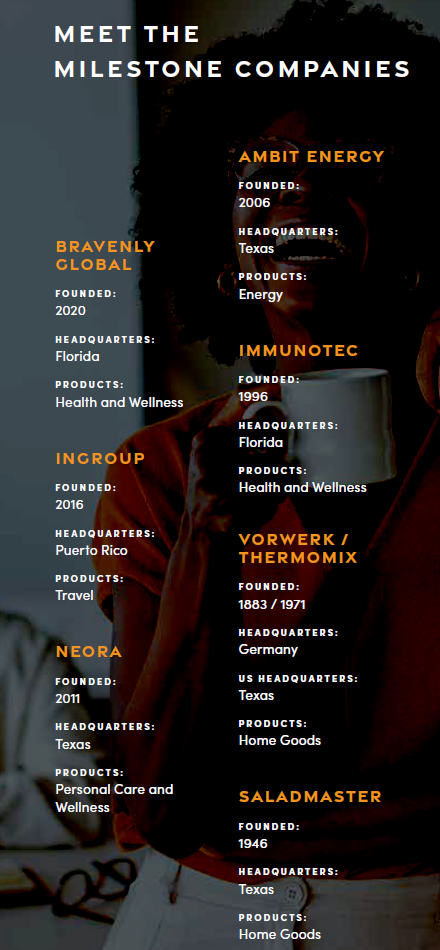
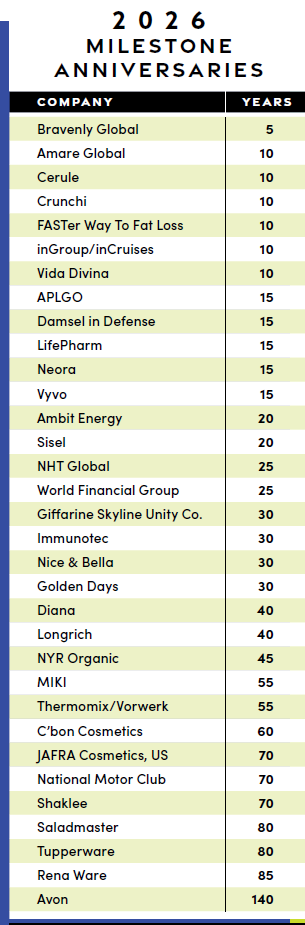
Across categories, company sizes and business models, direct selling companies are marking 5, 10, 15, 30, 55, 80—even more than 100—years in business. Some launched in a world of smartphones, social commerce and influencers. Others were selling person-to-person when families still gathered around the radio for news.

That range feels particularly noteworthy right now. Direct selling continues to evolve and find its footing in a new economy and a radically different shopping environment. Consumer expectations have shifted. Technology has transformed how products are discovered, purchased and shared. The gig and creator economies have dramatically expanded the options available to people seeking supplemental income. And the channel itself continues to rethink long-held assumptions about what direct selling should be.
There are real challenges in that transformation. But these anniversaries offer a real reminder of the channel’s viability and potential.
Rather than simply celebrate the anniversaries, DSN wanted to understand what they represent. We spoke with leaders from companies at dramatically different stages of the journey. We asked what they’ve learned; what they’ve overcome; what they’re still trying to figure out; and—perhaps most importantly—what they’re doing now to ensure there are many more anniversaries ahead.
Earning Another Year
There’s a temptation to view longevity as cumulative—as though every year in business makes the next one somehow more certain. But these leaders don’t see it that way.
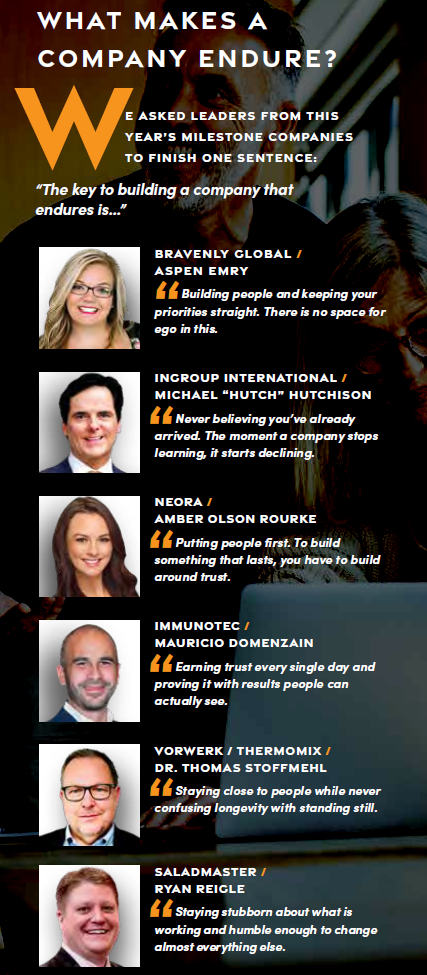
“Eighty years isn’t a number you inherit. It’s a number you re-earn every single year,” explained Ryan Reigle, Chairman and CEO of Regal Holdings, owner of Saladmaster.
Michael “Hutch” Hutchison, Founder and CEO of inGroup, used remarkably similar language to describe his company’s first decade: “Anniversaries aren’t about celebrating another year—they’re about earning another year.”
Amber Olson Rourke, Co-Founder and Co-CEO of Neora, agreed. “In this industry, longevity is earned.” For Rourke, 15 years validates the idea that a company can remain committed to purpose, principles and people while still having “the courage to keep reinventing itself.”
At 30 years, Immunotec CEO Mauricio Domenzain sees longevity as proof of something equally fundamental: a foundation strong enough to withstand changing markets and trends. Immunotec began as a research company before becoming a direct selling company, and Domenzain credits that with fueling long-term stability. “That discipline is why we’re growing rapidly today.”
Ambit Energy, celebrating 20 years, offers another perspective on what it means to endure. Chief Development Officer Eric Reisdorf points out that while electricity itself is an essential service, longevity in the category is anything but assured. “This is a complicated and challenging business, and Ambit’s longevity is a true testament to the ‘never quit’ mentality woven into the fabric of the brand.”
At Bravenly Global, Founder and CEO Aspen Emry views longevity from the other end of the spectrum. The company is still relatively early in its story, but she already sees success less as a destination than a repeated choice. “Success isn’t measured by how quickly you grow, but that you keep showing up, keep serving, keep innovating and keep holding true to the values and commitment you had the very first day.”
Taken together, those perspectives—from five years to 80—challenge the idea that longevity is something a company eventually achieves. It’s something a company continually proves. And while that proof looks different at every stage—surviving the fragile early years, turning momentum into durability or maintaining relevance across generations—the goal is ultimately the same: build a legacy without allowing legacy to become complacency.
Relevance Is Never Guaranteed
Perhaps the greatest challenge to longevity is determining what must evolve—and what must not. Today’s direct selling companies operate in a vastly expanded competitive landscape. They’re not simply competing against one another. They’re competing with Amazon, TikTok Shop, affiliate marketing, the creator economy, gig work and countless other platforms offering convenience, products, income or attention.
“We can’t simply be ‘good for direct selling,’” Rourke shared. “We have to deliver a world-class customer experience and a world-class entrepreneurial experience—period.”
At 80 years, Saladmaster faces the same challenge but from a very different starting point. For most of its history, relationships began in kitchens and homes. Now, those introductions are just as likely to happen through a screen. “The kitchen table may have moved online, but trust must be earned the same way it always has,” explained Ayo Olaseinde, Saladmaster Board Chair.
That tension—embracing technology without automating away the relationship—is one nearly every leader raised. Rourke calls Neora’s approach “high tech and high touch,” investing in AI, personalization and digital shopping while maintaining an equally strong focus on mentorship, events and community. “The companies that win the next decade will use technology to amplify people—not replace them.”
Bravenly is tackling a similar balancing act at five years old: becoming more sophisticated operationally while maintaining simplicity for the field. Its investments in leadership, technology, education and infrastructure pass through one filter: Does this help the average person succeed?
Vorwerk CEO Dr. Thomas Stoffmehl sees the same tension from the perspective of a company with more than a century of history as it celebrates the 55th anniversary of its flagship product, Thermomix. “We modernize the tools around direct selling. We do not remove the human connection that makes it successful,” he explained.
At every stage of the journey, future proofing isn’t about abandoning the fundamentals. It’s about continually finding more relevant ways to deliver them.
Built in the Hard Years
Anniversaries naturally invite companies to remember their biggest successes. But some of the most consequential moments in these companies’ histories weren’t victories at all. They were crises.
For inGroup, one came before the company had even properly launched. Just weeks before opening, its original cruise supplier unexpectedly withdrew. Hutchison now calls that moment “our first great blessing disguised as our first great crisis.” It forced the company to determine what kind of organization it intended to be before it had much of an organization at all. Years later, when the pandemic brought cruising to a halt, those lessons mattered.
“Resilient organizations recover from adversity; they become better because of it,” Hutchison said. “Many of the challenges we would never have chosen became catalysts for some of our greatest improvements.”
Neora offers another powerful example of resilience forged through adversity. The company emerged victorious from a seven-year legal battle with the Federal Trade Commission, defeating all the agency’s claims in federal court. Rather than simply return to business as usual, Neora used the years that followed to continue evolving its model, including an emphasis on customer-first social commerce. By the end of 2025, the company reported 47 percent year-over-year sales growth.
For Rourke, that experience reinforced a lesson that extends well beyond a courtroom. “Don’t confuse momentum with durability. Use the good years to build the infrastructure, leadership, product pipeline, financial discipline and culture you’ll need during the harder years.”
Reisdorf recounted how a pivotal decision for Ambit Energy made before a crisis helped determine how well the company could weather it. The electricity provider was acquired by Vistra in 2019. Not long afterward, Winter Storm Uri disrupted the Texas electricity grid, sending wholesale prices soaring and putting several electricity companies out of business. “As an independent power producer, Vistra was the perfect parent company to ensure that Ambit would weather that storm and be well-insulated from future disruptions in the wholesale market.”
Immunotec’s 30-year story has been shaped by a different kind of discipline. Domenzain points to the company’s roots in scientific research as a driver of growth through changing wellness trends and market cycles. “The wellness industry chases trends. I chase truth, and I built this company to do the same.”
Different challenges require different responses. But adversity seems to have taught these companies a common lesson: the decisions made when conditions are difficult often have far more to do with longevity than the decisions made when everything is going right.
Culture Is Infrastructure
If one theme rivals adaptation, it’s culture. Not culture as a mission statement or corporate perk. Culture as infrastructure.
At five years, Bravenly is already grappling with how to scale relationships. As companies grow, Emry acknowledged, senior leaders naturally become further removed from the people they serve. The challenge is finding intentional ways to keep those connections strong. “Protect your culture more aggressively than your growth,” she advises.
Fifteen years in, Rourke has reached much the same conclusion. “Culture isn’t the soft side of business. Culture is a competitive advantage.” Products can be copied. Technology eventually becomes available to everyone. Compensation plans can be replicated. “But a high-trust community built over 15 years is extraordinarily difficult to duplicate.”

/shutterstock.com
At 30 years, Domenzain takes responsibility for culture personally. “Culture isn’t a poster on a wall. It’s something people feel the moment they walk in or log on,” he said. “I take that personally, and I protect it like a founder, not a caretaker.”
At Ambit, preserving culture following its acquisition by Vistra has meant finding common ground between the two organizations. “This approach of competing with winning intention while never cutting corners aligns perfectly with the culture that fueled Ambit’s tremendous growth in the years leading up to the acquisition,” Reisdorf said.
And at 80, Saladmaster provides a glimpse of what happens when culture must survive not just growth but generations of leadership. The company uses a shared vocabulary—Share, Build, Lead—that Olaseinde believes helps values endure because culture “doesn’t live in one person’s head. It lives in how every new person is welcomed in.”
If I Knew Then…
One of the most interesting ways to understand longevity is to look backward. So, we asked each leader to imagine talking to the CEO of a company exactly five years behind them on the journey. What would they tell them?
The answers were remarkably practical.
At Bravenly, Emry would tell an earlier-stage leader to protect culture aggressively, stay present with the field and remain committed to the channel through its inevitable ups and downs.
Rourke would remind leaders to stay close to the field, particularly as a company matures. “Your Brand Partners will often see changes in consumer behavior before they show up in a corporate report.”
Stoffmehl would offer a similar lesson from a much longer vantage point. “A CEO of a people business should never lose that connection. Reports and presentations are important. But they cannot replace personal interactions.”
Hutchison would focus on leadership. “Don’t confuse business growth with leadership growth,” he said. “Businesses don’t outgrow their leaders. Leaders who keep growing create businesses that keep growing.”
Saladmaster President Joe Loch would tell younger companies to establish credibility before investing too heavily in messaging. Independently validating what a product can do gives the field something more powerful than a marketing claim: a fact that can withstand scrutiny.
Future Proofing Starts Now
Perhaps the most surprising thing about talking with companies celebrating anniversaries is how little time their leaders spend looking backward. They’re far more focused on what comes next.
Their investments vary widely: AI and personalization; product innovation; digital tools; global expansion, supply chain flexibility, compensation, leadership development. But the underlying objective was remarkably consistent across time and category: build an organization capable of changing without losing its identity.

Hutchison describes inGroup’s approach as investing simultaneously in leadership, systems and culture. “Leadership creates growth. Systems improve decision making. Culture creates longevity.”
Ambit has also spent the past 18 months modernizing the technology supporting its customers and websites. Reisdorf shared that the company is also investing more heavily in the front end of its compensation plan with the goal of creating earlier consultant success.
While Vorwerk continues to invest in products, digital capabilities and international markets, Stoffmehl stressed that “future-proofing starts with listening—with understanding what advisors and customers need and how those needs are changing.”
At Immunotec, investments span science, technology, manufacturing, digital tools, leadership development and global expansion. But when asked what is most important, Domenzain doesn’t hesitate: people.
Emry agrees. “People assume future proofing starts with technology. I think it starts with leadership. Technology matters, but leaders capable of building trust, communicating clearly and developing others will always have value.”
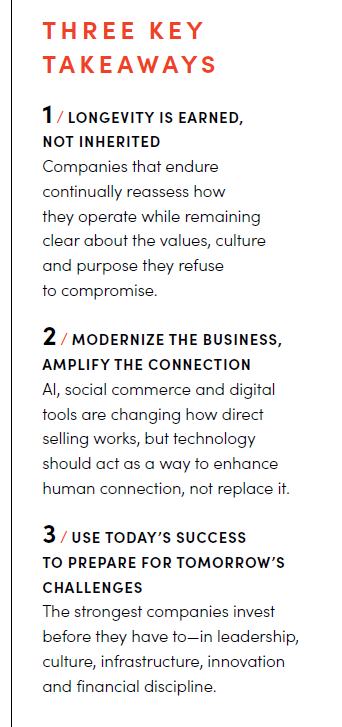
So, what’s the central lesson connecting companies separated by 75 years of experience? Future proofing isn’t predicting exactly what comes next. It’s knowing what can’t change while developing the willingness—and humility—to change almost everything else.
Playing for Keeps
There is no formula that guarantees a fifth anniversary will become a 15th—or that 80 years will become a century.
That’s particularly true in a channel navigating profound shifts in consumer behavior, technology, regulation and the way people work, shop and earn. But the companies celebrating milestones this year offer compelling evidence that direct selling’s fundamental value proposition remains viable—even as that value proposition continues to evolve.
Stoffmehl sees that continued relevance as a reason for confidence in the channel itself. “Direct selling is not a model from yesterday. It has evolved with changing customer expectations and the realities of modern life.”
Different milestones. Different challenges. Remarkably similar lessons. Don’t mistake momentum for durability. Don’t allow technology to replace relationships. Don’t sacrifice trust for speed. Protect the culture that made people want to join you in the first place. And never become so enamored with what got you here that you’re unwilling to change what will take you forward.
From the October/November/December 2026 issue of Direct Selling News magazine.