
Why the future of growth could be happening face-to-face.
For years, growth strategies were built on a simple premise: more content creates more opportunity. More posts, more campaigns and more visibility were expected to translate directly into stronger engagement and higher conversion.
And for a time, it worked—but now that equation is beginning to break down.
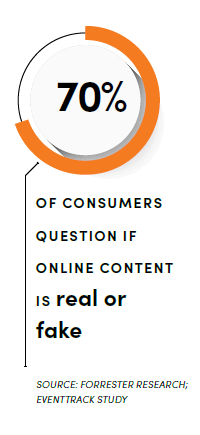
Consumers today are not just overwhelmed by the volume of content they are exposed to—they are tired of it. Despite getting more messages than ever before, customers are increasingly feeling ambivalent. Nearly 70 percent of consumers now question whether what they see online is real or fake, and only 25 percent say they trust advertising at all.
They scroll quickly, filter aggressively and question the validity of what they see. Instead of responding, many are choosing to disengage. And that level of skepticism fundamentally changes how decisions are made. It represents a move away from a growth model that is primarily focused on content toward something more foundational: trust.
The Conversion Gap
Digital channels remain powerful, but their role has shifted. Visibility is still achievable, but belief is no longer automatic. The gap between awareness and action has widened, and more exposure does not necessarily close it.
In fact, increasing output often compounds the problem. Fatigue is not driven by a lack of information—it’s driven by an excess of it. As brands compete for attention in increasingly crowded environments, messages blur together and differentiation becomes harder to establish.
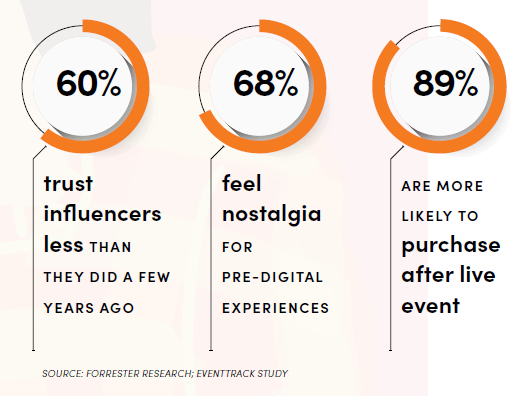
At the same time, trust in traditional digital signals is eroding. Sixty percent of consumers say they trust influencers less than they did just a few years ago, reinforcing a broader trend: authority is no longer assumed—it must be earned.
As a result, the strategies that once scaled effectively—more messaging, more frequency, more visibility—are delivering diminishing returns.
The Trust Equation
As digital fatigue grows, a countertrend is emerging. Consumers are placing greater value on experiences that feel direct, personal and unfiltered. They are seeking opportunities to engage in ways that allow them to observe, question and connect without relying solely on digital interpretation. This shift is not theoretical—it is behavioral.
Nearly 68 percent of consumers say they feel nostalgia for pre-digital experiences, and one in three actively plans to choose offline brand experiences in the coming year.
This signals a meaningful rebalancing. Digital interaction is no longer sufficient on its own. Consumers are seeking environments where trust can be built more naturally—through presence, interaction and shared experience.
A Natural Advantage for Direct Selling
This shift plays directly into the strengths of our channel. Long before digital platforms existed, direct selling was built on conversation, demonstration and relationship. Those fundamentals remain unchanged, but their relevance has increased in a fatigued and skeptical marketplace.
While other industries are now trying to recreate authenticity, direct selling already operates within it. Person-to-person interaction provides something content alone cannot replicate: context. It allows consumers to ask questions, evaluate outcomes and build trust in real time.
In this environment, that interaction becomes more than a differentiator—it becomes a necessity.
In-Person Events Drive Results
The resurgence of in-person engagement is not simply a trend; it is a response to digital fatigue. Consumers are seeking fewer distractions, more meaningful interaction and greater confidence in their decisions. In-person environments provide all three. They allow for focused attention, real conversation and immediate validation of the product experience. It is quickly becoming the quickest way to build the highest-converting metric: trust.
The data reflects this shift clearly. Eighty-five percent of consumers are more likely to purchase after attending a live brand event, and 70 percent go on to become repeat customers after just one in-person experience.
What digital often struggles to achieve over multiple touchpoints, in-person experiences can accelerate.
Simplicity in a Fatigued Market
Alongside fatigue, another issue has become more visible: complexity. As product offerings expand and messaging multiplies, it becomes harder for both consumers and distributors to navigate what matters most. Multiple entry points and competing narratives create friction, particularly in environments where attention is already limited.
When everything is being communicated, nothing stands out.
Simplicity offers a way forward. Clear, focused messaging allows for repetition, and repetition builds understanding. In a fatigued environment, clarity becomes more effective than comprehensiveness.
This does not require fewer products. It requires greater discipline in how those products are introduced and communicated.
A Return to What Works
The rise of digital fatigue does not diminish the importance of digital—it redefines it. Digital remains essential for building awareness and extending reach. But it is no longer sufficient on its own to establish trust or drive sustained engagement. That responsibility increasingly shifts to human interaction—through conversation, experience and community.
Organizations that recognize this are adjusting accordingly. They are using digital to initiate interest while creating opportunities for deeper one-on-one connection.
In other words—they are aligning with how consumers are actually behaving right now.
In many ways, this moment represents a return to fundamentals.
- Clarity in communication.
- Consistency in execution.
- Authenticity in interaction.
These principles have always mattered. But in a crowded and fatigued marketplace, they matter even more. Going forward, success will not be measured in the amount of content produced. It will be defined by the companies that create the most meaningful connection.

AMBER OLSON ROURKE, Co-Founder & Co-CEO, Neora, has more than a decade of leadership, marketing and direct sales experience and has been an integral part of Neora’s strategic development and growth. She provides strategic vision and leadership supporting the company’s global expansion while overseeing sales, product development, marketing, branding, communications and digital strategy.
From the July/August/September 2026 issue of Direct Selling News magazine.