How direct selling companies can thrive in the social commerce era.
Not long ago, marketers measured success by how efficiently they moved customers through a funnel.
Awareness led to consideration, consideration to evaluation and eventually—if all went according to plan—to purchase.
Today, that journey looks very different.
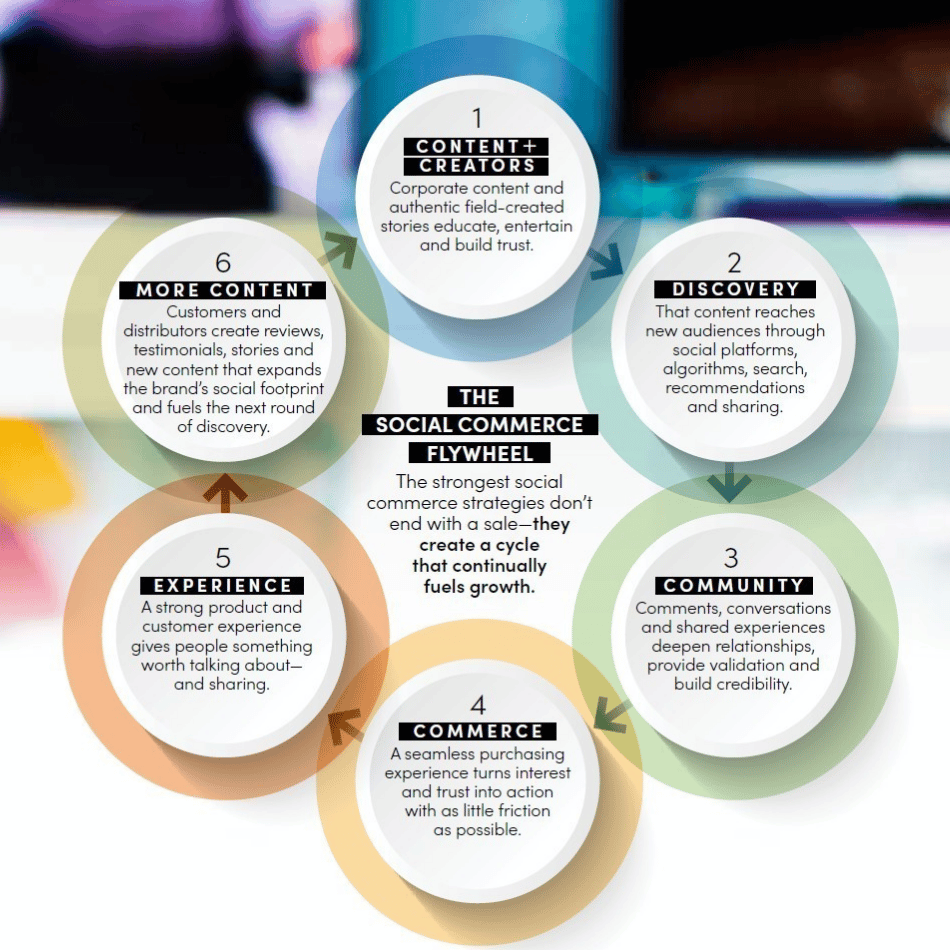
A customer might discover a product in a creator’s video, watch comments fill with testimonials, search for reviews in ChatGPT, see another recommendation on Instagram and complete a purchase—all in a matter of minutes. What once required dozens of carefully orchestrated marketing touchpoints now happens in a single, continuous digital experience.
That shift is at the heart of social commerce.
Social commerce is best defined as the new operating environment for commerce rather than simply another marketing channel. The implications are significant for direct selling because the channel has always excelled where relationships, trust and community intersect.
Those strengths haven’t become less valuable—they’ve become essential. The challenge is that the environment surrounding those strengths has fundamentally changed.
“The brand-controlled funnel has collapsed into a feed,” shared David Vanderveen, advisor and podcast host at Social Commerce News, during a recent Direct Approach podcast. “Discovery, trust and checkout now happen in one place.”
For direct selling executives, the question is no longer whether to participate in social commerce. The question is how to redesign systems, training and field support for a marketplace driven by creators, content and community.
Discovery Is the New Front Door
For decades, companies invested heavily in controlling the customer journey. Brands purchased advertising, optimized websites and refined search rankings to guide consumers toward a purchase. Today’s consumers increasingly begin somewhere else.
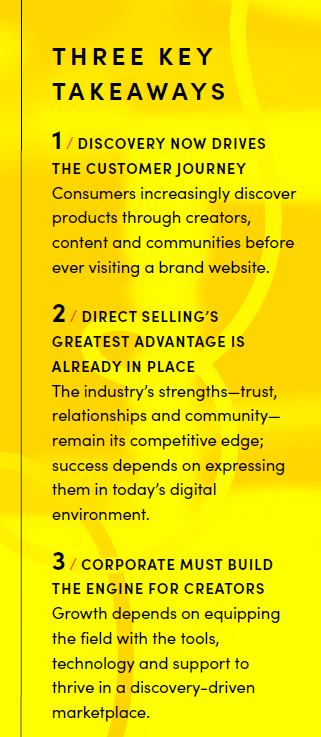
“They’re starting with discovery,” said Peter Griscom, President of Zinzino and advisor at Social Commerce News. “They’re finding products through social content, creators and communities before they ever arrive at a brand website.”
And that distinction matters.

Rather than searching for a specific product, consumers are often discovering products because someone they trust demonstrated a solution, answered a question or shared an authentic experience.
Algorithms surface recommendations based on interests instead of purchase intent, creating opportunities for brands long before a consumer actively begins shopping.
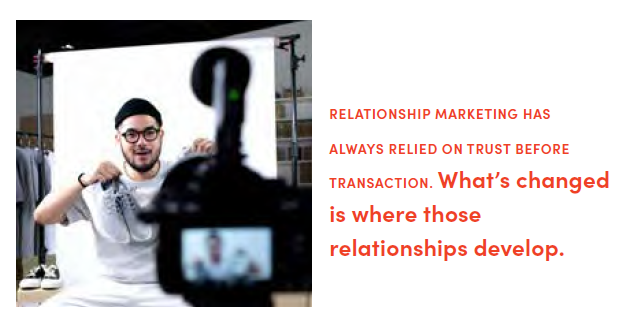
For direct selling, this isn’t an unfamiliar concept. Relationship marketing has always relied on trust before transaction. What’s changed is where those relationships develop. Kitchen table demonstrations have become livestreams. Product conversations happen in comments sections. Recommendations travel through short-form video instead of neighborhood gatherings.
Consumers haven’t stopped buying from people. They’re simply meeting those people in different places.
Content Has Become the Storefront
If discovery begins with content, then content is no longer simply marketing collateral. It is the storefront. That requires a fundamental shift in thinking for many brands.
Instead of asking, “How do we advertise this product?”, companies should begin asking, “Why would someone stop scrolling to watch this?”
Too many organizations still approach social platforms like digital brochures. As Vanderveen explained, “Nobody wants to be sold, but everybody loves to buy.” The difference may seem subtle, but it changes everything.
Successful content doesn’t begin with product features. It begins with curiosity, education, entertainment or solving a problem. Products become part of the conversation instead of the entire conversation.
Vanderveen often shares an analogy from his early retail career. Sales associates were discouraged from greeting shoppers with “Can I help you?” because customers immediately recognized it as the beginning of a sales pitch. Instead, associates started authentic conversations about the customer’s interests, creating opportunities for products to emerge naturally.
The same principle applies online. Whether the platform is TikTok, Instagram, YouTube or Facebook, audiences reward creators who consistently provide value. The product earns attention because the conversation earned trust.
Direct Selling Isn’t Behind—It’s Underbuilt
Perhaps the biggest misconception surrounding social commerce is that direct selling is somehow late to the party. In reality, many of the principles driving today’s fastest-growing consumer brands—relationship, authenticity, community and trust—have been the foundation of direct selling for decades.
The retail world has spent the last several years trying to recreate what direct selling already does well: building communities around people instead of products. Direct-to-consumer brands invest heavily in creators, ambassadors and loyalty programs because they understand trust drives conversion. Direct selling already has those assets in place.
The challenge is helping those assets perform in today’s digital environment.
Rather than asking distributors to fit into legacy systems, companies have an opportunity to redesign those systems around how consumers now discover products, engage with content and make purchasing decisions. Social commerce isn’t asking direct selling to become something new. It’s asking the channel to express its greatest strengths in new ways.
Your Field Is Already a Creator Network
Most consumer brands must recruit influencers to generate authentic content. Direct selling companies already have thousands of independent distributors sharing product experiences, customer stories and lifestyle content every day.
The opportunity is recognizing that direct selling may already possess one of the largest creator networks in retail—it simply hasn’t always treated it that way. “I think we need to put a lot more emphasis on teaching our partners how to be creators,” Griscom shared.
That means equipping the field differently than many organizations have historically done. Instead of relying primarily on replicated marketing materials, companies should be helping distributors understand platform-specific storytelling, short-form video, content repurposing and audience engagement.
Corporate marketing also has an opportunity to become a stronger partner. Rather than producing every asset internally, companies can create assets that shift autonomy to the field. The goal shouldn’t be greater control—it should be greater capability.
As social platforms increasingly reward authentic, frequent content over polished advertising, helping distributors become more confident creators may prove more valuable than creating another corporate campaign.
Community Is Still the Competitive Advantage
For all the attention given to algorithms and artificial intelligence, Griscom believes direct selling’s greatest differentiator remains community. Many direct-to-consumer companies invest enormous resources trying to build loyal customer communities through memberships, online groups, events and loyalty programs.
Direct selling has been cultivating communities for generations. That existing infrastructure creates an advantage extending well beyond customer acquisition. Communities:
- Generate trust;
- Encourage retention;
- Increase customer lifetime value.
“They are what makes direct selling unique,” Griscom said. “Community gives you validation and retention.”
Social commerce doesn’t replace community. It expands where community lives. Facebook Groups, WhatsApp conversations, Instagram communities and livestream audiences become extensions of the same relationship-driven model that has always defined direct selling.
AI Changes the Scale—Not the Strategy
Artificial intelligence remains an integral part of the conversation but it’s not a replacement for human relationships. Instead of replacing human connection, AI removes repetitive work—editing video, analyzing performance, testing creative and personalizing customer experiences—so people can spend more time doing what direct selling has always done best: building relationships.
Vanderveen described organizations testing thousands of creative variations, optimizing landing pages, analyzing engagement and refining customer journeys continuously. No human team could process that volume of experimentation.

For direct selling companies, the opportunity may be less about sophisticated technology than practical application. AI can:
- Help create short-form content from longer videos;
- Personalize landing pages;
- Identify high-performing creative;
- Recommend which content to amplify and where customers leave the purchasing journey.
But perhaps most importantly, it can allow organizations to support far more creators without dramatically increasing corporate headcount. Technology doesn’t replace authentic storytelling, but it does make authentic storytelling easier to distribute, measure and improve.
The Changing Role of Corporate
Perhaps the biggest organizational shift isn’t happening in the field. It’s happening at corporate. For years, marketing departments were primarily responsible for protecting the brand. In a social commerce environment, their role increasingly becomes enabling thousands of creators to tell compelling stories while preserving brand trust.
That’s a very different assignment—one that requires investing in creator education, simplifying checkout experiences, reducing friction across platforms and providing systems that help distributors succeed where customers already spend time.
“Corporate has to build the engine,” Griscom explained. “That engine includes everything from easier mobile commerce and platform integrations to review generation, analytics and content support.”
It may also require rethinking what behaviors companies reward. Some brands are already exploring incentives not only for purchases but also for activities that fuel social commerce—creating educational content, collecting reviews or building engagement that ultimately strengthens discovery.
Equally important is a willingness to experiment. Platforms evolve rapidly. Algorithms change. Consumer behavior shifts. Companies that treat social commerce as a finished playbook risk falling behind organizations willing to test, learn and adapt continuously.
Modernizing Relationship Commerce
Perhaps the most reassuring takeaway for direct selling leaders is that this transformation doesn’t require abandoning the industry’s identity. If anything, social commerce validates it. The broader retail market is discovering that trust, authentic recommendations and community drive purchasing decisions more effectively than traditional advertising alone.
Those have always been direct selling’s strengths. The opportunity now is expressing those strengths in ways that feel native to today’s consumer. The companies seeing the greatest success aren’t inventing entirely new principles. They’re modernizing timeless ones.
Trust still matters.
Community still matters.
Authentic recommendations still matter.
What has changed is where those experiences happen and how quickly they spread. The brands that thrive won’t be those trying to force yesterday’s systems into today’s platforms. Instead, they’ll be the companies willing to redesign their businesses around discovery, empower their field as creators and treat community not as a legacy advantage.
From Distributor to Creator
For years, direct selling companies have focused on equipping distributors with product knowledge, business tools and sales training. In a social commerce environment, another skill set is becoming just as important: content creation.
Today’s highest-performing social sellers aren’t simply sharing products—they’re creating content that educates, entertains and builds trust. Corporate teams can accelerate that shift by giving the field the resources to create confidently and consistently.
The goal isn’t to turn every distributor into a professional influencer. It’s to give every distributor the confidence and tools to become a more effective creator—meeting customers where discovery now begins.

Reusable Video Clips
Record interviews, product demonstrations, customer stories and educational sessions once, then repurpose them into dozens of short-form videos distributors can personalize and share across platforms.
Creator Briefs
Instead of prescribing scripts, provide monthly content themes, conversation starters and creative prompts that help distributors tell authentic stories while reinforcing key brand messages.
AI-Powered Editing
Leverage AI tools to automatically clip long-form videos into social-ready content, generate captions, suggest titles and format videos for multiple platforms—making content creation faster and more accessible for the field.
Social Templates
Provide customizable graphics, reels, story formats and post frameworks that maintain brand consistency while giving distributors room to add their own voice and personality.
Platform-Specific Education
What performs well on Instagram may fall flat on TikTok or YouTube. Equip the field with best practices tailored to each platform’s audience, content style and algorithm.
Performance Analytics
Give distributors visibility into what content resonates with their audiences. Simple dashboards highlighting engagement, shares, watch time and conversions can help them refine their approach over time.
For more insights & takeaways, listen to or watch the Direct Approach podcast episode 141: David Vanderveen & Peter Griscom on Winning in the Social Commerce Era.
From the October/November/December 2026 issue of Direct Selling News magazine.