
The new rules of AI leadership
Think back to your first promotion. You worked hard for it, and when it finally came, it felt like validation of everything you’d been doing right. Then the hard part hit. Nobody warned you that the skills that got you to that moment weren’t necessarily the same ones that would make you successful in your new role. You had to learn how to develop others; how to think at a higher level instead of just executing; how to delegate and actually let go. It was uncomfortable, and it was necessary.
I’m here to tell you that you just got another promotion.
Whether you feel ready or not, your job has changed. Every leader in every industry is now managing something they’ve likely never been formally trained on. We are all—at this moment—managers of AI, and just like that first promotion, success from here forward is going to look different.

What Your Team is Actually Worried About
I speak to leadership teams across the country and globe about AI transformation, and the number one thing I hear is frustration about slow adoption. Leaders push out new tools and wonder why nothing changes. Here’s what the research actually says: your team is mostly optimistic about AI and ready to explore it—but they feel like tools are being handed to them without a roadmap, without real training and without a culture that makes experimentation feel safe.
According to McKinsey, the biggest barrier to AI success isn’t your team’s willingness. It’s leadership. And most of the leaders I talk to haven’t adjusted their own habits at all.
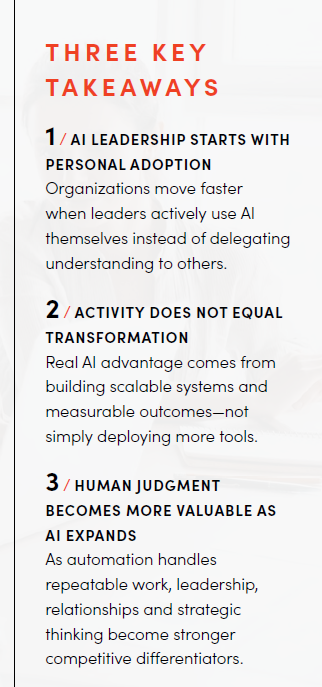
When it comes to this promotion, you can’t lead something you don’t understand. You can’t evaluate whether your team is using AI well if you’ve never really integrated AI into your workflows and used it yourself. You can’t make the right calls on where it belongs in your organization if you’ve outsourced your AI education to someone else on the payroll. I believe you must know the way to show the way, and right now too many leaders are skipping that step.
The Wrong Scorecard
Right now, the metrics being celebrated at most organizations are the wrong ones. How much content was written by AI? How many agents deployed? How many hours did the tool claim it saved? I was testing a platform recently that told me I’d saved fourteen hours on email drafting, and I looked at my calendar and thought: those fourteen hours did not actually show up anywhere. So, let’s be clear about what we’re measuring and why.

These metrics may feel like you are making progress, but they really just signal activity. They say almost nothing about whether what you’re building actually matters to the bottom line.
McKinsey’s most recent State of AI data shows that 88 percent of organizations are using AI in at least one function, which sounds impressive until you put it next to the other numbers: Gartner found that only one percent of executives consider their AI rollout mature, and McKinsey reports that only 39 percent of organizations are seeing any measurable business impact. We are not as far along as the noise suggests.
There is a lot of AI activity happening. There is very little AI transformation happening, and we have to stop celebrating them as if they’re the same thing.
Adoption is not Advantage
The distinction between AI adoption and AI advantage is the one most organizations are getting wrong right now. Adoption looks like tools without a plan or using AI to do the same work faster without ever asking whether that work should be redesigned entirely. It looks like every team member doing their own thing with no shared standards, where output quality depends entirely on who happened to be working that day.
Advantage looks like systems. Not a stack of tools, but a real system that anyone on your team can run, built on shared workflows and shared institutional knowledge that compounds over time rather than staying siloed in individual prompts. Here’s the part that makes this manageable: you’re probably not as far behind on AI as you think, but you may be further behind on systems than you realize. And systems are something every leader already knows how to build. That is the actual opportunity right now.

Where AI Actually Belongs
AI works best when something is repeatable, documented, measurable and teachable. If your team does the same research every week; if you have a content process that follows consistent patterns; if you have a playbook that top performers already follow, those are the natural places to start.
Where it still struggles is in the work that requires real relationships, real judgment and the kind of deep specialized expertise that comes from years of experience—much of which has never been written down anywhere a model can learn from.
That’s good news for most of us. The knowledge and judgment you’ve built over your career is something AI doesn’t have access to yet, and your ability to walk into a room and know exactly what’s needed is something a model cannot replicate. My prediction is that as more work gets automated, genuine people skills and relationship-building will become more valuable, not less. And for anyone in a leadership role centered on people, that’s a very good development.
What a Real System Looks Like
Most teams right now are using AI to write emails, do quick research and generate first drafts, which is a perfectly reasonable starting point. But most of that use is individual and unstructured, so nothing compounds. The quality of the output depends entirely on who is doing the prompting that day, and you never capture the institutional advantage that comes from building something shared.
A real system looks different. Imagine an agent trained on your brand standards and your top-performer playbooks, coordinating with other agents handling research and drafting, where the output arrives ready for a human to review and refine. Your team shifts from doing the work from scratch to overseeing and improving something that runs at scale. Teams are building versions of this right now, and the gap between organizations that have real systems in place and those still running one-off prompts is going to widen significantly over the next year.

A New Scorecard
If adoption is the wrong scorecard, what should we be measuring instead? It starts with leadership modeling, meaning you are actively learning, testing and demonstrating the behavior you want to see from your team rather than delegating your AI education to someone else because it feels overwhelming or because you’re too busy continuing to work the way you always have.
From there, the goal is building systems that anyone on the team can run. If your best AI results depend on one person, you haven’t built a system yet. Then measure what actually matters: are conversions improving; is your cost per output going down; is your team getting to market faster? That’s where the real impact shows up, and that’s the scorecard worth chasing.
Accept the Promotion
Every event I attend right now has the same energy. Leaders want the secret tool, the fastest shortcut, the thing that will finally make their AI investment feel worth it. I tell them the same thing I’m telling you here: the technology is not the hardest part. The hardest part is what it’s always been—accepting that what made you successful before isn’t necessarily what will make you successful from here on out.
You’re going to have to change the way you work, and your teams need to see you do it, not perfectly and not all at once, but visibly and honestly. I still sit down every month and ask myself whether I’ve gotten too comfortable; whether I’m testing enough; and whether I’ve kept the right people around me who will keep pushing me forward.
AI is a team sport, and the leaders and organizations that win with it will be the ones that learn together, share what works and build cultures that celebrate exploration.
The honeymoon phase of AI is over. The era of real transformation is just getting started. Accept the promotion—because your job has changed, and the best thing any of us can do right now is stop fearing that and start creating what comes next.

KATHLEEN ROSS is a Fractional CMO, AI educator and keynote speaker helping marketing leaders build AI-ready teams and systems. Follow her at KathleenRossCreative.com.
From the July/August/September 2026 issue of Direct Selling News magazine.