As 2025 draws to a close we review the trends and stories that defined the year and what’s on the horizon for 2026.
As 2025 draws to a close, the direct selling channel finds itself in a period of meaningful transformation—shaped by rapid technological advancement, shifting consumer expectations, economic pressures and renewed clarity around where future growth will come from. Three years after ChatGPT brought artificial intelligence into the global mainstream, its impact is no longer abstract. AI is now embedded across product development, coaching, customer acquisition, compliance, personalization and the infrastructure that supports how people shop, share and build businesses.
The result is an industry moving faster—and more selectively—than ever. While services continue to gain ground, product companies are recalibrating; ecommerce is modernizing; social commerce is redefining discovery; and ownership models are evolving. At the same time, consolidation is accelerating; international expansion is becoming more complex; and the pace of new company formation has slowed. These dynamics reflect a channel that is not shrinking, but maturing—raising the bar for execution, differentiation and strategic clarity.
Nearly every defining trend of 2025—from services growth and equity participation to global expansion and startup discipline—has been shaped by these realities. The question is no longer if the channel will adapt, but how intentionally it will position itself for what comes next.
Services: A Success Story
In 2025, services continued to play an increasingly important role in direct selling, now representing more than 60 percent of all US channel volume, closely aligned with the broader 70 percent services-based US economy.
The appeal is straightforward: services often deliver essential, recurring value rather than discretionary purchases, supporting stronger retention and more predictable revenue. Over the past decade, nearly 70 percent of service-based companies have posted growth, reflecting how subscription dynamics, digital delivery and ongoing customer relationships have reshaped consumer expectations.
This momentum underscores a broader shift within the channel toward models that emphasize continuity and engagement over one-time transactions. While services have clearly led recent expansion, their success highlights a more universal lesson: recurring value—whether delivered through services or highly differentiated products—has become a defining competitive advantage.
What to Watch in 2026
Services are likely to remain a growth leader in 2026, particularly in models that combine recurring value, digital delivery and scalable infrastructure. At the same time, product-driven companies that significantly elevate differentiation, personalization and engagement will continue to compete effectively in a more selective marketplace.

Product Headwinds
While services surged in 2025, product-focused companies continued to face real headwinds. Slower category growth, shifting consumer priorities and increased competition from DTC, marketplace and influencer-led brands made momentum harder to sustain. Consumers have become more price-sensitive and more discerning, gravitating toward fast-shipping platforms and brands with clear proof points. At the same time, heightened regulatory scrutiny around claims and compliance has raised the bar for how products are positioned and communicated.
Still, this moment represents recalibration rather than decline. Companies that held steady—or grew—tended to offer true intellectual property, defensible exclusivity and scientific differentiation that cannot be easily copied or price-shopped. Commodity products struggled, but premium, story-driven solutions continued to resonate. Hybrid approaches that combine product and service—such as subscription wellness ecosystems, diagnostics-enabled routines or coaching-supported programs—gained traction by delivering ongoing value instead of one-time consumption.
Within wellness, the longevity category—encompassing age-management solutions, hormone optimization and peptide-related protocols—continues to expand rapidly. While current forecasts often cite market figures north of $70 billion, many industry observers believe even those estimates significantly understate long-term demand.
What to Watch in 2026
Product opportunity will increasingly favor AI-enhanced personalization, test-based wellness, customized supplementation and longevity-focused solutions, particularly among Boomers and Gen X. These categories reward measurable outcomes, differentiation and education—the areas where direct selling’s relationship-driven model can still excel.
The Future of Ecommerce
As 2025 draws to a close, ecommerce modernization remains a central focus for the channel. Platforms like Shopify and BigCommerce now sit at the heart of many transformation efforts, offering consumer-grade experiences supported by expansive app ecosystems and rapid innovation cycles. At the same time, neither platform was built specifically for direct selling’s unique complexities—replicated sites, attribution, commissions, global payments and subscription structures—requiring thoughtful implementation and customization.
Companies that approached modernization strategically reported smoother checkouts, stronger enrollment flows, better promotional flexibility and greater reliability—benefits aligned with expectations shaped by Amazon and other digital leaders.
A parallel shift is unfolding through agentic AI, as commerce increasingly moves into conversational and platform-native environments. Transactions now begin—and often end—inside social feeds, messaging apps and AI-driven interfaces. To remain discoverable, companies must structure product data and content so it can be understood and surfaced by large language models.
In this context, multi-channel refers to DTC, affiliate, influencer and platform-native commerce—not traditional retail, which has yet to prove scalable for most direct selling models.
What to Watch in 2026
AI-curated, hyper-personalized, multi-channel commerce will accelerate. Organizations that combine modern ecommerce foundations with AI-ready catalogs, conversational checkout and predictive personalization will gain a competitive advantage.
Social Commerce Takes Center Stage
Social commerce has become a defining force in how consumers discover and purchase products. Unlike traditional ecommerce, the entire journey—discovery, conversation and checkout—now happens inside the feed. Short-form video, creator content, livestreaming and in-app payments have turned social platforms into frictionless storefronts.
This evolution aligns naturally with direct selling’s strengths in trust, community and referral-based buying. AI further amplifies this dynamic by personalizing recommendations and enabling one-to-one engagement at scale.
As platforms control more visibility and data, companies must rethink field identity and customer ownership. Participation is no longer optional; younger consumers increasingly begin their shopping journeys inside social apps.
What to Watch in 2026
Social commerce will continue to scale rapidly, potentially representing a majority share of customer acquisition and first-time purchases. Companies will compete not only in markets, but within algorithms—blending creator-led discovery, in-app checkout and owned communities.
Equity Sharing Evolves
Equity sharing has become one of the most significant shifts in direct selling over the past decade, reflecting a broader move from short-term earnings toward long-term ownership and alignment. As independent contractors increasingly compare opportunities across industries—from startups to creator platforms—the desire to participate in enterprise value, not just transactional compensation, has grown. Equity offers what traditional commissions and bonuses cannot: a tangible stake in what distributors help build over time.
The earliest and most visible examples emerged in real estate, where profit sharing and equity participation reshaped how agents viewed their role within an organization. Models that rewarded collaboration, leadership development and sustained contribution demonstrated that shared ownership could strengthen culture, improve retention and accelerate growth. These structures helped transform agents from independent producers into invested partners, aligning individual success with enterprise performance.
Financial services later reinforced this approach at scale, using equity participation to reward tenure, restore confidence and unify large field organizations. By broadening access to ownership, these companies showed that equity could serve as both a retention mechanism and a long-term wealth-building opportunity without relying on restrictive contracts or short-term incentives.
More recently, some product-focused companies have begun exploring equity as a strategic differentiator—particularly those with recurring revenue, subscription-based models or strong international trajectories. While still early, these efforts signal recognition that ownership can play a role beyond services alone. That said, equity is neither universal nor simple to implement, and its effectiveness depends heavily on company size, structure and long-term objectives.
Across sectors, the benefits are consistent: equity deepens alignment between the field and corporate leadership, encourages collaboration and motivates more sustainably than bonuses alone. It also reflects a cultural shift, as top performers increasingly want to build wealth with a company, not just earn income from it.
What to Watch in 2026
Equity participation is expected to expand most aggressively among large, services-led organizations with clear paths to liquidity or public markets. At the same time, many product-focused and mid-sized companies are likely to pursue enhanced bonus pools, profit participation and performance-based incentives that mirror equity’s alignment benefits without requiring public-company scale. Rather than a one-size-fits-all solution, compensation and equity sharing models in 2026 will become more segmented and strategic—aligned with organizational maturity, financial structure and long-term vision.
Continuing Consolidations
Consolidation in direct selling is accelerating because multiple macroeconomic and structural pressures have converged, making scale, stability and operational efficiency more important than ever. Companies are facing shrinking margins, rising customer-acquisition costs and increased pressure from investors to deliver predictable, profitable growth.
At the same time, trillion-dollar retailers like Amazon and Walmart have redefined what consumers expect in terms of price, speed, convenience and digital experience—raising the bar to a level that smaller or under-capitalized direct selling companies struggle to meet.
These forces have created a landscape where joining forces is often the only viable path to remain competitive. Scale now enables advantages that previously weren’t optional: stronger supply chains, more resilient payment and compliance systems, broader product portfolios and the ability to spread technology costs across a larger base.

In addition, the rise of daily-use, wellness-focused categories has reinforced the need for stronger product ecosystems that drive recurring revenue, prompting companies to acquire rather than build from scratch. Rescue acquisitions are also increasingly common, reflecting the desire to preserve communities and product lines when distressed companies falter.
Another increasingly important driver of consolidation is international expansion. For many companies, building infrastructure market by market is capital-intensive and slow. Being acquired by, or merging with, a global organization can accelerate international objectives overnight—providing immediate access to licensing, compliance, logistics and leadership teams already in place.
What to Watch in 2026
In 2026, consolidation is expected to accelerate as scale becomes essential rather than optional. More than $1 billion in direct selling companies are likely to change hands. The most successful acquirers will treat consolidation as a growth strategy, using it to expand reach, strengthen recurring revenue and modernize systems more quickly than organic growth allows. Sellers, in turn, will increasingly prioritize cultural alignment and field continuity, favoring partners that protect distributor relationships and preserve trust.
The Hispanic and Latino Opportunity
The Hispanic and Latino market across the Americas continued to expand rapidly in 2025, representing one of the strongest growth engines in direct selling. In the US, the Latino population has reached 64 million people—19 percent of the population and 26 percent of all children—and will account for one in five workers by 2030.
Companies report that both US Hispanic communities and LATAM markets drive some of their highest sales and recruitment growth, with 20 percent of the US salesforce identifying as Hispanic or Latino. And as momentum builds, more companies are increasing their physical footprint in the region—for example, PM-International recently opened a new Americas headquarters in Florida to support rising demand.
Digital adoption is rising quickly as well—90 percent of Latinos in the US use digital channels to run their businesses, while Mexico has become the second-fastest-growing ecommerce market in the world.
Together, these trends show that the Hispanic and Latino markets in the US, Mexico, Central America and South America are not just growing—they are reshaping the future of the channel.
What to Watch in 2026
Some industry leaders have begun to suggest that the Americas—from Mexico to Argentina—could represent the next Asia for direct selling, given shared language, cultural cohesion and accelerating digital adoption. The US Latino population will continue to boost sales and recruitment, while Central and South America remain among the channel’s most resilient regions. Success in 2026 will hinge on localized content, bilingual support, thoughtful pricing and tools designed for younger Latino entrepreneurs entering the digital economy.
International Landscape
Beyond the Americas, global markets continue to evolve unevenly in 2025, underscoring that international growth remains viable—but increasingly complex.
Europe has shown surprising resilience, supported by strong wellness demand, established consumer protections and mature field organizations that value long-term relationships. While growth rates vary by country, many European markets continue to deliver stability and consistent engagement, particularly for companies with science-backed products and localized leadership.
Asia remains one of the most opportunity-rich regions in direct selling, but also one of the most demanding. Success in Asia requires preparation, patience and deep market understanding. Regulatory environments vary widely; cultural expectations differ significantly; and execution missteps can be costly. Asia is not for the unprepared—but for companies that invest properly, it continues to offer scale that few other regions can match. China, in particular, remains highly rule-bound, requiring companies to operate strictly within defined frameworks, while India presents enormous potential paired with significant localization, infrastructure and leadership challenges.

Elsewhere, Africa remains early-stage and uneven, often described as a “wild west” market where mobile adoption is accelerating faster than traditional infrastructure. Opportunity exists, but outcomes vary dramatically by country, execution model and economic conditions.
Across all regions, the lesson is consistent: international expansion today demands far more precision than it once did, and success depends on regulatory readiness, cultural fluency and long-term commitment rather than speed alone.
What to Watch in 2026
International expansion will continue—but with greater selectivity. Companies are expected to prioritize fewer markets and execute more deeply, often leveraging partnerships or acquisitions to reduce risk and accelerate readiness. Europe is likely to remain a steady contributor. Asia will reward only the well-prepared. And emerging regions will continue to test new models. In 2026, international success will belong less to the fastest movers and more to the most disciplined operators—those willing to match ambition with infrastructure, patience and local expertise.
Startup Slowdown
One continuing area of concern in 2025 is the noticeable slowdown in new direct selling startups. Launches are still occurring, but the pace has clearly cooled compared to earlier cycles. This shift reflects a convergence of economic, regulatory and cultural forces—many of which extend beyond direct selling and mirror broader trends in entrepreneurship.
Externally, the cost of starting and scaling a business has risen significantly. Tariff volatility, supply chain instability, higher manufacturing costs and tighter capital availability have made launching new companies more expensive and risk-intensive than in previous years. Venture funding for consumer goods has contracted sharply since 2022, with investors placing greater emphasis on profitability and recurring revenue rather than rapid experimentation. At the same time, regulatory scrutiny—both domestically and internationally—has increased, raising compliance costs and making founders more cautious around compensation structures, earnings claims and product positioning.
Inside the channel, expectations for what a “modern” direct selling company must deliver have increased dramatically. New entrants are now expected to launch with polished ecommerce, mobile-ready tools, social commerce capabilities, AI-assisted onboarding and real-time reporting. The technical infrastructure required to compete has expanded far beyond the starter-kit era. As a result, startup complexity has increased—and so has startup cost—at the very moment when many digital-native entrepreneurs can pursue lower-friction models outside the channel.
That broader entrepreneurial shift matters. Today’s founders can open a Shopify store, build an affiliate-driven brand or operate entirely within platform-native ecosystems without inventory risk or long-term structural commitments. Against that backdrop, traditional direct selling—while powerful—can appear heavier to launch and harder to operationalize.
Still, the slowdown in startups should not be mistaken for a lack of opportunity. Instead, it reflects a rising bar. Innovation is increasingly focused on personalization, AI-enhanced product design, test-based wellness and digitally enabled services, rather than sheer volume of new launches. In addition, new service concepts—some within familiar categories, others entirely new—are expected to emerge as entrepreneurs apply modern technology and strategy to unmet needs.
What to Watch in 2026
Rather than a single category driving new-company formation, innovation is likely to come from smarter design and delivery. Expect continued experimentation with personalization and AI-supported offerings, alongside thoughtful exploration of new go-to-market strategies. While not all these approaches will succeed, they will expand the industry’s playbook and signal where future models may take shape.
Moving Forward
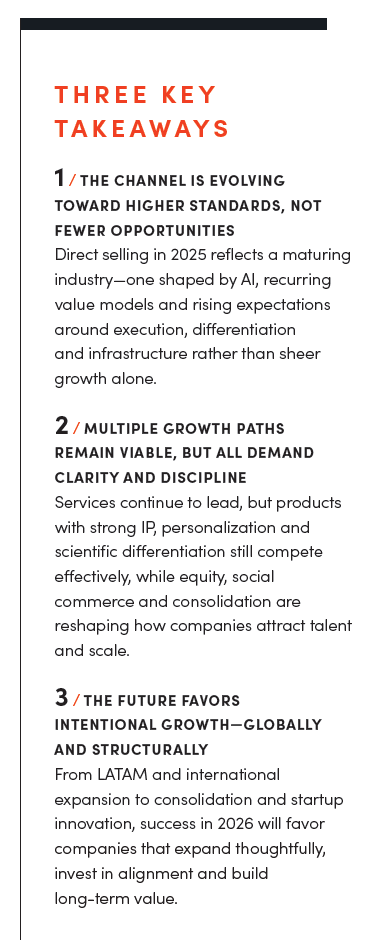
As the channel looks toward 2026, the story is not one of decline, but of realignment. Services highlight the power of recurring value. Product innovation underscores the importance of differentiation and personalization. Ecommerce and social commerce reveal how consumers now discover and buy. Equity participation reflects what today’s leaders value, while consolidation and international expansion demonstrate how scale and discipline are reshaping competitive advantage.
At the same time, the slowdown in new company formation signals a higher bar—not a lack of opportunity. Innovation is still occurring, but with greater emphasis on execution, infrastructure and long-term viability. Direct selling has reinvented itself many times before, and it is doing so again—but more deliberately and more strategically.
The companies that thrive in 2026 will be those that embrace AI as a partner, build genuine value through products or services, expand globally with intention and meet people where they already live, shop and connect. The path ahead is more demanding—but it remains full of possibility.

STUART JOHNSON has served the direct selling industry for nearly 40 years. His passion for the channel encompasses a broader commitment to build and connect the direct selling community through exclusive industry events such as Direct Selling University and the DSN Global Celebration. Stuart is arguably the most connected person in direct selling. He has built an impressive and growing network of executives, thought leaders, strategists and innovators. His advice and counsel are sought after by leaders throughout the channel.
An Online Exclusive from Direct Selling News magazine.