


Direct Selling’s Global Snapshot
Direct selling has always reflected the moment it operates in—shaped by consumer confidence, economic realities, cultural norms and the everyday needs of people looking for flexibility, income and connection.
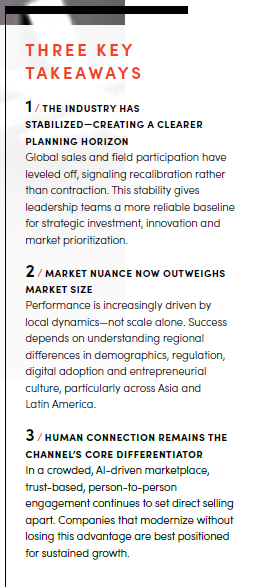
In 2024, that reflection was complex, uneven and unmistakably human. The World Federation of Direct Selling Associations’ latest global data shows an industry that has stopped sliding, even if it hasn’t yet surged forward.
Sales were essentially flat year-over-year, representative counts stabilized and—in many markets—the sense is not one of retreat but of recalibration.
In the past, we’ve used this report to focus solely on billion-dollar markets, but this year we’ve decided to take a fresh approach, one that provides a snapshot of how direct selling feels on the ground right now: cautious in some regions, quietly resilient in others and—in select pockets around the
world—newly energized.
Against a backdrop of inflation hangovers, geopolitical tension, regulatory scrutiny and economic uncertainty, direct selling continues to do what it has always done—adapt locally while thinking globally.
What follows is a regional look at where the channel stands today; what pressures are shaping it; and where opportunity still lives.

Asia Pacific—Scale, Shifts and a New Center of Gravity
Asia Pacific is still the largest and most influential region in direct selling. But it most certainly is not a monolith, and the forces shaping mature East Asian markets differ dramatically from those driving growth across South and emerging Asia.
In East Asia and the more developed Pacific markets, direct selling is navigating maturity. Japan and South Korea, long-standing industry leaders, are experiencing softer growth as populations age; consumer behavior shifts; and digital-first commerce reshapes how products are discovered and purchased. These are not markets in decline so much as markets in transition—where loyalty, quality and brand trust matter more than rapid expansion.
China sits in a category of its own. After several years of contraction, the market returned to growth in 2024, offering a meaningful signal of renewed momentum ahead of the 20th anniversary of the resumption of direct selling. Regulatory oversight remains significant, but the rebound suggests that both companies and consumers are re-engaging cautiously.

As Sun Xuanzhong, Professor and Ph.D. at China University of Political Science and Law, explained, “The industry is shifting from traditional off-line sales to an expanded direct selling model that combines off-line and on-line approaches as well as digital tools. This change centers on consumers and urges a reconstruction of the core values of good products, good models and good culture. Consequently, the industry is developing higher-quality international markets.”
Across these markets, wellness and nutrition continue to anchor product portfolios, though companies are increasingly challenged to modernize engagement models and attract younger participants.
Regional Snapshot:
Asia Pacific (East & Developed Asia)
- 40% of global direct selling sales originate in Asia overall
- 8 of the world’s 21 billion-dollar markets are in Asia Pacific
- Mature markets face slower growth and demographic pressure
- Wellness remains dominant, but competition from digital retail is intense
Asia Beyond the Pacific—India, South Asia & Emerging Asia
If Asia Pacific reflects maturity and recalibration, the rest of Asia tells a story of momentum still forming.
India stands out not just for its current growth, but for its long runway. With one of the world’s largest populations of working-age adults and a deeply ingrained entrepreneurial culture, direct selling increasingly appeals as a low-risk entry point to business ownership. Digital adoption, mobile commerce and social selling are accelerating reach well beyond major urban centers.
Elsewhere in South and Southeast Asia—markets such as the Philippines, Vietnam and Indonesia—direct selling remains closely tied to wellness, nutrition and household essentials. These markets can be economically sensitive, but they are also highly responsive when consumer confidence improves. Even modest increases in participation or spend can translate into significant gains due to population size.
Taken together, Asia is best understood not as a monolith, but as two parallel realities: established markets redefining their value propositions and emerging markets still discovering the full potential of the channel.
Regional Snapshot:
INDIA, SOUTH ASIA & Emerging Asia
- India ranks among the fastest-growing large markets globally
- Hundreds of millions of potential entrepreneurs across the region
- Mobile-first commerce is a primary growth driver
- Wellness and personal care lead product demand
North America—Rebuilding Confidence in a Mature Market
North America remains the industry’s single largest regional contributor, anchored by the United States. But size brings scrutiny, and 2024 was another year of adjustment.
In the US, post-pandemic normalization continues. Consumer spending has been selective, inflation-sensitive and value-driven. Direct selling companies are navigating a more skeptical consumer, increased regulatory attention and competition from every corner of the digital marketplace. Canada faces similar pressures, compounded by trade uncertainty and economic headwinds.
Yet beneath the surface, the fundamentals that built the channel remain intact. Wellness, personal care and household products continue to resonate, particularly when paired with authenticity and clear value propositions. Layoffs and corporate restructuring—often driven by automation and AI—have also quietly renewed interest in flexible income options.
Peter Maddox, President of DSA Canada, is optimistic about the channel’s future in North America. He feels direct selling’s ability to pair personal connection with quality products is the industry’s superpower in a world crowded with AI noise and distraction.
“Personal recommendation and trust are what sets us apart. I believe the path to short- and long-term growth in our market is leaning into this differentiator.”
The challenge in North America is less about demand and more about perception. Companies that can modernize their narratives, simplify entry points and demonstrate real-world income relevance are finding traction. The opportunity here is not explosive growth, but durable reinvention.
Regional Snapshot:
North America
- Largest single regional sales contributor globally
- Post-pandemic sales normalization continues
- Wellness and personal care remain core categories
- Growing interest in flexible income amid layoffs and AI-driven disruption
Latin America—Volatility Meets Momentum
Latin America tells one of the most dynamic stories in global direct selling right now. It is a region where economic instability and opportunity coexist—sometimes within the same market.
Brazil and Mexico continue to anchor the region, supported by large populations, established field infrastructures and strong cosmetics and personal care demand.
“In Mexico, we believe that sales will continue to grow, although at moderate rates, likely in the single digits and close to 5 percent,” said Adelfo Enríquez, President of the Mexico DSA, “This performance would be consistent with what has been observed over the past two years.”

Colombia stands out as a market where direct selling remains closely tied to informal employment and household economics, offering resilience even amid broader uncertainty.
According to Elizabeth Acuna of the Colombia DSA, “The direct selling sector in Colombia continues to consolidate itself as one of the fundamental pillars of the collaborative economy and the livelihood of thousands of families.”
Argentina’s headline growth in 2024 is inseparable from inflation dynamics, but it also reflects renewed activity following regulatory and monetary shifts. While volatility remains a defining feature across the region, direct selling’s adaptability—low barriers to entry, immediate earning potential and community-based selling—keeps it relevant.
As Gonzalo Falcón, Executive Director of the Argentine DSA explained, “2026 is projected as a period of economic realignment with international estimates anticipating GDP growth between three and four percent. This presents a clear opportunity for direct selling.”
Product preferences skew heavily toward beauty and personal care, but wellness is gaining ground as consumers prioritize health amid economic stress. Latin America’s opportunity lies in its entrepreneurial spirit: direct selling is often not supplemental income here—it is essential income.
Regional Snapshot:
Latin America
- One of the most volatile—but dynamic—regions
- Beauty and personal care dominate, with wellness gaining ground
- Direct selling often represents primary income, not supplemental
- High responsiveness to economic shifts and regulatory change
Europe—Resilience Under Pressure
Europe’s direct selling landscape is shaped by regulation, maturity and fragmentation. Overall sales dipped slightly in 2024, but the region’s story is more nuanced than the top line suggests.

Germany remains Europe’s cornerstone market, even as it navigates softer growth. France and Italy reflect broader economic caution, while markets like the United Kingdom and Poland face their own mix of consumer restraint and structural change.
At the same time, pockets of resilience are evident. Some Eastern and Southern European markets are showing renewed energy, driven by entrepreneurial necessity and changing workforce expectations.
Across Europe, sustainability, transparency and compliance are not optional—they are table stakes. European consumers tend to be discerning and value-driven, favoring quality, trust and longevity over hype.
Susannah Schofield OBE, Director General of the Direct Selling Association for the UK and Ireland, characterized the region as having a renewed emphasis on human connection.
“As consumers navigate economic uncertainty and digital fatigue, we are seeing a growing appreciation for trusted, person-to-person retail models. Ultimately, the future of our sector lies in proving the innovation and human connection are not opposites but partners.”
For companies willing to operate within a tighter regulatory framework, Europe still offers stable, long-term opportunity—particularly in wellness, home and personal care.
Regional Snapshot:
Europe
- Most regulated direct selling environment globally
- Germany anchors regional sales, but growth is uneven
- Consumers prioritize trust, quality and sustainability
- Long-term opportunity favors stability over speed
Africa—High Potential, High Volatility
Africa remains the smallest region by sales, but also one of the most compelling from a long-term perspective. The continent’s direct selling markets are early stage, fragmented and deeply influenced by local economic conditions.

Armand Friess, Direct Selling and MLM Expert for the African continent, shared his thoughts on the market. “Africa plays by different rules and does not develop efficiently from a distance. Today, two relatively stable and structured entry points stand out for serious players: Morocco and South Africa.”
South Africa continues to serve as a regional hub, even as it faces economic strain. Elsewhere, informal economies, youthful populations and limited access to traditional employment make direct selling a meaningful pathway to income.
Infrastructure challenges, currency volatility and regulatory inconsistency remain real barriers. Yet digital adoption—particularly mobile commerce—offers a leapfrogging opportunity. In many African markets, direct selling’s person-to-person model aligns naturally with cultural norms around trust and community.
As Friess explained, “By 2050, Africa is expected to host around 1.4 billion urban residents, including roughly 800 million people of working age, concentrated in megacities such as Lagos, Nairobi and Cairo. Within 20 to 30 years, Africa will become one of the world’s primary engines of human and entrepreneurial growth.”
Regional Snapshot:
Africa
- Smallest region by sales, but high long-term upside
- Direct selling closely tied to informal economies
- Mobile technology enables leapfrogging traditional retail
- Education and infrastructure remain key growth barriers
Middle East—Selective Growth, Structural Complexity
The Middle East occupies a unique position in the global direct selling landscape. While regional sales remain relatively small, certain markets show signs of selective, high-quality growth—often tied to wellness, premium personal care and digitally enabled selling models.
In countries such as the United Arab Emirates, high digital penetration, diverse expatriate populations and strong logistics infrastructure support newer, more agile direct selling approaches. Elsewhere in the region, regulatory complexity and market fragmentation require careful navigation.
Overall, the Middle East favors precision: targeted products, culturally attuned messaging and strong compliance frameworks rather than broad-based expansion.
Regional Snapshot:
The Middle East
- Small share of global sales, but above-average digital readiness
- Growth concentrated in select, well-regulated markets
- Wellness and premium categories outperform mass-market goods
- Opportunity favors focused, compliant market entry
Oceania—Small Markets, Sharp Adjustments
Oceania’s direct selling markets are modest in size but revealing in trend. Australia and New Zealand—long considered stable and predictable—have faced sharper adjustments in recent years. Rising cost of living, cautious consumer spending and competition from subscription-based and influencer-led models have pressured traditional approaches.
Yet these markets also illustrate how quickly direct selling can pivot. Digital tools, social commerce and hybrid models that blend retail, community and content are gaining traction. While sales volumes may be lower, the experimentation happening here often foreshadows broader industry shifts.
Geoff Mulham, CEO of Direct Selling Australia believes that this blended approach is working well in the market. “In Australia and New Zealand, we are seeing real growth in our member companies that are focusing on the right mix of traditional direct selling (face-to-face) combined with social media interaction and promotion.”
Opportunity in Oceania is less about scale and more about sophistication—rethinking engagement, modernizing field support and meeting consumers where they already are.
Regional Snapshot:
Oceania
- Highly developed but economically sensitive consumer base
- Digital-first engagement outpaces traditional in-person models
- Strong experimentation with hybrid and social commerce strategies
- Opportunity favors innovation over scale
A Moment, not a Verdict
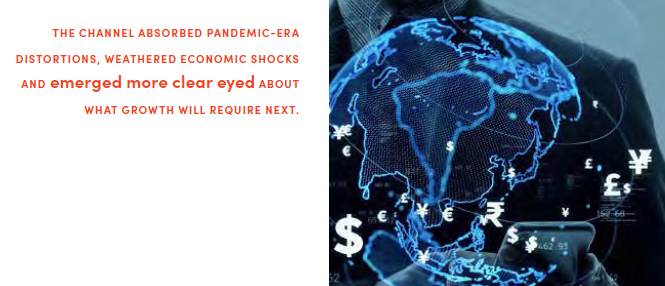
Globally, direct selling in 2024 felt like a pause—not a plateau. The channel absorbed pandemic-era distortions, weathered economic shocks and emerged more clear eyed about what growth will require next.
The global sales force has stabilized. The industry remains overwhelmingly powered by women. Younger participation has softened, but older cohorts—often with stronger purchasing power and relationship networks—are increasingly engaged. Product innovation, particularly in wellness and personal care, continues to evolve alongside consumer expectations.
Most importantly, direct selling remains grounded in relationships. Whether those relationships are built in living rooms, WhatsApp groups or livestreams, the core value proposition remains unchanged: products shared through trust; opportunity created through connection.
This moment in time is defined not by exuberance, but by resilience. And for an industry that has thrived through decades of change, that may be the most hopeful sign of all.
Learn more in-depth market analysis from global experts.
For more insights on channel dynamics, download the World Federation of Direct Selling’s Global Statistical Data Report.
From the March/April 2026 issue of Direct Selling News magazine.


