
Gordon Hester, a direct selling business consultant and seasoned direct selling executive with more than 35 years of experience in the industry, released a new book titled The Architecture of a Direct Selling Turnaround. Hester calls on his years leading well-known direct selling organizations to provide a more expansive view on how executives, board members, field leaders, investors, advisors and founders can distinguish between a temporary slowdown and a structural decline, and gain a greater understanding of which capabilities must be protected during decline cycles.
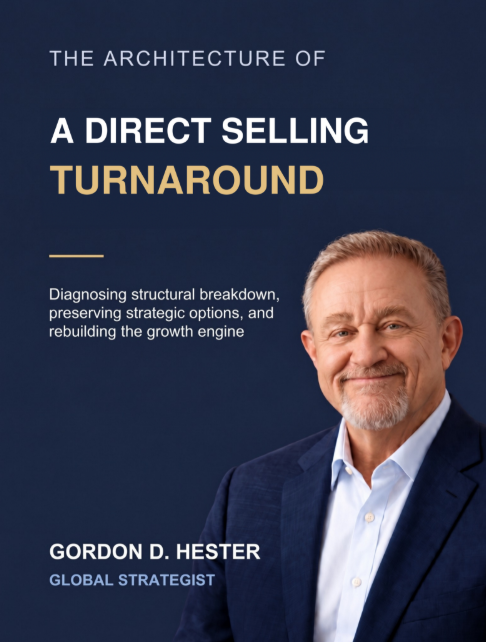
Through an intentionally practical framework, Hester offers a management perspective that leaves space for affiliate architecture, recapitalization, hybrid models, acquisitions and orderly wind-downs as leaders identify the economic facts at play and the operating system’s capacity.
“Decline is an architecture,” Hester writes. “It is built through reinforcing decisions and reinforcing behaviors. Recovery must therefore be architectural as well: coordinated across economics, field behavior, customer value, culture, technology and governance.”
The book is organized in six parts, including:
- How Decline Is Built
- The Economic Compression Cycle
- Field, Culture and Operating-System Failure
- Strategic Choices
- Turnaround Architecture
- Case Studies
“The defining mistake in decline is treating the visible symptom as the root cause,” Hester writes. “Sales fall, so management cuts cost. The cuts improve near-term expense ratios, but they may also reduce customer acquisition capacity, field support, product innovation, technology reliability and leadership development. Those reductions weaken future revenue and can force another round of cuts. What begins as rightsizing becomes a self-reinforcing decline cycle. The practical issue is not whether expenses should be reduced. A company that is losing money must change its cost structure. The issue is whether leadership can separate waste from growth capacity. A business in decline needs more precision, not simply less spending.”